Understanding the Limitations of USBL Systems
Underwater positioning and navigation play a crucial role in various marine applications, from scientific research to offshore construction. One of the most widely used technologies for underwater positioning is the Ultra-Short Baseline (USBL) system. USBL systems utilize acoustic signals to determine the position of underwater targets, such as remotely operated vehicles (ROVs) or divers, relative to a surface vessel. While USBL technology offers many advantages, it also has its limitations that can affect data accuracy and reliability. In this article, we will explore the key limitations of USBL systems and the environmental factors that contribute to these challenges.
Key Takeaways
- USBL systems, while widely used, have inherent limitations that can affect positioning accuracy and reliability in underwater operations.
- Environmental factors such as temperature variations, salinity changes, and water depth directly influence acoustic signal propagation and positioning performance.
- Acoustic signal interference from background noise, multipath effects, and physical obstructions can distort signals and lead to inaccurate positioning data.
- The accuracy of USBL systems depends heavily on system components, including transducer quality, proper calibration, and reliance on a surface vessel.
- USBL systems have operational range and depth constraints, which may limit their effectiveness in deep-water or long-distance applications.
- Many USBL limitations can be mitigated through regular calibration, advanced processing algorithms, and integration with complementary positioning systems such as LBL.
Limitations of USBL Systems
Despite their widespread use, USBL systems come with several inherent limitations that may compromise their effectiveness. Understanding these limitations is essential for users to make informed decisions when selecting a positioning system for underwater activities. Below, we delve into the primary constraints faced by USBL technology.
How Do Environmental Factors Impact USBL System Performance?
One of the most significant limitations of USBL systems is their sensitivity to environmental factors. Various underwater conditions can impact the performance of acoustic positioning systems, including:
- Temperature Variations: Changes in water temperature can affect the speed of sound, which in turn influences the accuracy of positioning data.
- Salinity Levels: Fluctuations in salinity can also alter sound speed, leading to discrepancies in position calculations.
- Water Depth: USBL systems may struggle to maintain accurate positioning at significant depths due to changes in acoustic signal propagation.
What Causes Acoustic Signal Interference in USBL Systems?
USBL systems rely on acoustic signals for communication between the surface vessel and underwater targets. However, several factors can cause interference, including:
- Background Noise: Ambient noise from marine life, vessels, and underwater machinery can mask acoustic signals, complicating data transmission.
- Multipath Propagation: Acoustic signals can reflect off the seabed or other underwater structures, resulting in signal distortion and incorrect positioning information.
- Obstructions: Objects in the water column or on the seabed can block or scatter acoustic signals, further hindering communication.
Which System Components Limit USBL Accuracy and Reliability?
The performance of USBL systems is also contingent on the quality and configuration of their components. Some common limitations include:
- Transducer Quality: The effectiveness of the system largely depends on the quality of the transducer used. Low-quality transducers may produce weaker signals, reducing accuracy.
- Calibration Requirements: USBL systems require precise calibration to function optimally. Poor calibration can lead to significant errors in positioning data.
- Dependency on Surface Vessel: USBL systems are reliant on a surface vessel equipped with the necessary hardware, which can limit their application in certain scenarios.
What Are the Range and Depth Limitations of USBL Systems?
Lastly, USBL systems have inherent limitations regarding their operational range and depth. These aspects include:
- Operational Range: USBL systems typically have a limited operational range, often effective only within a few thousand meters from the surface vessel. This limitation can restrict their use in deep-sea applications.
- Depth Limitations: As the depth increases, the reliability of acoustic positioning can decrease. USBL systems may struggle to maintain accuracy beyond specified depth thresholds.
How can USBL System Limitations be Mitigated?
While USBL limitations can pose challenges, there are strategies to mitigate their impact and enhance overall performance:
- Use of Advanced Algorithms: Implementing sophisticated algorithms can help filter out noise and improve data accuracy.
- Regular Calibration: Routine calibration of USBL systems ensures optimal performance and minimizes errors.
- Supplemental Positioning Systems: Integrating USBL with other positioning technologies, such as Long Baseline (LBL) systems, can enhance overall accuracy and reliability.
Many of these limitations can be addressed through proper system selection, sensor integration, and deployment strategy, particularly in ROV and AUV operations.
What Should Be Considered When Using USBL Systems?
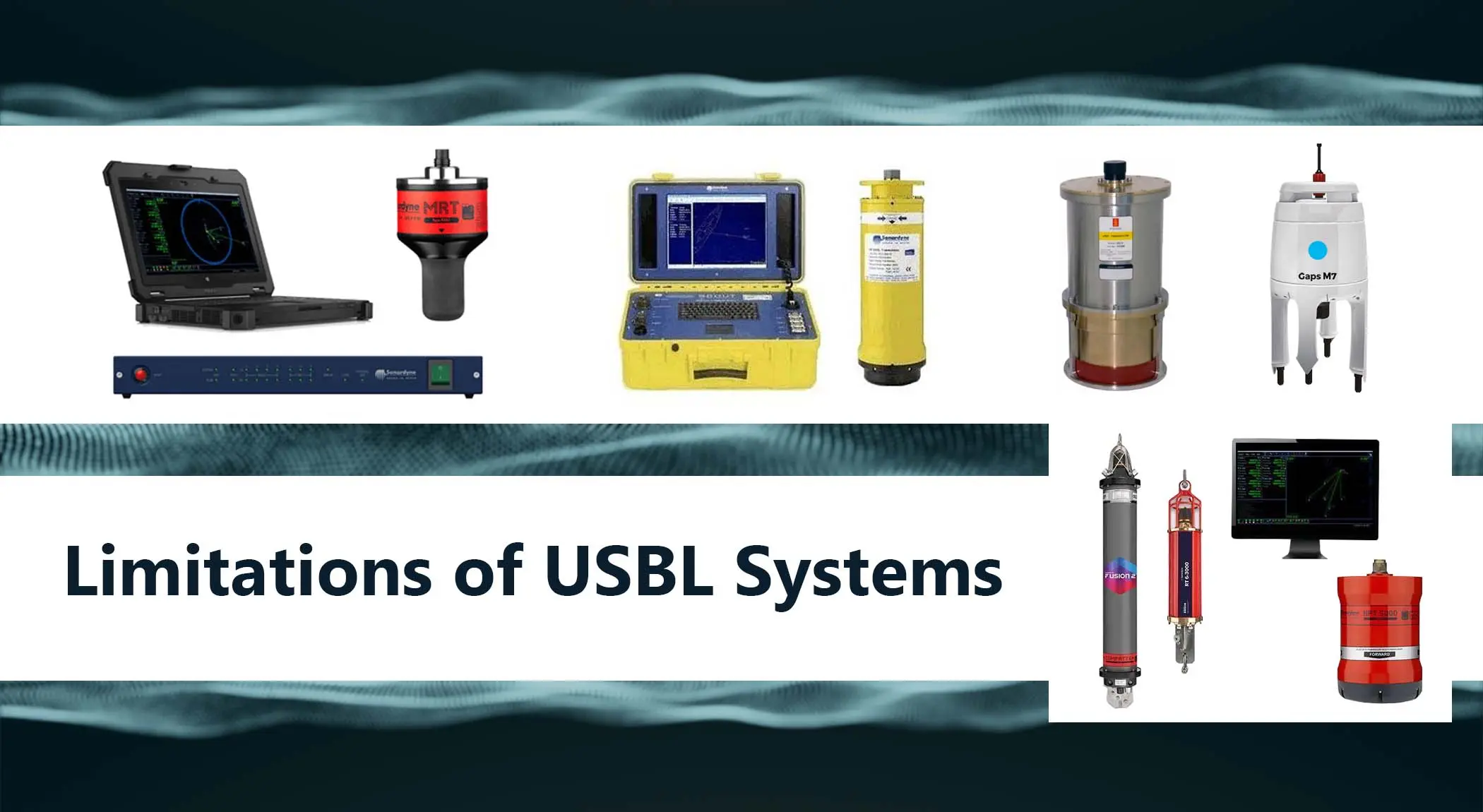
Understanding the limitations of USBL systems is critical for effective underwater positioning and navigation. While USBL technology offers valuable capabilities, factors such as environmental influences, acoustic signal interference, and system component limitations can significantly affect data accuracy. By being aware of these limitations and implementing mitigation strategies, users can optimize the performance of USBL systems in various underwater applications. To learn more about our USBL positioning systems and how they can meet your underwater navigation needs, explore our range of products, including Sonardyne Ranger 2 and Sonardyne Scout Type 8024.
In applications where these limitations become critical, alternative positioning approaches such as LBL or hybrid systems may be more suitable.