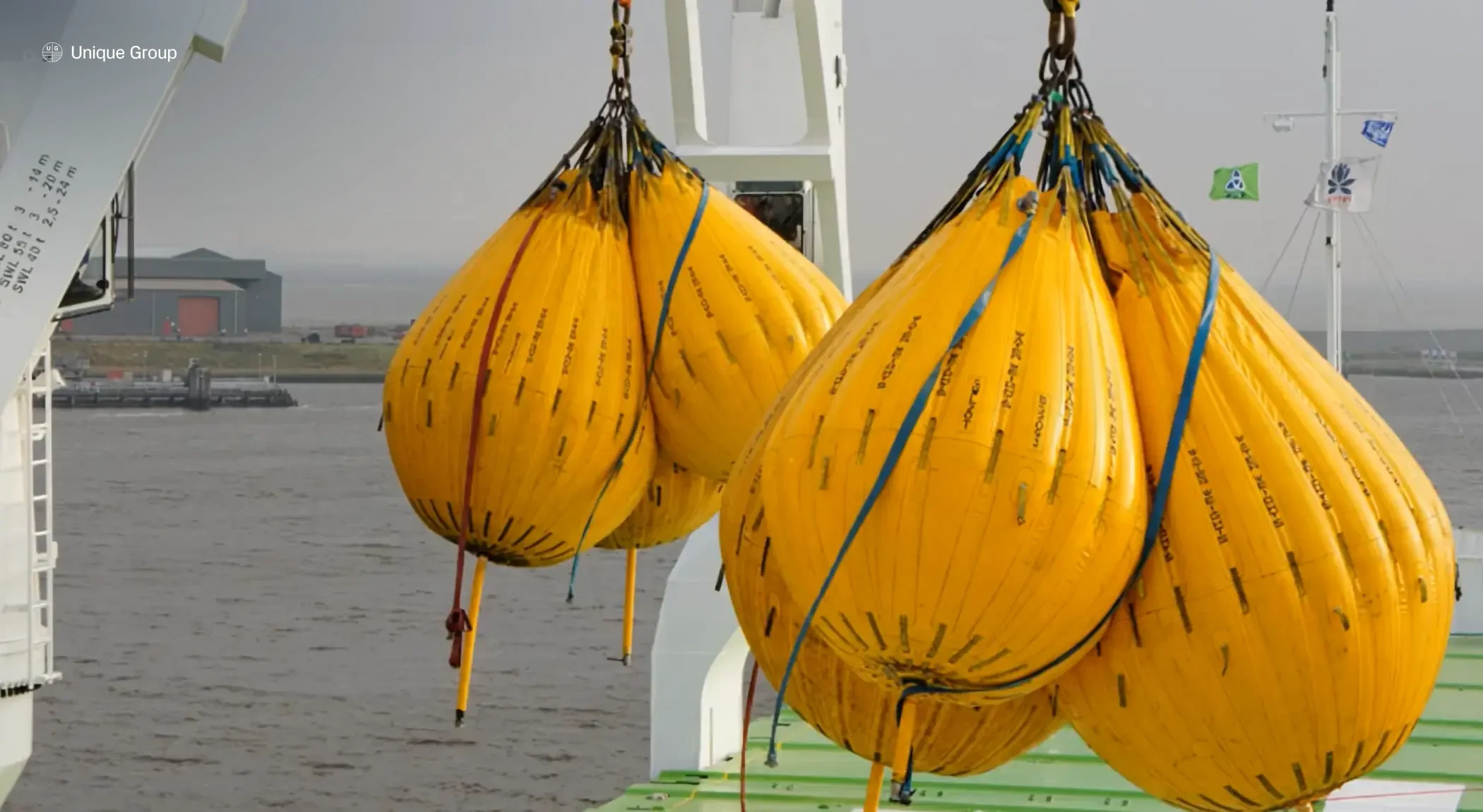
Water bag proof load testing is a way to test cranes, davits, lifting beams and other lifting equipment. Flexible bags are attached to the equipment and filled with water until they reach a defined test load. Because the water is added and measured gradually, the load is applied in controlled stages, held, and then released. No solid test weights need to be shipped to site.
Water Weights® was engineered in 1979 to cut the cost and difficulty of shipping solid test weights to North Sea oil platforms. Today, Unique Group supplies Water Weights® proof load bags for sale and rental worldwide. We also carry out load tests on our clients’ behalf as a turnkey service. This guide explains how water bag load testing works, what it can test, and how to choose the best way to run your next test.
What is proof load testing?
Proof load testing applies a load greater than the equipment’s safe working load (SWL) or working load limit (WLL). This confirms that the equipment can handle its rated load safely. The test is non-destructive: equipment that passes goes back into service.
A proof load test is typically required in three situations:
- Before new lifting equipment is used for the first time
- After repair, modification or re-rating
- At periodic intervals set by regulation, class rules or the manufacturer
The test load and frequency come from the applicable standard, not from the test method. A crane tested with water bags must reach the same proof load as one tested with solid weights. The table below lists the standards most often referenced for the equipment covered in this guide.
| Standard or regulation | Applies to | What it requires |
|---|---|---|
| ASME B30.2 and OSHA 29 CFR 1910.179 (US) | Overhead and gantry cranes | New and altered cranes must be load tested before first use. OSHA caps test loads at 125% of the rated load unless the manufacturer recommends otherwise. ASME B30.2 sets a test load of 100–125% of the rated load. |
| LOLER 1998 and HSE ACOP L113 (UK) | Lifting equipment at work | Thorough examination by a competent person. LOLER does not set a fixed proof load test: the competent person decides whether a load test is needed and how it is carried out. |
| LEEA 051 (2012) | Water bags used as test weights | LEEA guidance on the design, inspection and use of water bags as test weights. It covers type testing of the bag design to a 6:1 factor of safety, and thorough examination of the lifting set at least every six months. |
| DNV-ST-0378 | Offshore and platform lifting appliances | A test load of SWL + 25% up to 20 t, SWL + 5 t from 20 t to 50 t, and SWL + 10% above 50 t. |
| SOLAS III/20 and IMO Resolution MSC.402(96) | Lifeboats, rescue boats and their launching appliances | An annual thorough examination and operational test. Every five years, an overload operational test of the winch with a proof load of 1.1 times the weight of the craft and its full complement of persons and equipment. In force since 1 January 2020. |
Clause numbers and figures can change between editions. Always confirm the required test load with your classification society, competent person or the equipment manufacturer before planning a test.
How water weights work
Bag design and capacities
Water Weights® proof load bags hang from a single lifting point and take a raindrop shape, which is the natural shape of a flexible container full of water. The range comes in fixed capacities so that test loads can be planned precisely:
- Standard proof load bags: 10 t to 110 t per bag
- Low Headroom bags: 1.0 t to 12.5 t, for sites where vertical space is restricted
- Deck and floor loading bags (mattress bags and flexidams): 1 t to 100 t per unit, for applying an even load across a surface rather than a suspended load
| Model | SWL | Dimensions L × W × H (m) | Net weight (kg) |
|---|---|---|---|
| BS 10S | 10 t | 1.00 × 1.20 × 0.80 | 140 |
| BS 20S | 20 t | 1.20 × 1.50 × 0.90 | 230 |
| BS 25S | 25 t | 1.20 × 1.50 × 0.90 | 240 |
| BS 35S | 35 t | 1.20 × 1.50 × 1.00 | 340 |
| BS 55S | 55 t | 1.20 × 1.50 × 1.20 | 520 |
| BS 110S | 110 t | 1.60 × 1.80 × 1.80 | 1,200 |
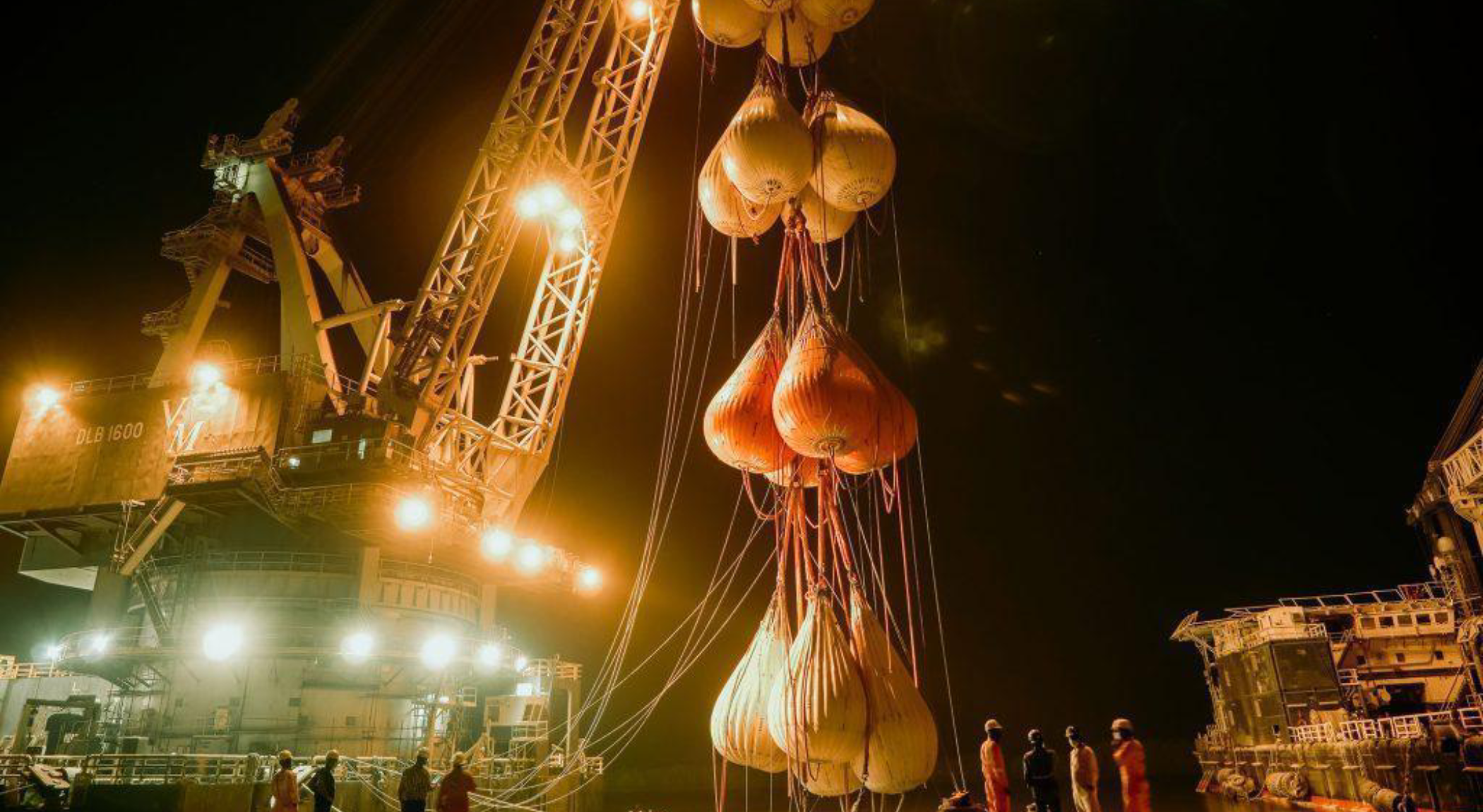
For test loads above 110 t, several bags are combined using spreader beams or a multi-bag rigging layout. This is how Unique Group has completed proof load tests of 693 t, 726 t and 1,500 t.
Light to ship, heavy on site
An empty proof load bag weighs roughly 1–1.5% of its rated capacity. A 110 t bag has a net weight of 1,200 kg, and a 10 t bag weighs 140 kg. The rest of the test load is water sourced on site, from a hydrant, a tank, a river or the sea.
For remote sites, offshore installations and vessels, this is the main advantage. The equipment that travels is a fraction of the test load, so it moves as normal freight rather than as heavy-lift cargo. Up to 500 t of test capacity fits in a single standard ISO container.
Filling and measuring the load
Bags are filled through hoses from a pump or another water supply. Deck and floor bags use Camlock filling connections: 1″ on MB-type bags and 2″ on FT-type bags. A manifold lets several bags fill at the same time.
Water is sourced locally. Onshore, bags are filled from a hydrant, a reservoir or open water. On vessels and offshore installations, they are typically filled with seawater pumped on board. Seawater is denser than fresh water, so the final load is always confirmed by measurement rather than by volume alone.
The test load is measured in one of two ways:
- Certified load cell: a load cell and indicator rigged between the hook and the bag, which reads the actual weight below the hook. For suspended crane tests, this is usually the primary measurement. See JCM load cells and shackles.
- Certified flowmeter: registers the volume of water delivered to the bags. For deck and floor bags, the calibrated flowmeter has a stated accuracy of +1% / −2%.
The ±3% tolerance quoted for the bags is not the accuracy of the test load. It is the manufacturing tolerance on each bag’s nominal capacity, meaning how much water a bag holds when completely full. The test load is set by measurement, not by filling a bag to the brim.
Gradual loading and controlled release
Because water is added continuously, the load rises smoothly rather than in block-sized steps. The test team can pause at intermediate loads, check the structure, brakes and wire rope, and stop before the full proof load if anything looks wrong.
When the test is complete, the water is drained in a controlled way and the load comes off gradually. The empty bags are then folded and packed for the next job.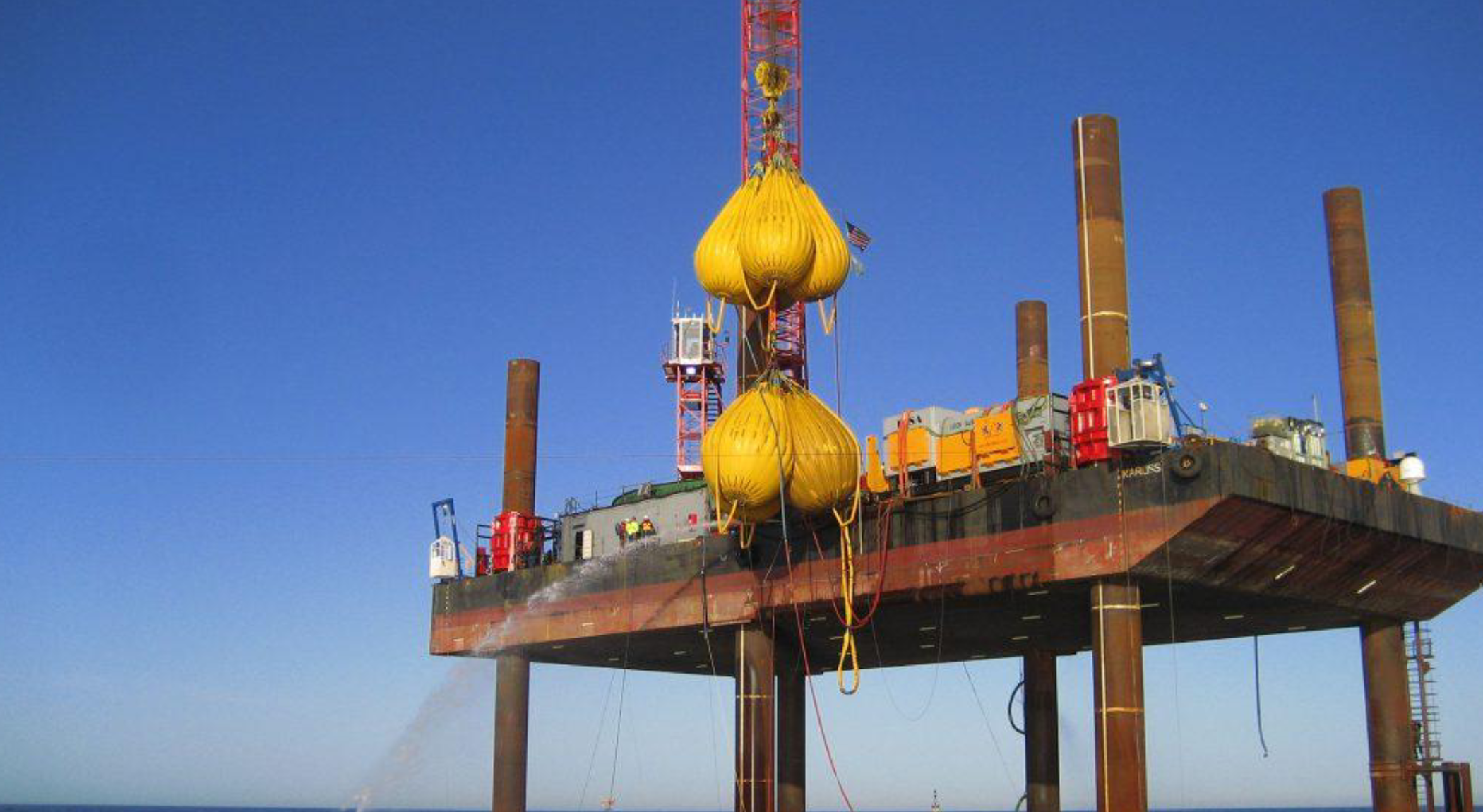
Water bags vs solid test weights
Solid test weights, such as steel or concrete blocks, are still used, especially in workshops where they are kept on site permanently. For most field and offshore tests, water bags make the logistics much simpler.
| Factor | Water bags | Solid test weights |
|---|---|---|
| Weight shipped to site | Empty bags only, around 1–1.5% of the test load | The full test load |
| Handling on site | Bags are positioned empty, then filled | Cranes or forklifts move every block |
| How the load is applied | Gradually, at any intermediate value | In steps, based on block size |
| Several test loads | One rigging, filled to each load in turn | Re-rigging with extra blocks for each load |
| Restricted headroom | Low Headroom bags from 1.0 t | Depends on block size and how high they stack |
| Remote or offshore sites | Water sourced locally | Blocks shipped by vessel or truck |
| After the test | Bags drained, folded and packed | Blocks lifted, loaded and removed |
Solid weights can still make sense for small, repeated tests at a fixed location, where the weights are already on site.
What can you test with water weights?
Water Weights® are used indoors and outdoors, onshore and offshore. The applications below cover most of the test work Unique Group supports. Each one is available as a turnkey service or with rented or purchased equipment.
Offshore, port and mobile cranes
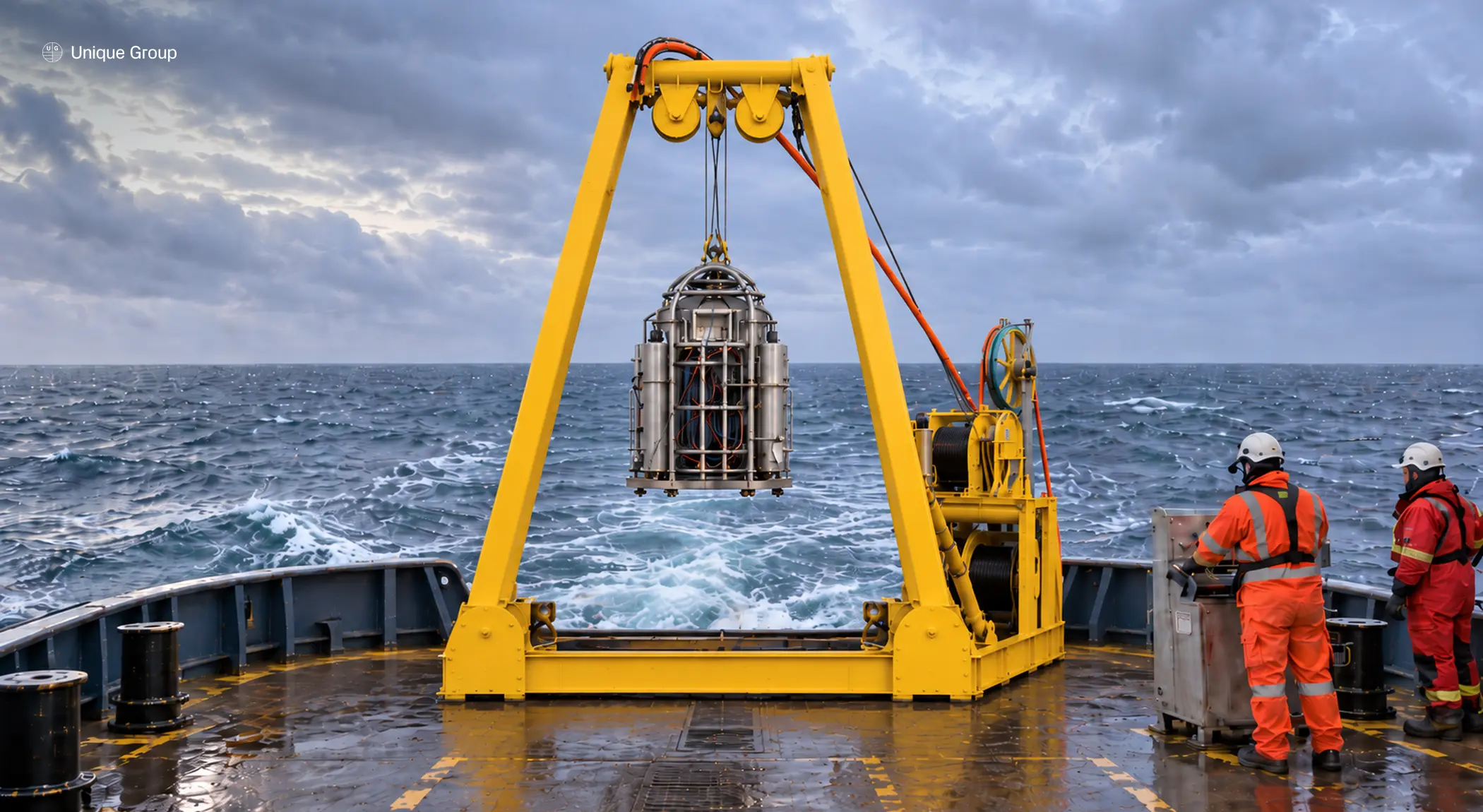
Crane proof load testing is the most common use for water bags. A single rigging can be filled to the SWL and then to the proof load, so the crane does not need to be re-rigged between test stages. On vessels and platforms, water is pumped straight from the sea or the ship’s supply.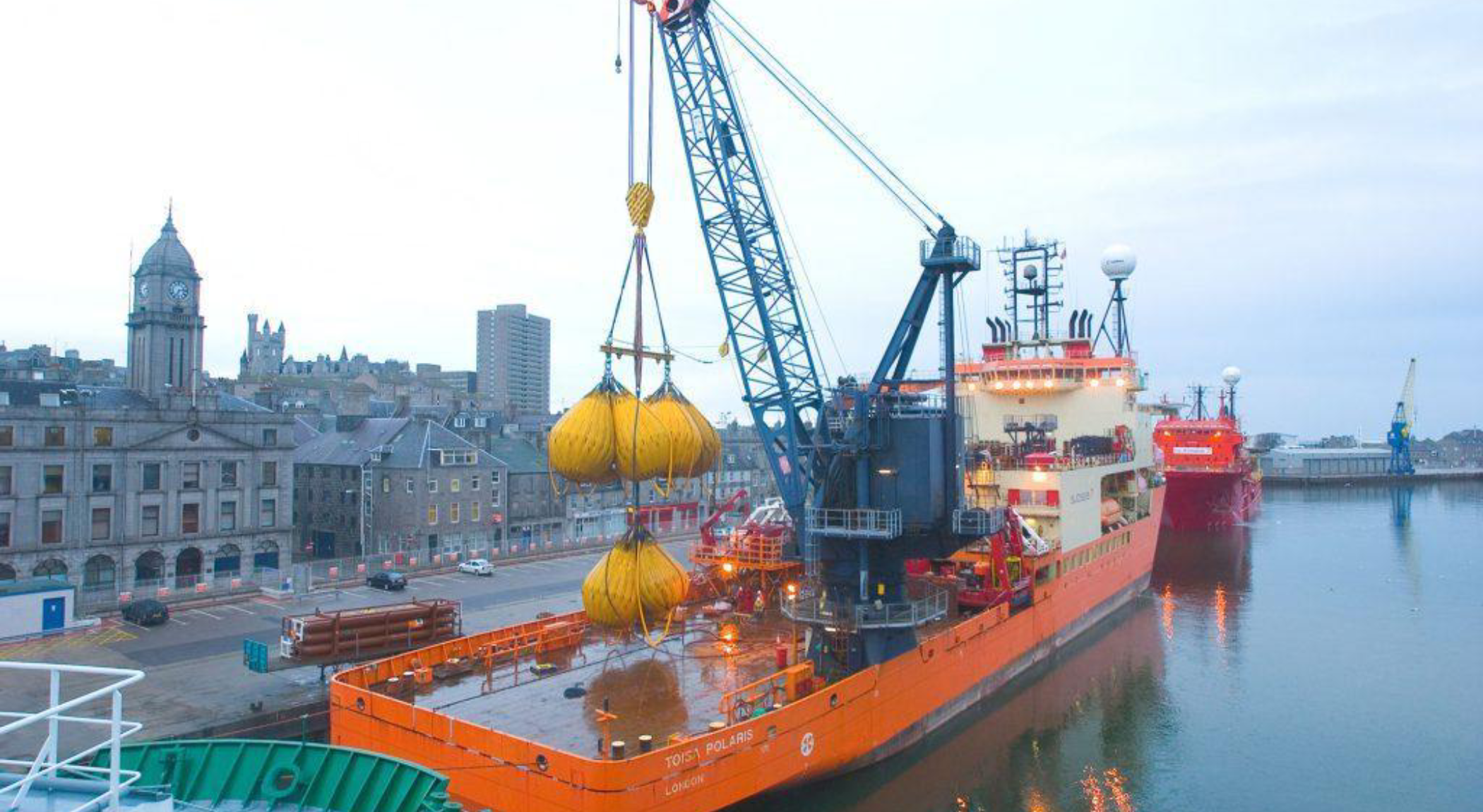
See Proof Load Testing Bags and our guide to tailoring crane load testing to specific requirements.
Davits, lifeboats and rescue boats
Under SOLAS regulation III/20 and IMO Resolution MSC.402(96), launching appliances for lifeboats, rescue boats and davit-launched liferafts must be thoroughly examined every year. Every five years they must also pass an overload operational test, with a proof load of 1.1 times the weight of the craft and its full complement of persons and equipment. Water bags supply that proof load without loading the boat with solid blocks.
See Water Weights® for Davit Testing and Life Saving Appliance Load Testing.
Gangways, accommodation ladders and ro-ro ramps
Gangways and ramps need a load spread along their length rather than one hanging from a hook. Deck and floor loading bags spread the test load evenly along the walkway. Water Weights® have been used to test roll-on/roll-off ferry ramps with total test loads of 70 to 600 tonnes, using several bags on each ramp.
See Deck/Floor Testing and our five-yearly overload test of gangways and pilot ladders in Singapore.
Floors, decks, bridges and structures
Structural load testing checks that a floor, deck or bridge can carry its design load. It is typically needed after renovation, a change of use or suspected damage. Mattress bags and flexidams apply a uniform surface load that can be increased in controlled steps.
Past projects include a 130-ton test for an educational establishment and a 40-ton test for a historical monument. For larger or longer tests, choose between Enclosed Floor Test Bags and Open Top Floor Test Bags.
Elevators and construction hoists
Passenger lifts, freight lifts and construction hoists can be tested with water bags placed inside the car or cage. This avoids carrying solid weights through finished buildings. See Construction Hoist Test System.
BOP carriers
Blowout preventer (BOP) carriers must be load tested after installation, repair or retrofit. Water bags with the matching rigging gear apply a controlled, repeatable test load. See BOP Carrier (Blowout Preventer) Testing.
Boat hoists, travel lifts and rubber-tyred gantries
Marinas, shipyards and ports use boat hoists and rubber-tyred gantries, where conventional test weights are impractical to bring in and position. Water bags can be positioned empty, then filled under the hoist. See Boat Hoist Testing with Water Weights®.
Lifting beams, spreader beams and winches
Below-the-hook equipment, lifting beams and winches can be proof load tested with the same bags. Spreader beams can also combine bags for higher test loads. See Lifting Equipment Proof Load Testing and Britlift Spreader Beams.
Four ways to work with Unique Group
Clients don’t all need the same thing. Some have no in-house testing capability, while others test every month. Water Weights® are available worldwide through four models:
| Model | Best for | What Unique Group provides |
|---|---|---|
| Turnkey load testing service | One-off or infrequent tests, or teams with no in-house load testing crew | Everything: the bags, rigging, load measurement and technicians. We fill, test, drain and clear the site, carrying out the test on your behalf and providing the results you need. |
| Rental | Occasional tests run by your own competent team | Water Weights® bags, with rigging and load measurement equipment as required, shipped to your site |
| Purchase with training | Operators who load test several times a year | Your own bags, plus training for your staff so they can run tests in-house |
| Rental with on-site support | Large or complex loads, even for teams with their own equipment | Additional bags, plus our engineers and technicians to support the rigging layout and the test |
Many clients move between these models. A company may start with a turnkey test and buy its own bags as testing becomes routine. It then comes back for rental and support when a test is larger than its own equipment can handle.
To have our team run your test, see Water Weights® Load Testing Services. To rent or buy equipment, browse the Water Weights® range.
Planning a water bag load test
How well a test is planned decides how quickly it is completed. Before mobilising, confirm the following:
- Test load and standard: the proof load required, and the standard or authority that sets it.
- Headroom and rigging: the height available under the hook, and whether Low Headroom bags, spreader beams or a multi-bag layout are needed.
- Water supply: a water source with enough flow to fill the bags in the time available.
- Discharge: where permitted, water can be released near the test, channelled or pumped back to its source, or directed to a storm drain. Check local permits and site rules. Unique Group can supply its standard environmental documentation with a quotation.
- Surface and access: for floor and deck tests, the area to be loaded, and safe access for the team and equipment.
- Lead time: time for shipping equipment to site, especially for remote or offshore locations.
For answers to the practical questions clients ask most, read Water Weights load testing FAQs answered. For hard-to-reach sites, see safe and compliant crane load testing in remote locations.
Quality and standards
All Water Weights® bags are manufactured under a management system that fulfils ISO 9001, ISO 14001 and ISO 45001, and they comply with LEEA Guidance 051. The bag design is type tested to a 6:1 factor of safety. The bag material complies with the EU REACH Regulation, so the bag skin contains no harmful heavy metals or plasticisers.
For more on LEEA 051, read the importance of LEEA 051 and water weights in load testing lifting equipment.
Two safe-use rules apply on every job:
- Bags must never be filled beyond their rated capacity.
- Mattress bags must not be stacked more than two high.
Custom bag sizes and capacities are available for applications outside the standard range.
Proven at scale: project examples
Unique Group has used Water Weights® on cranes, vessels, gangways and buildings worldwide. Recent projects include:
- A 1,500 t load test on a barge-mounted crane in Mexico
- The world’s largest water bag load test without spreader beams, completed within 24 hours
- A 726 t proof load test of cranes on board a pipelay vessel
- A 693 t proof load test on a gantry crane, completed in two days
- Deck cranes load tested in Singapore in 9 hours
- Structural load testing on a building in a complex urban environment in Belgium
Frequently asked questions
How accurate is water bag load testing?
Accuracy depends on the measuring instrument rather than the bag. Suspended tests are measured with a certified load cell between the hook and the bag. Deck and floor tests are measured with a calibrated flowmeter, which has a stated accuracy of +1% / −2%.
What capacities are available?
A single proof load bag covers 1.0 t to 12.5 t (Low Headroom range) or 10 t to 110 t (standard range). Deck and floor loading bags cover 1 t to 100 t per unit. For higher loads, several bags are combined. Unique Group has completed tests of 1,500 t this way.
Can water bags be used offshore?
Yes. Water Weights® were first developed for North Sea oil platforms and are designed for use onshore and offshore, indoors and outdoors. Offshore, bags are typically filled with seawater pumped on board. Because seawater is denser than fresh water, the final load is confirmed with a load cell or calibrated flowmeter.
How long does a water bag load test take?
It depends on the test load, the rigging and the water flow rate. On recent Unique Group projects, deck cranes in Singapore were tested in 9 hours, and a 693 t gantry crane test was completed in two days.
Should I rent, buy or outsource my load testing?
Outsource if you test rarely or don’t have a trained crew. Rent if your team is competent and tests occasionally. Buy, with training, if you test several times a year. For loads beyond your own equipment, rent additional bags with on-site support.
What happens to the water after the test?
The water is drained from the bags in a controlled way. Where permitted, it can be released near the test site, channelled or pumped back to its original source, or directed to a storm drain, subject to local rules. The empty bags are then folded and packed for return or the next job.
Plan your next load test
Water bag proof load testing gives you a controlled, measurable test load without the cost and handling of solid weights. Your own team can run the test with Water Weights®, which are available for sale and rental worldwide. Or Unique Group can deliver it end to end through our turnkey load testing service.
- Rent or buy Water Weights®: view the range
- Let our team run your load test: Water Weights® Load Testing Services
Speak with our buoyancy and ballast specialists to discuss your project requirements.