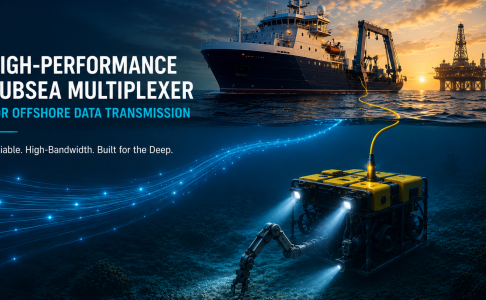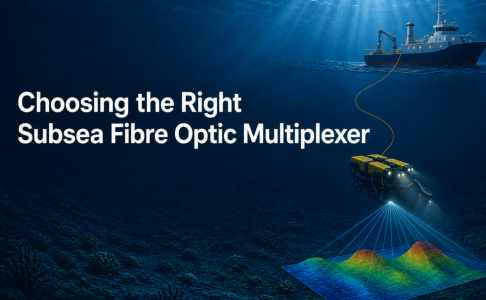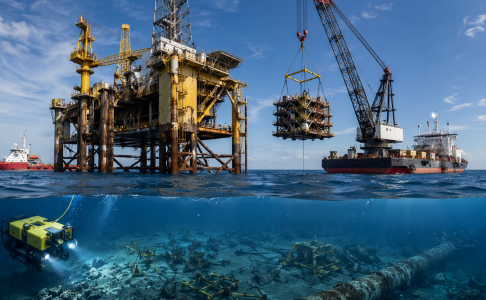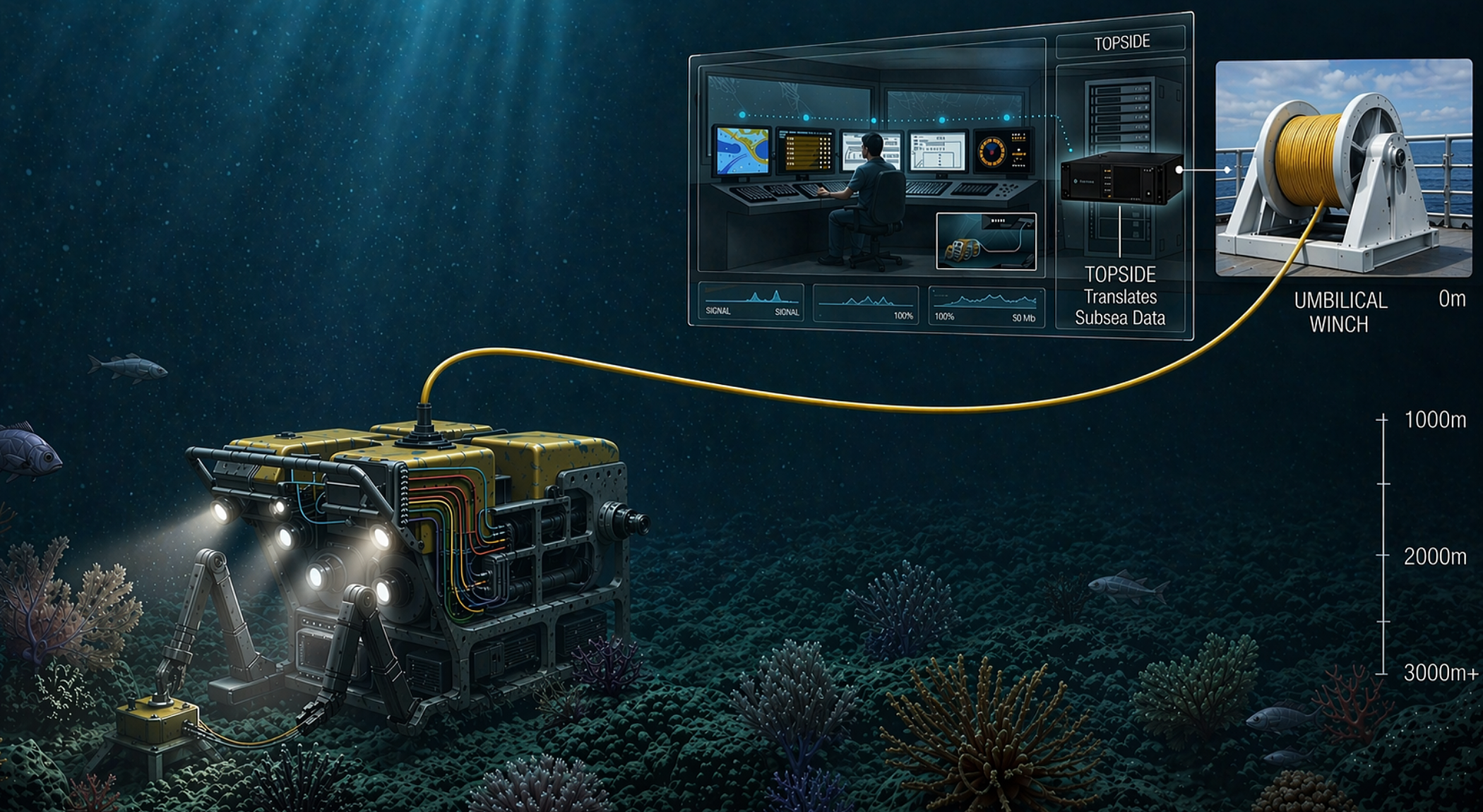
In offshore and subsea operations, transmitting large volumes of data reliably over long distances is a fundamental requirement. From survey sensors to ROV systems, multiple data streams must be transmitted simultaneously (often in real time) through a single communication link.
This is where a fibre optic multiplexer (MUX) becomes essential. Explore our fibre optic multiplexer solutions.
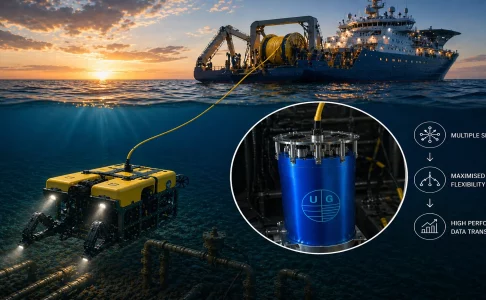
A fibre optic multiplexer is a subsea communication system designed to multiplex multiple data streams for transmission over a single fibre optic link, enabling efficient and reliable transmission between subsea equipment and surface systems.
What is a Fibre Optic Multiplexer (MUX)?
A fibre optic multiplexer (MUX) is a system that:
- Combines multiple input signals.
- Transmits them over a single fibre optic cable.
- Separates them back into individual signals at the receiving end.
(This process is called multiplexing at the transmitter and demultiplexing at the receiver.)
In offshore applications, it is commonly used in:
- ROV systems
- Subsea survey equipment
- Inspection and monitoring operations
Why Multiplexing is Required in Offshore Operations
Subsea systems typically involve multiple devices operating simultaneously, such as:
- Cameras
- Sonar systems
- Navigation sensors
- Environmental monitoring equipment
Without multiplexing:
- Each device would require a separate cable
- System complexity would increase significantly
- Deployment and maintenance would become inefficient (and costly)
A multiplexer solves this by:
- Reducing cabling requirements
- Improving system integration
- Enabling efficient data transmission (low signal loss over long distances)
How a Fibre Optic Multiplexer Works
A fibre optic MUX operates in four main stages:
1. Signal Input
Multiple signals from subsea equipment are fed into the multiplexer, including:
- Video feeds
- Sensor data
- Control signals
2. Signal Combination (Multiplexing)
The system combines these signals into a single optical stream for transmission over an optical link.
(This is typically achieved using techniques such as Time Division Multiplexing (TDM) or Wavelength Division Multiplexing (WDM), depending on system design.)
This allows:
- Multiple data types to travel together
- High bandwidth utilisation
- Efficient communication over long distances
3. Signal Transmission
The combined signal is transmitted through a fibre optic cable to the surface.
Fibre optics are used because they:
- Support high data rates
- Provide low signal loss over distance
- Are resistant to electromagnetic interference
4. Signal Separation (Demultiplexing)
At the receiving end:
- The signal is separated back into individual data streams
- Each system (camera, sensor, control unit) receives its specific data
Key Features of Subsea Fibre Optic Multiplexers
In offshore environments, multiplexers are designed to meet specific operational requirements:
1. High Bandwidth Capability
- Supports transmission of:
- Video
- Data
- Control signals
(including high-definition video and high-frequency sensor data)
2. Multi-Signal Integration
Allows multiple systems to operate simultaneously through a single link.
3. Reliability in Harsh Environments
Designed for:
- High pressure
- Deep water
- Harsh subsea conditions
(including corrosion resistance and long-term deployment stability)
4. Compact and Modular Design
Enables integration into:
- ROV systems
- Subsea platforms
- Survey equipment setups
Applications in Offshore & Subsea Operations
Fibre optic multiplexers are widely used in:
ROV Operations
Transmitting video and sensor data to the surface
Enabling real-time control and monitoring
Offshore Survey Systems
- Integrating sonar, positioning, and environmental sensors
- Supporting geophysical survey workflows
Subsea Inspection & Monitoring
- Monitoring pipelines and infrastructure
- Collecting inspection data in real time
Data Transmission in Deep Water
- Ensuring reliable communication over long distances
- Supporting complex offshore operations
Why Fibre Optic MUX is Critical in Modern Offshore Systems
Modern offshore projects rely heavily on real-time data. A fibre optic multiplexer enables:
- Efficient use of communication channels
- Reduced system complexity
- Reliable high-speed data transmission
Seamless integration of multiple subsea systems
Without multiplexing, offshore systems would become:
- More complex
- Less efficient
- Harder to deploy and maintain
(and significantly more expensive to scale)
Conclusion
A fibre optic multiplexer (MUX) is a fundamental component in offshore and subsea operations, enabling multiple data streams to be transmitted efficiently through a single fibre optic link.
By combining data, video, and control signals into one channel, it simplifies system design, improves reliability, and supports the growing demand for high-performance subsea communication systems.
As offshore operations continue to evolve, multiplexers remain a key technology enabling efficient, integrated, and scalable subsea solutions.
Once you understand how a subsea MUX works, the next step is choosing the right unit for your operation.
Explore our subsea fibre optic multiplexer systems to support your offshore communication requirements.