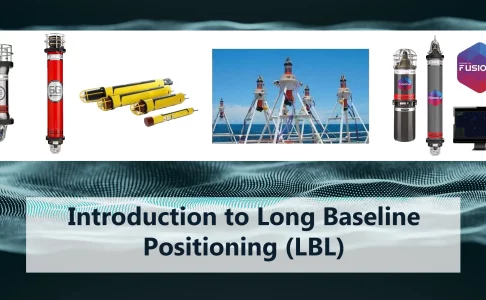
Why LBL Trade-Offs Matter in Offshore Positioning
Underwater positioning is never one-size-fits-all. Operators can choose between USBL, LBL, INS-aided navigation and various hybrid positioning approaches. Each comes with a different balance of accuracy, cost, mobilisation time and operational flexibility.
Long Baseline (LBL) systems are widely recognised for delivering very high absolute accuracy and position stability in many subsea scenarios. To understand how the technology works, see our guide to What is Long Baseline (LBL) positioning.
LBL positioning uses a calibrated network of fixed seabed transponders to create a stable underwater reference frame. This makes it well suited to offshore projects where repeatability, depth-independent positioning and high accuracy are critical.
This article looks at the main advantages and limitations of LBL so that engineers and survey managers can decide when it’s the right tool, and when an alternative might serve better.
Key Takeaways
- LBL systems use a calibrated network of seabed transponders to deliver highly stable underwater positioning.
- Their main strengths are accuracy, repeatability and long-term subsea reference control.
- Their main drawbacks are deployment time, infrastructure requirements and higher spread complexity.
- LBL is often best suited to deepwater, long-duration or high-value projects where positional uncertainty is costly.
- Hybrid approaches combining LBL with INS, DVL and software such as Fusion 2 can reduce deployment burden while retaining many of LBL’s benefits.
Advantages of LBL Systems
1. Centimetre-Level Accuracy and Stability
Because LBL is built around a calibrated network of seabed transponders, its positions are referenced directly to fixed points on the seabed rather than to a moving vessel.
Key benefits:
- Traditional LBL systems can achieve centimetre-level positional accuracy under good conditions.
- Accuracy is largely independent of water depth, provided the array geometry is sound.
- Because the reference frame is stable, LBL delivers excellent repeatability for as-built surveys, metrology and long-term monitoring.
2. Robust Performance in Challenging Environments
With carefully spaced baselines and modern wideband signal processing, LBL typically offers:
- Better resilience to multipath and reverberation compared with surface-referenced systems working under a noisy hull.
- Strong geometry for positioning – the wider the spacing between transponders, the more robust the position solution.
This makes LBL attractive in deep water, near large structures or where vessel noise and reflection complicate USBL performance.
3. Flexible Reference Frames and Geodetic Control
Once the transponders in an LBL array are surveyed, they provide a local subsea reference frame that can be tied back to global coordinates:
- The array can be connected to GNSS and surface control networks, effectively extending GPS underwater.
- Multiple campaigns (construction, inspection, decommissioning) can all reference the same stable network, improving long-term asset management.
4. Ideal for Long-Duration, High-Value Projects
For large offshore construction campaigns, deepwater fields or long-term monitoring:
- The initial effort to deploy and calibrate the array is spread over months or years of operation.
- LBL can then serve as a high-accuracy backbone for multiple vessels, ROVs and tasks over the life of the field.
Limitations of LBL Systems
1. Deployment Time and Infrastructure
LBL’s biggest strength – seabed infrastructure – is also its main limitation:
- Transponders must be deployed, surveyed, and calibrated before useful positions can be produced.
- This consumes valuable vessel time, which can be a significant cost driver on short projects.
In contrast, USBL can often be mobilised quickly with minimal subsea hardware, making it more attractive for short, simple tasks.
2. Higher CAPEX and OPEX
A full LBL spread typically includes:
- Multiple transponders (e.g. Compatt 6/6+, Midi Compatt)
- ROV or vessel transceivers (ROVNav, Dunker)
- Deck units and specialist LBL software (Fusion 2)
- Plus spares and test equipment
Compared with a basic USBL-only solution, this means:
- Higher upfront equipment costs (purchase or rental)
- More complex logistics (batteries, storage, transport)
- Specialist personnel for deployment, calibration and operations
3. Less Flexibility for Rapid, Mobile Campaigns
Because transponders are fixed on the seabed:
- The array is optimised for a particular worksite or route.
- If the project moves to another field or a very different geometry is required, the array may need to be partly or entirely redeployed.
For highly mobile campaigns – for example, short inspections across multiple small fields – a USBL-centric approach may be more efficient.
4. Sensitivity to Environmental Factors
Although LBL is robust, it still relies on:
- Accurate sound-velocity models – incorrect sound speed can bias range measurements.
- Stable transponder positions – movement due to soft seabed, trawling, or installation issues can degrade accuracy.
These risks are managed with good system design, regular checks, SV profiling and, increasingly, hybrid solutions combining LBL with INS and DVL.
Hybrid and Sparse LBL Approaches
Modern systems are moving beyond a simple “LBL vs USBL” choice. A few trends are worth noting:
Sparse LBL + INS: using fewer transponders, combined with high-grade INS and DVL, can deliver near-traditional LBL accuracy with reduced hardware and deployment time.
Hybrid LUSBL: concepts that blend USBL and LBL aim to offer robust positioning and flexibility for DP operations.
These approaches are increasingly supported by advanced navigation software such as Sonardyne Fusion 2, which can manage range-aiding, multi-sensor fusion and complex array geometries within a single project-wide solution.
When Is LBL the Right Choice?
LBL is often the right fit when:
- Accuracy requirement is at the decimetre or centimetre level
- Water depth and environmental conditions make USBL performance uncertain
- The project justifies a stable, long-term subsea reference frame (field developments, large wind farms, deepwater pipelines)
- The cost of positional uncertainty (re-work, downtime, safety risks) outweighs the extra spread complexity
For shorter, lower-risk tasks where flexibility is key, [USBL] may be more cost-effective – but even there, a small LBL or sparse LBL array can provide valuable cross-checks and resilience.
Next Steps
If you’re exploring how Long Baseline positioning fits into offshore operations:
- Start with What Is LBL? for a conceptual overview of Long Baseline acoustic positioning.
- Continue with LBL Systems for Offshore Survey and Construction to understand how LBL arrays are deployed in real offshore survey and installation projects.
- Then review the Long Baseline Systems (LBLs) product range to explore available transponders, transceivers and navigation software used in practical subsea positioning spreads.