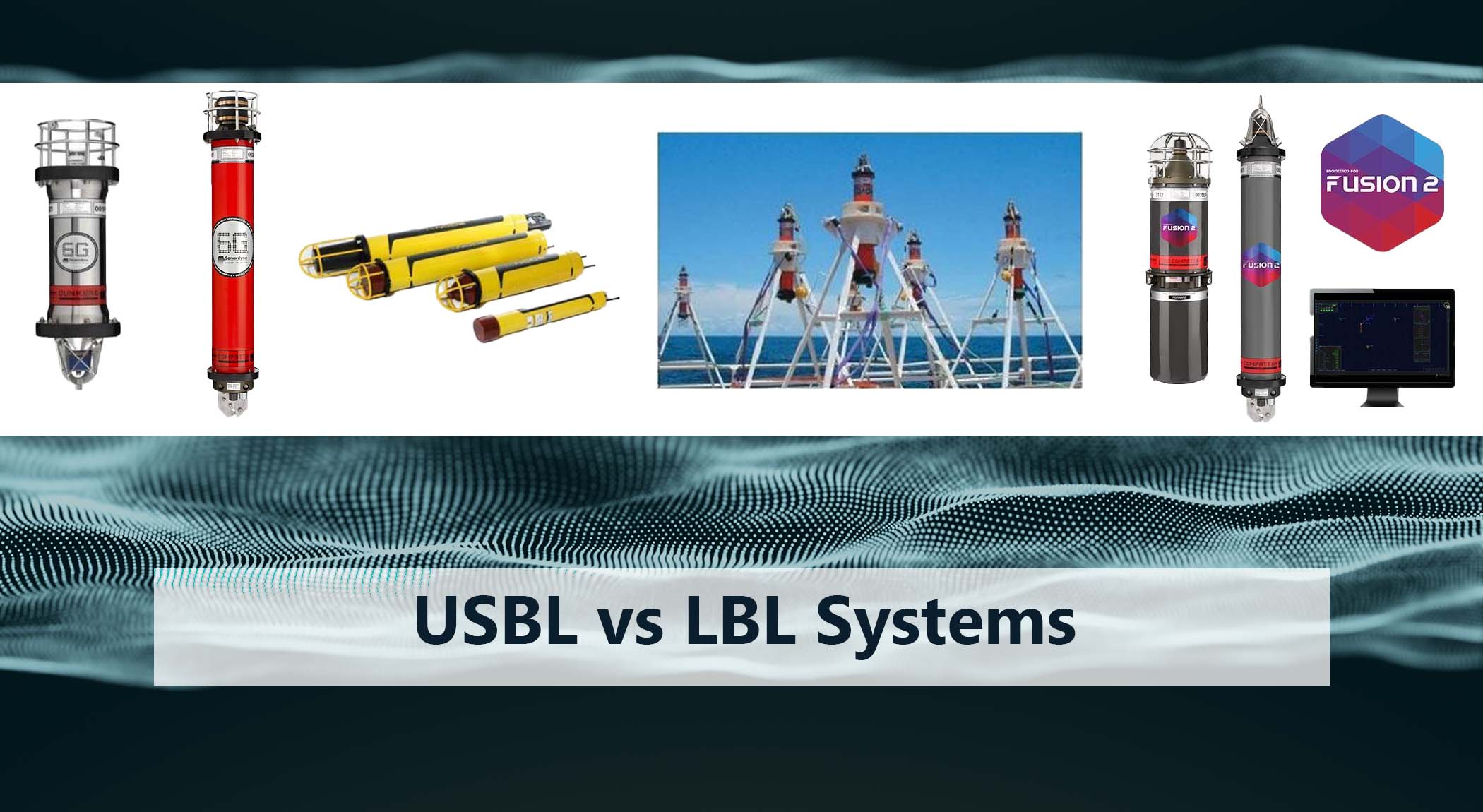
Underwater positioning plays a decisive role in offshore operations, from laying subsea pipelines and inspecting assets to conducting precision surveys. A small positional error can lead to costly rework, safety risks, or inaccurate data, making reliable subsea navigation systems indispensable.
Two of the most widely used acoustic positioning technologies in offshore operations are USBL (Ultra-Short Baseline) and LBL (Long Baseline) systems. Each technology offers distinct advantages depending on project conditions, accuracy requirements, and operational constraints.
This article explores how these systems differ, what factors influence their performance, and how offshore teams can select or integrate them effectively.
Key Takeaways
- USBL systems offer rapid mobilisation and operational flexibility, making them ideal for tracking ROVs, AUVs, and divers during survey and inspection campaigns.
- LBL systems deliver the highest positional accuracy and long-term stability, making them preferred for construction metrology and deepwater applications.
- USBL systems are quicker to deploy, while LBL systems require seabed transponder arrays and calibration before operations begin.
- Hybrid positioning configurations combining acoustic systems with aiding sensors are commonly used to balance accuracy, cost, and operational resilience.
- Selecting the right positioning system depends on factors such as required accuracy, water depth, environmental conditions, project duration, and available vessel time.
Underwater Positioning: The Fundamentals
Why Underwater Navigation Is Different
Unlike terrestrial navigation, underwater environments block GNSS signals, forcing offshore operations to rely on acoustic positioning technologies.
Sound waves travel efficiently underwater, but environmental factors such as temperature, salinity, and pressure alter sound velocity. If these variations are not properly accounted for, positioning errors can occur.
Common sources of positioning error include:
- Variable sound – velocity profiles (especially in thermoclines)
- Multipath reflections from vessel hulls or subsea structures
- Vessel motion and sensor misalignment
- Poor geometry between acoustic transponders and receivers
Understanding these factors is essential when selecting an underwater positioning system.
USBL (Ultra-Short Baseline) Positioning Systems
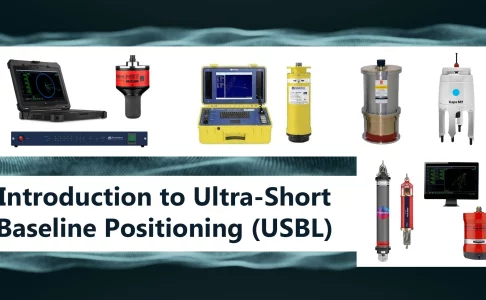
USBL systems determine the position of a subsea target by measuring the time-of-flight and angle of acoustic signals between a vessel-mounted transceiver and a subsea transponder. The system calculates both range and bearing to produce a real-time 3D position relative to the vessel.
Advantages and Typical Applications
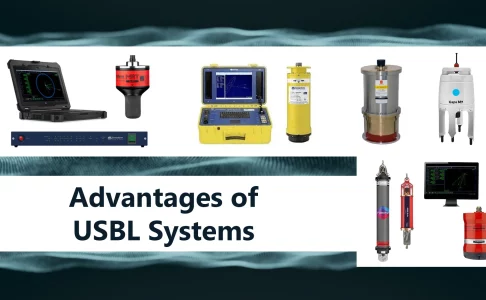
USBL Systems offer several operational benefits. A deeper discussion of these strengths can be found in Advantages of USBL Systems. They are widely used in offshore operations due to their operational flexibility:
- Fast mobilisation – no seabed infrastructure required
- Versatile asset tracking – ROVs, AUVs, towfish, and divers
- Wide operational depth range
- Useful for dynamic positioning reference inputs
Typical applications include:
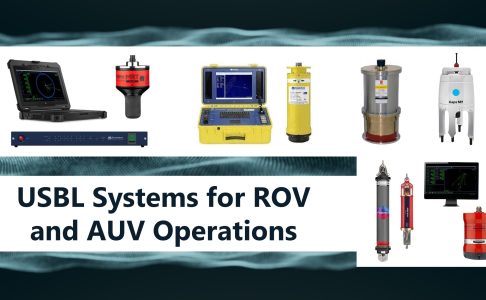
- ROV tracking during inspection, maintenance, and repair (IMR)
- Geophysical and environmental surveys
- Underwater exploration campaigns
- UXO detection and clearance operations
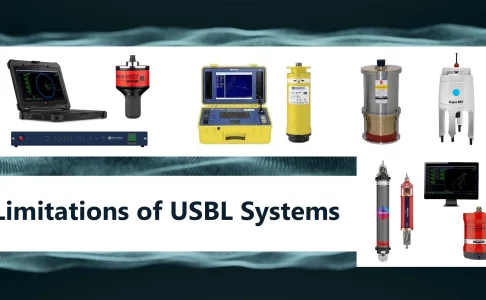
Limitations and Challenges
Despite their flexibility, USBL systems have several limitations:
- Accuracy decreases with increasing water depth and slant range
- Performance can be affected by vessel motion and acoustic noise
- Multipath reflections may degrade signal quality
- Careful sound-velocity correction and alignment calibration are required
USBL systems are therefore best suited for operations requiring rapid deployment and moderate positional accuracy.
LBL (Long Baseline) Acoustic Positioning
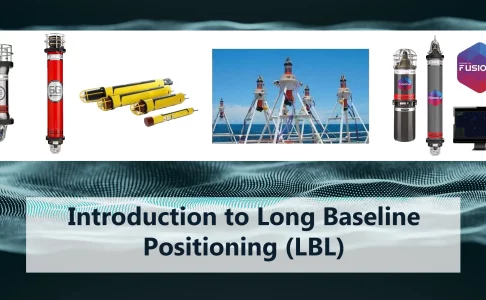
Long Baseline (LBL) positioning systems determine the location of a subsea asset using a network of seabed-mounted acoustic transponders placed around the worksite. These transponders form a calibrated reference frame on the seabed.
Advantages and Typical Applications
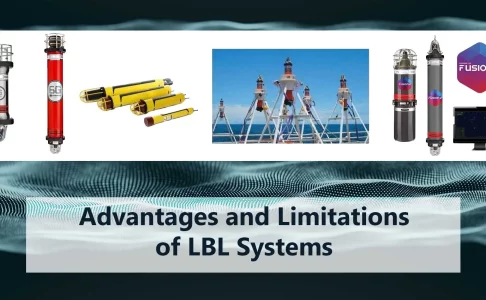
LBL systems are widely used in high-precision offshore operations. The strengths and operational trade-offs of LBL positioning are discussed in detail in Advantages and Limitations of LBL Systems. They offer:
- Centimetre-level positioning accuracy
- Depth-independent performance
- Stable and repeatable geometry
- Strong integrity for long-term monitoring
Typical applications include:
- Subsea construction metrology
- Pipeline and cable installation
- Template and manifold placement
- Spoolpiece measurement and tie-ins
- As-built surveys and field development monitoring
Limitations and Challenges
LBL systems also introduce operational challenges:
- Deployment effort – transponders must be installed and calibrated
- Additional vessel time required for setup and recovery
- Logistical complexity when operating across multiple sites
- Environmental conditions may affect sound-velocity stability
LBL systems are therefore most suitable for long-duration or high-precision offshore projects where accuracy outweighs deployment effort.
The key operational differences between USBL and LBL positioning systems can be summarised as follows:
USBL vs LBL: Comparative Evaluation
| Parameter | USBL | LBL |
| Accuracy | Typically 0.5–2% of slant range | Decimetre–centimetre accuracy |
| Deployment | Fast mobilisation | Requires seabed transponder array |
| Sensitivity to depth | Accuracy decreases with depth | Depth-independent |
| Setup time | Minimal | Higher mobilisation effort |
| Operational flexibility | Highly mobile operations | Fixed worksite positioning |
| Typical use cases | ROV tracking, surveys, inspections | Construction metrology, subsea installation |
USBL systems are typically chosen for rapid deployment and mobile operations, while LBL systems are preferred where maximum positioning accuracy and repeatability are required.
Choosing Between USBL and LBL
Selecting the right underwater positioning system depends on several operational factors.
Choose USBL when:
- Rapid mobilisation is required
- Operations are short-term or mobile
- Moderate positioning accuracy is sufficient
- ROV tracking or survey support is needed
Choose LBL when:
- Centimetre-level positioning accuracy is required
- Operations focus on a fixed subsea worksite
- Construction metrology or installation tasks are involved
- Long-term positional stability is critical
Hybrid Positioning Architectures
Modern offshore positioning spreads often combine acoustic systems with aiding sensors such as Inertial Navigation Systems (INS) and Doppler Velocity Logs (DVL).
- These hybrid configurations allow:Acoustic systems (USBL or LBL) to provide absolute position updates.
- Inertial systems to maintain continuous navigation between acoustic fixes.
This integration improves overall reliability and ensures positioning continuity even during acoustic dropouts.
Deployment Insights: Best Practices
USBL
- Conduct box-in calibration to verify offsets and geometry
- Monitor sound-velocity profiles continuously
- Apply vessel motion compensation
- Use redundant references for QA/QC verification
LBL
- Optimise baseline geometry when deploying transponders
- Perform calibration surveys before operational use
- Monitor temperature and salinity conditions
- Conduct periodic beacon health checks
Following these procedures helps maintain high positioning accuracy during offshore campaigns.
Unique Group’s Integrated Survey & Positioning Solutions
Unique Group supports offshore positioning campaigns with integrated survey equipment solutions, including USBL and LBL systems from leading manufacturers.
Our capabilities include:
- Rental and sale of subsea positioning systems
- Integrated packages including acoustic positioning sensors
- Deployment and calibration support
- Hybrid solutions tailored to project requirements
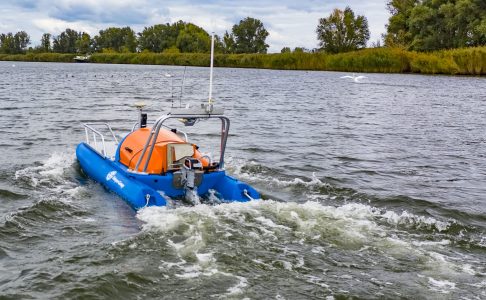
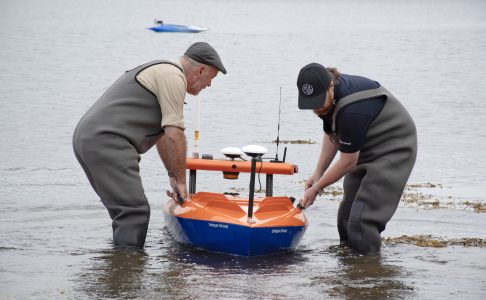
Combined with access to Unmanned Surface Vessels (USVs) such as the Uni-Mini and Uni-Pact, Unique Group provides flexible and efficient positioning solutions for offshore survey and construction projects worldwide.
Conclusion
No single underwater positioning system is universally superior. The optimal choice depends on project objectives, required accuracy, site conditions, and operational constraints.
USBL systems provide flexibility and rapid deployment for survey and inspection operations, while LBL systems deliver the highest levels of positional accuracy and stability for construction and metrology tasks.
By understanding the strengths and limitations of each technology and integrating them where appropriate offshore teams can ensure safe, efficient, and reliable subsea operations.
Contact our experts for USBL and LBL positioning system solutions.
Frequently Asked Questions
Can USBL meet construction-metrology accuracy requirements?
In most cases, USBL systems alone cannot reliably meet centimetre-level metrology tolerances. LBL systems or hybrid configurations are typically preferred for high-precision construction work.
How long does it take to deploy an LBL array?
Deployment time depends on site size and water depth. Additional vessel time is required for transponder placement, calibration surveys, and sound-velocity verification.
What factors most affect USBL accuracy?
Sound-velocity variations, acoustic noise, multipath reflections, and sensor alignment can all influence USBL performance.
Are hybrid positioning systems common offshore?
Yes. Many modern offshore positioning spreads combine acoustic systems with aiding sensors to improve accuracy, redundancy, and operational reliability.