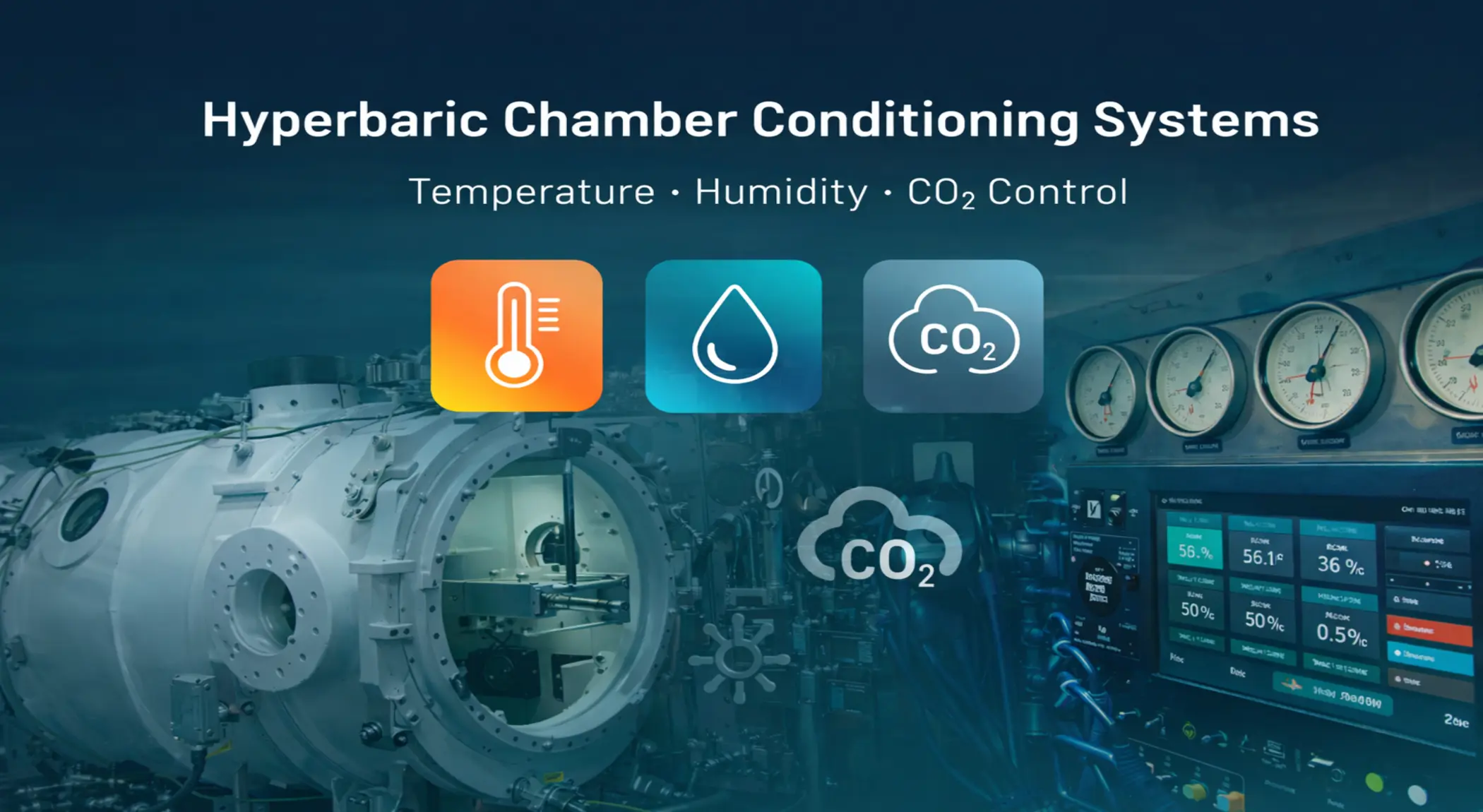
A hyperbaric chamber conditioning unit controls temperature, humidity, and carbon dioxide levels inside a sealed pressure environment.
Hyperbaric chambers, whether used for deck decompression, treatment, training, or saturation living – are fundamentally pressure vessels housing people in a sealed atmosphere. Once occupied, the atmosphere does not “self-correct.” CO₂ rises from exhalation, humidity increases from breath and wet equipment, and temperature variations can develop depending on airflow, heat loads, and gas properties.
In saturation systems, environmental control becomes more demanding. Diver living compartments are often helium-rich environments where gas is continuously recirculated. These systems typically use chemical scrubbers to absorb CO₂ while oxygen is added to replace metabolic consumption.
Key Takeaways
- A hyperbaric chamber conditioning unit regulates temperature, humidity, and CO₂ levels inside sealed pressure environments.
- These systems help maintain safe atmospheric conditions for divers and occupants during hyperbaric or saturation operations.
- Environmental control typically includes CO₂ scrubbing, dehumidification, thermal regulation, and gas circulation.
- Proper circulation prevents gas stratification, ensuring uniform temperature and gas distribution within the chamber.
- Chamber operators rely on conditioning systems to stabilize the internal atmosphere and reduce operational workload.
Why This Matters for Operations, Not Just Comfort
Poorly controlled chamber environments create operational risks. High humidity, rising CO₂, or unstable temperature conditions can reduce diver work tolerance, increase fatigue, and contribute to condensation or corrosion that damages equipment. These issues can also lead to atmosphere readings outside acceptable limits, forcing operational interruptions.
Hyperbaric chamber operations are actively managed by trained personnel. Operators control gas flow into and out of the chamber while monitoring and regulating the internal atmosphere. Equipment that stabilizes humidity, temperature, and CO₂ reduces operator workload and improves the consistency of chamber conditions during operations.
What Standards Imply for Chamber Environmental Control
Industry standards define environmental control requirements that directly translate into engineering performance expectations.
1. CO₂ Removal and Limits
Commercial diving standards require CO₂ removal or atmospheric renewal systems for bells and living compartments. The design basis typically assumes a CO₂ production rate per diver per hour and specifies maintaining chamber CO₂ partial pressure below a defined threshold during normal operation.
Emergency absorption capacity is also required so the system can maintain acceptable CO₂ levels for extended periods in contingency scenarios.
Operational guidance notes also highlight that saturation chambers often operate with slightly elevated CO₂ levels compared with ambient air, depending on system design and operational limits.
2. Humidity Reduction Targets
Standards require humidity control systems within living compartments. For saturation diving environments, a relative humidity target of around 50% under steady conditions is often specified. In certain environments, achieving this target may require additional cooling or moisture removal capacity.
3. Heating and Cooling Control
Environmental control systems must regulate temperature accurately. In saturation systems, heating and cooling systems are expected to maintain temperature within approximately ±1°C of the set point under steady conditions.
Redundant heating and cooling arrangements are typically required for safety and reliability.
4. Circulation and Avoidance of Stratification
Environmental control involves more than heating or cooling capacity. Gas circulation systems must ensure uniform mixing within the chamber. Proper airflow prevents temperature gradients and uneven gas concentrations, ensuring homogeneous distribution of oxygen, CO₂, and other gases.
Together, these requirements create a clear evaluation checklist: environmental control systems should integrate CO₂ removal, humidity reduction, temperature control, and effective gas circulation while remaining compatible with the chamber’s operating gas mixture
Key Environmental Control Principles in Hyperbaric Chambers
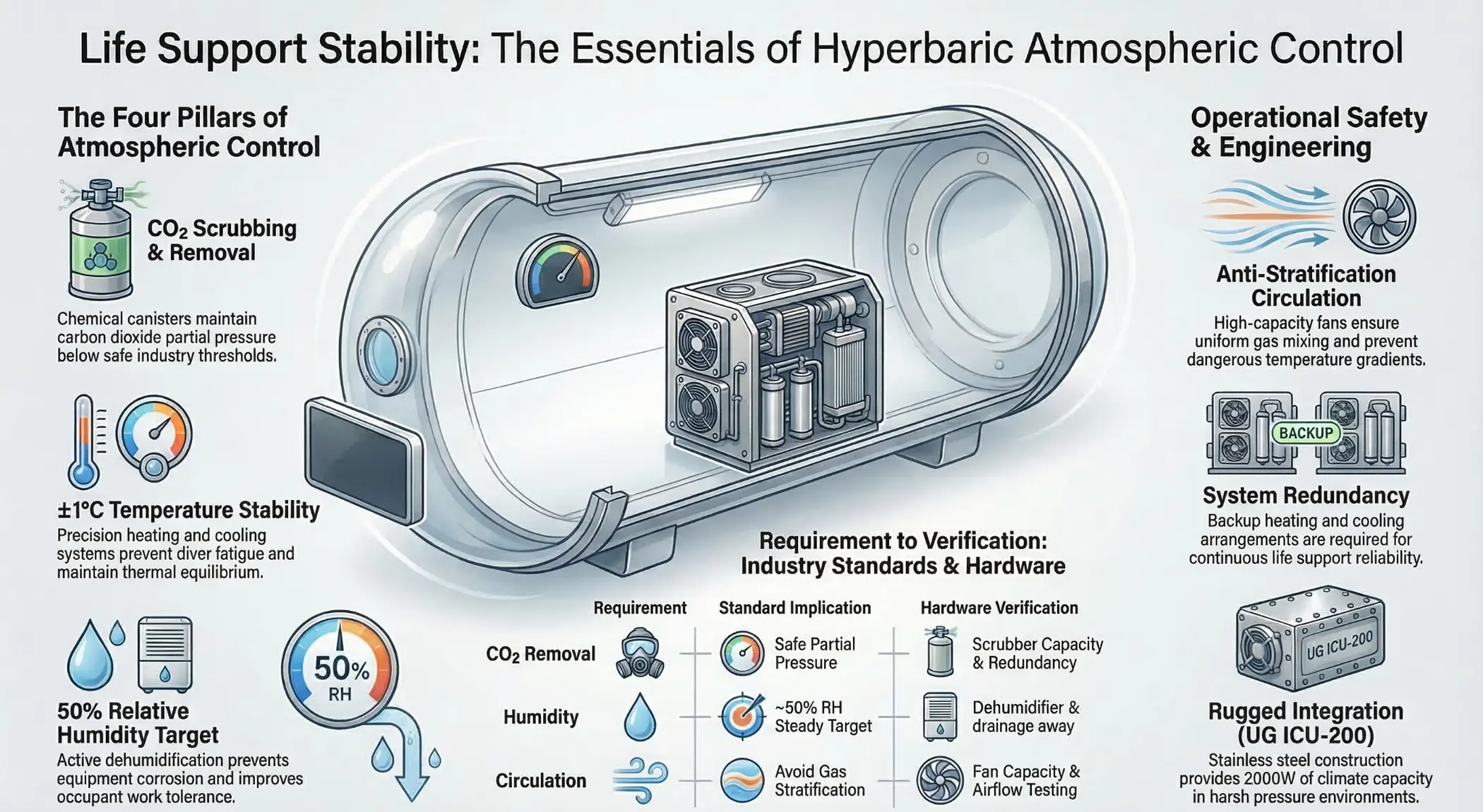
What a Chamber Internal Conditioning Unit Includes
Based on these operational requirements, hyperbaric chamber conditioning units typically combine several environmental control functions into a single integrated system.
Most chamber conditioning systems include several integrated subsystems:
Thermal Control
Heating elements and cooling capacity sized to the chamber volume and expected operating conditions.
Dehumidification
Cooling coils or condensation systems that remove water vapor and manage condensate to maintain humidity targets.
CO₂ Scrubbing
Chemical absorbent systems, often using replaceable canisters, designed to keep CO₂ partial pressure within acceptable limits.
Airflow and Mixing
Fans and outlet designs that prevent hot or cold zones and maintain uniform gas distribution within the chamber.
Measurement and Operator Workflow
Environmental control systems must support monitoring and maintenance routines so operators can effectively manage chamber atmosphere conditions.
A Standards-to-Design Translation Table
| Requirement Area | What the standard implies | What to verify in hardware |
| CO₂ removal | CO₂ removal capacity required with defined limits for normal operations and redundancy requirements | Scrubber capacity, consumable size, redundancy, monitoring capability |
| Humidity | Humidity reduction required with ~50% RH steady target in saturation systems | Dehumidification mechanism, condensate drainage, performance under operating temperatures |
| Temperature | Accurate regulation around set point with redundancy | Heating and cooling capacity, stability of control systems |
| Circulation | System must avoid stratification and ensure homogeneous gas distribution | Fan capacity, outlet design, airflow testing and commissioning |
Sizing and Integration Checklist
Several engineering factors determine the correct system size and configuration:
Occupancy and CO₂ Load
CO₂ generation per diver provides the baseline for sizing scrubber capacity and redundancy planning.
Chamber Volume and Geometry
The internal volume and layout influence airflow design and mixing requirements.
Operating Mode
Different chamber uses, such as saturation living, deck decompression chambers, or training facilities have different duty cycles and environmental tolerance levels.
Consumables Logistics
CO₂ absorbent replacement, storage, and transfer through chamber locks must be considered when designing operational procedures.
Where the UG ICU-200 Fits
Hyperbaric chamber conditioning units designed for diving and saturation environments typically integrate heating, cooling, dehumidification, and CO₂ removal within a compact system.
The UG ICU-200 is a chamber internal conditioning unit designed to provide temperature control, dehumidification, and CO₂ scrubbing for hyperbaric chamber environments.
Key integration features include corrosion-resistant stainless steel construction, configurable orientation, adjustable air outlets designed to minimize temperature stratification, and variable-speed fans for airflow control.
Specifications include:
- 2000 W heating capacity
- 2000 W cooling capacity
- 11-litre CO₂ scrubbing canister
- 4-inch air outlet
These features align with common requirements for chamber circulation, humidity reduction, and CO₂ control within hyperbaric and diving system environments.
Frequently Asked Questions
What does a chamber internal conditioning unit do?
It controls temperature, removes excess humidity, circulates chamber gas to prevent stratification, and supports CO₂ scrubbing as part of maintaining a breathable environment.
What CO₂ level is typically targeted in saturation chambers?
Saturation environments often operate with slightly elevated CO₂ levels compared with ambient air, depending on system design and operational limits.
Do standards specify CO₂ requirements in partial pressure terms?
Yes. Diving system standards often define CO₂ removal capacity requirements using partial pressure limits to ensure safe atmospheric conditions inside the chamber.
Why can chambers suffer from stratification?
Without adequate circulation, temperature and gas concentrations can vary in different parts of the chamber. Airflow systems are designed to ensure homogeneous mixing and prevent these gradients.
How often do you need to replace CO₂ absorbent media?
Replacement intervals depend on chamber occupancy, CO₂ production rates, and monitoring systems. Operational procedures typically define safe replacement cycles.
What is the operator’s role in atmosphere management?
Hyperbaric chamber operators monitor and regulate internal atmosphere conditions, controlling gas flow and environmental systems during operations.