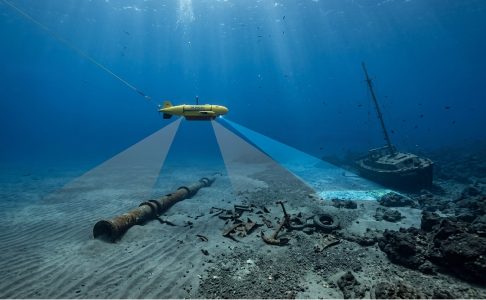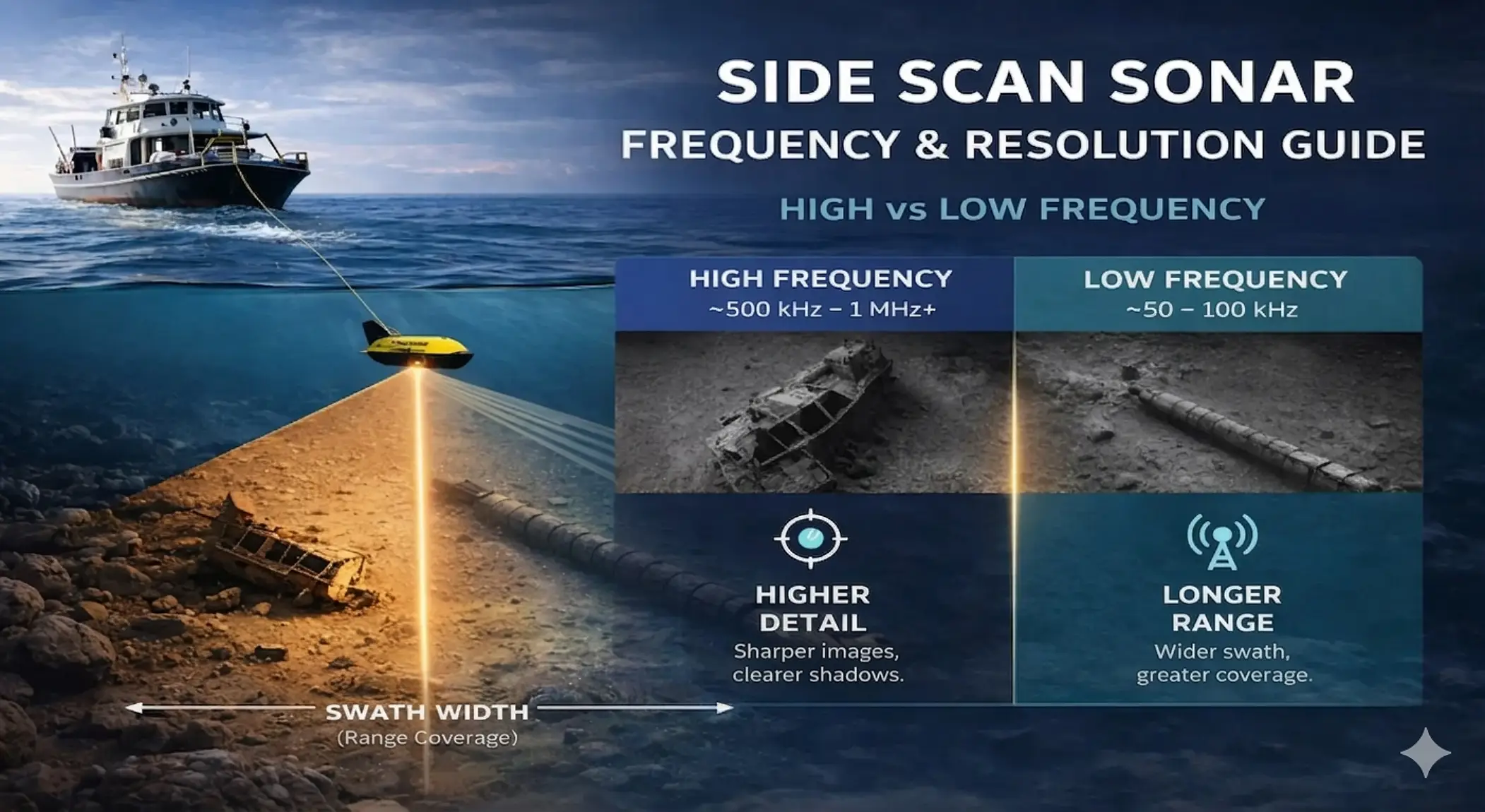
The best side scan sonar frequency depends on your survey objective. High frequency provides higher resolution for detecting smaller objects and producing clearer acoustic shadows, while low frequency provides longer range for covering larger areas more efficiently. In practice, the right choice depends on target detectability, coverage requirements, water depth, and tow stability.
Most teams ask the same question when specifying side scan sonar: “What frequency do we need?” The right answer depends on the smallest target you must detect, the coverage area, and the operating environment. Frequency directly influences both resolution and range, and this trade-off shapes everything from line planning to deliverable quality.
If you’re new to the technology, start with our guide on what side scan sonar is and how it works, then explore our range of side scan sonar systems for offshore and nearshore surveys.
Frequency and resolution: What changes in the real world
In practical terms:
- Higher frequency generally gives sharper images, especially for small objects.
- Lower frequency generally gives wider range, which can improve survey efficiency over larger areas.
However, the best results come from matching frequency to:
- Target size and hazard criticality
- Seabed type and complexity
- Depth and tow altitude constraints
- Expected swath coverage and line spacing
In broad industry terms, lower side scan sonar frequencies such as approximately 50–100 kHz are used when wide swath coverage is the priority, while higher frequencies from roughly 500 kHz to 1 MHz are used when image detail is more important than maximum range. Many commercial offshore systems sit between these extremes and are offered in dual-frequency combinations to balance coverage and resolution.
Typical Side Scan Sonar Frequency Ranges
Although exact settings vary by manufacturer and platform, side scan sonar is commonly grouped as follows:
- Low frequency: around 50–100 kHz, longer range, lower image resolution
- Medium frequency: around 100–500 kHz, balanced coverage and detail
- High frequency: around 500 kHz to 1 MHz or more, shorter range, higher resolution
This is why many offshore systems are supplied in paired frequencies rather than a single fixed mode. Published examples from EdgeTech include 100/400 kHz, 100/600 kHz, 300/600 kHz, 300/900 kHz, 400/900 kHz, and 600/1600 kHz, depending on the towfish and application.
What “High Frequency” is typically used for
High frequency side scan sonar is commonly selected when:
- you need detailed imagery and clear acoustic shadows
- you’re detecting smaller debris or hazards
- you’re working in relatively shallow water
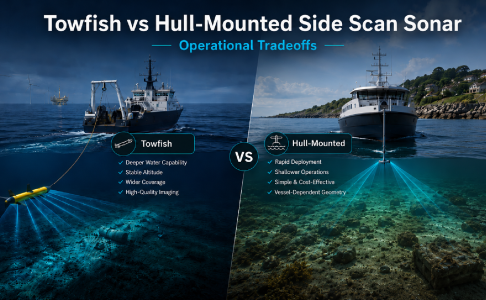
- you can tow at stable altitude and consistent speed
High frequency is often associated with inspection-oriented surveys where clarity matters more than maximum coverage.
Typical use cases include search and recovery, harbour inspection, detailed UXO investigations, and nearshore surveys where smaller targets must be resolved more clearly.
What “Low Frequency” is typically used for
Lower frequency side scan sonar is often selected when:
- you need longer ranges and efficient corridor coverage
- you’re surveying larger areas or longer routes
- conditions require stable performance at greater depths
- the target set is larger (or follow-up passes are planned for detail)
This is common in route surveys and broader geophysical scopes where efficiency and coverage are major drivers.
Low-frequency operation is often preferred during early-stage corridor surveys and wider-area seabed search where the goal is to screen a larger zone first, then revisit anomalies at higher resolution if needed.
Range vs Resolution: How to think about the Tradeoff
Instead of choosing frequency in isolation, decide which of these matters more:
- If your key requirement is detecting small targets, favor higher resolution setups, accept narrower swaths, and potentially more survey lines, prioritize stable tow altitude and controlled speed.
- If your key requirement is covering large corridors efficiently, favor longer range setups, accept lower fine-detail resolution, plan follow-up passes for anomalies that require detail.
This approach reduces the risk of re-running entire corridors because imaging didn’t meet target detectability requirements.
A simple rule of thumb is this: higher frequency improves image detail but reduces the width you can cover efficiently in a single pass, while lower frequency increases swath width but reduces the ability to resolve smaller seabed features.
High vs Low frequency comparison
| Factor | High Frequency | Low Frequency |
|---|---|---|
| Resolution | Higher | Lower |
| Range / swath | Shorter | Longer |
| Best for | Small objects, detailed inspection, clearer shadows | Large corridor coverage, reconnaissance, efficient screening |
| Typical survey style | Close, controlled, detail-focused | Broad, efficient, area-focused |
| Re-survey risk | More lines may be required | Follow-up detail passes may be required |
This table simplifies the decision, but in practice tow altitude, seabed conditions, and motion control still have a major effect on final image quality.
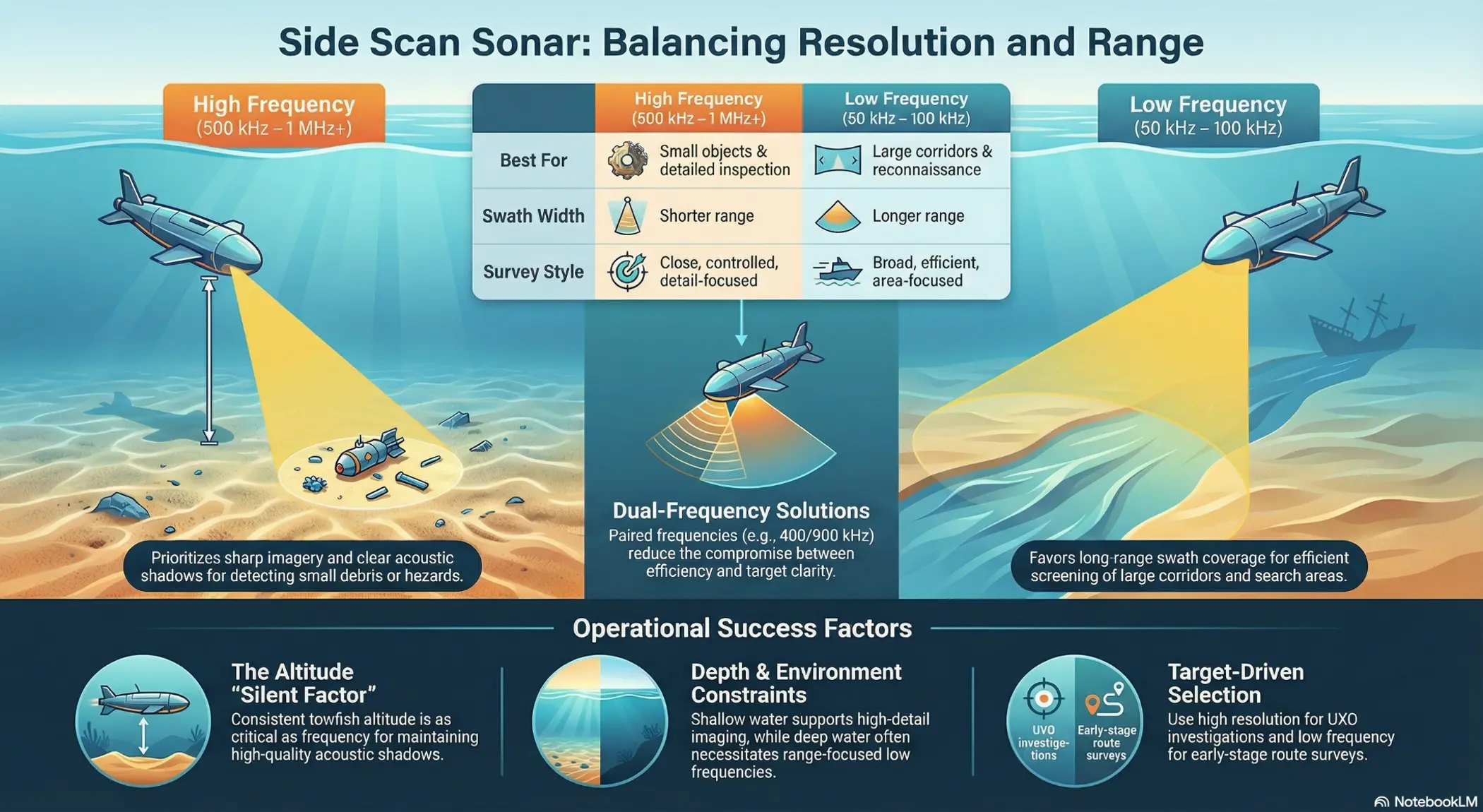
Altitude control: The Silent Factor that makes frequency “work”
Regardless of frequency, imaging quality is heavily influenced by tow altitude and stability:
- too high: weaker returns and reduced detail
- too low: risk of seabed interaction and inconsistent imagery
- inconsistent altitude: inconsistent shadows and interpretation risk
That’s why towfish configuration, handling practices, and line planning are as important as frequency selection.
This is especially important because side scan sonar interpretation relies not only on strong target returns, but also on the quality and consistency of the acoustic shadows behind those targets.
Shallow water vs deep water considerations
Shallow water
- often supports higher detail imaging and closer tow altitude
- but can introduce challenges like vessel motion and environmental noise
Deep water
- may push priorities toward range and stability
- deployment and tow handling become major operational considerations
Many “deep water side scan sonar” decisions come down to operational constraints as much as sensor selection.
Towfish depth rating and towing configuration also matter here. For example, published EdgeTech 4200 Series options include shallow-water and deep-water towfish variants, with frequency selection layered on top of the towfish choice rather than treated as a standalone decision.
Dual-frequency Side Scan Sonar: Why many Operators use both
Many modern systems are available in dual-frequency configurations. Explore dual-frequency side scan sonar system to see how different configurations support both coverage and high-resolution imaging.
This is one reason dual-frequency towfish are widely used in offshore survey work: they help reduce compromise between efficiency and target clarity.
Practical frequency selection checklist
Before specifying frequency, define:
- Smallest hazard or object size you must detect
- Corridor width and total area to be covered
- Depth range and current conditions
- Vessel type and tow stability
- Deliverables: mosaic quality, target list detail, reporting standards
Then choose frequency and range settings that satisfy the objective with minimal re-work risk.
It is also worth confirming whether the system will be used as a standalone side scan sonar or alongside multibeam echosounders, sub-bottom profilers, or other survey sensors, as this can change the frequency strategy and the role of follow-up passes.
Summary
Side scan sonar frequency selection is a tradeoff between resolution and range — but the best choice is always tied to the deliverable and operational reality. The right setup balances detectability, coverage efficiency, and stability offshore.
In most offshore survey projects, the best answer is not simply “high” or “low” frequency. It is the frequency strategy that best matches the survey objective, target size, tow stability, water depth, and required deliverables.
Explore our side scan sonar systems available for rental and purchase to find the right solution for your offshore survey requirements.
Side Scan Sonar Solutions from Unique Group
As a global supplier and distributor of side scan sonar systems, Unique Group supports offshore survey operations worldwide with both rental and purchase options. Whether you are looking to rent equipment for short-term projects or deploy systems for long-term operations, our solutions are available across key regions including the US, UK, Middle East, Asia, and Europe. Working with leading manufacturers such as EdgeTech, we provide reliable equipment, technical support, and project-ready solutions for survey, inspection, and subsea operations.