Selecting a fibre optic multiplexer is not complicated if you know what to look for, but the wrong choice creates real problems. An underpowered MUX limits sensor integration. A poorly matched unit creates integration headaches on deck. One that isn’t rated for your operational depth is unusable.
Most subsea MUX selection decisions come down to five questions: What signals do you need to carry? How many channels? What depth are you operating at? What platform is it going onto? And do you need to buy or rent?
This guide covers each of those factors directly, with the practical context needed to make a confident decision.
Key Takeaways
- A subsea fibre optic multiplexer enables multiple signals to be transmitted through a single fibre optic link, supporting efficient offshore operations
- The right MUX depends on bandwidth requirements, signal types, and system integration needs
- Fibre optic systems are preferred offshore for long-distance, high-bandwidth, and interference-free communication
- Scalability and compatibility with multi-sensor systems are critical when selecting a multiplexer
- Choosing the wrong system can lead to integration issues, performance limitations, and increased operational costs
1. Start With Your Signal Requirements
The most common mistake in MUX selection is focusing on channel count before confirming signal types. Different offshore systems generate fundamentally different types of signals, and not all multiplexers support the same mix. The signal interface directly determines the high-bandwidth subsea communication performance you can expect from a given unit.
The signals you need to carry will typically fall into some combination of:
- HD video: High-definition camera feeds from ROV-mounted or towed cameras. HD-SDI requires higher bandwidth per channel than standard video and must be explicitly confirmed as supported by the MUX.
- Standard video: SD cameras, including observation cameras and backup systems.
- Ethernet: Used by most modern survey equipment, navigation systems, and data acquisition platforms. Confirm Gigabit vs. Fast Ethernet port count and data rate per channel.
- Serial communication (RS-232/RS-485): Still widely used by older sonar systems, positioning transponders, and legacy sensors. If you are integrating any legacy equipment, serial support is essential. Some MUX systems offer software-switchable RS232/RS485 ports, which adds flexibility without increasing physical channel count.
- Control signals and TTL/PPS : Thruster commands, manipulator control, valve actuation, and time-synchronisation triggers for survey sensors.
- Telemetry:Status monitoring, diagnostics, and sensor health data.
Before specifying a MUX, list every device that needs to communicate through it and confirm the interface each one uses. This is the single most important step in the selection process.
2. Channel Count: Now and in the Future
Once you know your signal types, count the channels. A common error is specifying a MUX that exactly meets current requirements with no headroom.
Offshore systems tend to grow. A survey spread that starts with a multibeam, camera, and USBL often gains a sub-bottom profiler, a second camera, or a new positioning sensor within a few projects. A MUX with no available channels forces you to either swap out the unit or run a second system, neither is operationally convenient.
The practical approach: specify a unit with at least 20–30% more channels than your immediate requirement. If a project-specific rental is being configured for a single mobilisation, an exact match is acceptable.
3. Depth Rating
Every subsea MUX has a rated operating depth. This is a hard constraint, exceed it and the pressure housing will fail.
Check the depth rating of any unit against your project’s maximum operational depth, and allow margin where the actual target depth is close to the rated limit.
Key depth rating considerations:
- Standard survey and ROV operations to around 1,000 m may be served by compact aluminium-housed units
- Work-class operations typically require 3,000 MSW-rated housings — the most common rating for aluminium 6082-T6 pressure housings
- Deeper deployments to 5,000 MSW require titanium-housed systems
- Ultra-deepwater work may require titanium Grade 5 or duplex steel housings with corresponding connector and umbilical upgrades
For operations where depth requirements are uncertain at the time of mobilisation, select a unit rated conservatively deeper than the anticipated maximum.
4. ROV Class and Platform Compatibility
The platform the MUX is going onto determines how much physical size and weight can be accommodated, and what integration requirements apply.
Observation-class ROVs are compact, often electric, and weight-sensitive. These deployments benefit from smaller, lighter multiplexers, typically those supporting a limited number of Gigabit Ethernet and serial channels, with a compact physical footprint. Fewer sensors mean fewer channels are needed.
Light work-class ROVs typically carry a broader sensor payload. Multiplexer requirements increase: HD-SDI video, multiple Ethernet channels, serial ports, and control signals are all common.
Heavy work-class ROVs used in intervention, IRM, and deepwater survey carry the broadest sensor suites and generate the highest communication demand. These deployments require high-channel-count, high-bandwidth MUX systems with support for all signal types, Gigabit Ethernet, HD video, and robust connector standards.
Towed survey systems have different requirements again, weight is less critical but depth rating and long-term deployment reliability are more important.
Confirm not just that the MUX fits the ROV frame physically, but that the connector standards on the MUX are compatible with the ROV’s umbilical termination and topside control system.
Unique Group supplies fibre optic multiplexers compatible across all ROV classes, from inspection-class through to heavy work-class platforms.
5. Integration With Your Existing System
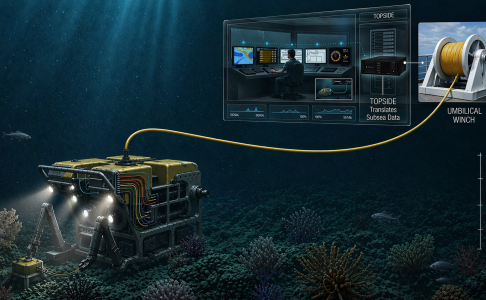
A fibre optic multiplexer does not operate in isolation. It interfaces with the ROV control system, the umbilical, the topside rack, and every sensor connected to it.
Before specifying a unit, confirm:
Umbilical fibre type: Single-mode fibre is standard in most offshore umbilicals and is required for long-distance transmission. Confirm the MUX supports the fibre type in your umbilical. Mixing single-mode and multi-mode components causes signal loss.
Connector compatibility: Subsea wet-mate and dry-mate connector standards vary. Confirm the MUX bulkhead connectors are compatible with your ROV frame’s existing wiring and your preferred wet-mate connector system.
Topside rack integration: The topside unit must fit the available rack space and interface with your surface control and acquisition systems. Most modern MUX systems offer a web-based GUI accessible from the topside unit, with status displayed for all channels. Confirm this matches your operational workflow.
If you are specifying a MUX for a vessel or contractor spread that uses a standardised system, confirm compatibility with the existing topside infrastructure before mobilisation — not on the back deck.
6. Purchase vs. Rental
The right commercial model depends on your operational profile.
Rental makes sense when:
- The project is a single mobilisation or short-term campaign
- MUX requirements differ between projects (e.g. sensor payloads change)
- You want to access specific systems without capital outlay
- Maintenance and calibration are covered by the rental provider
Purchase makes sense when:
- You have consistent, ongoing operational requirements
- You run a permanent survey spread or own your own ROV system
- The unit will be mobilised repeatedly across multiple projects
- Total cost of ownership over a multi-year period is more favourable than recurring rental costs
Unique Group supplies fibre optic multiplexers for both sale and rental worldwide. Speak with our survey specialists to discuss which model fits your operational schedule.
Matching MUX to Application
Selecting the right subsea fibre optic multiplexer depends on the specific operational requirements of each offshore and subsea application.
| Application | Channel priority | Depth consideration | Key signal types | Typical unit type |
|---|---|---|---|---|
| Observation-class ROV | Low–medium | Shallow–medium | Ethernet, serial, SD video | Compact, lightweight |
| Light work-class ROV | Medium | Medium–deep | Ethernet, serial, HD video | Mid-range |
| Heavy work-class ROV / IRM | High | Deep | HD video, multi-Ethernet, serial, control | High-channel, high-bandwidth |
| Towed survey system | Medium | Variable | Ethernet, serial, multi-sensor | Depth-rated, reliable |
| Deepwater survey | High | Deep–ultra-deep | HD video, multi-Ethernet, serial | High-depth-rated |
Common Mistakes to Avoid
Specifying only current channel requirements. Leave headroom for sensor additions. A spread that exactly fills the MUX today is a problem waiting to happen.
Not confirming signal type support before mobilisation: Ethernet and serial requirements are often discovered late. Confirm the channel mix before the unit leaves the warehouse.
Ignoring fibre type in the umbilical: Single-mode and multi-mode fibres are not interchangeable. Check the umbilical spec before pairing with a MUX.
Selecting a unit based on price alone: A cheaper MUX that cannot support HD-SDI video or lacks the required Ethernet port count creates operational problems that cost more to resolve than the price difference.
Under-specifying depth rating: If there is any chance the unit will be deployed deeper than its rating, specify the next tier up. There is no fix for a flooded pressure housing on the back deck.
Fibre Optic Multiplexers Available from Unique Group
Unique Group supplies a range of fibre optic multiplexers for sale and rental worldwide, covering observation-class through to work-class and deepwater survey operations.
- Uni-MUX DeepLink6 — Unique Group’s own-engineered subsea MUX for high-bandwidth, multi-signal ROV and survey operations.
- Innova Matrix MK II+ — A standalone MUX and control solution for work-class ROV, IRM, and deepwater survey operations, available in aluminium and titanium housings.
- Innova Micro Matrix — A compact multiplexer suited to small ROVs and space-constrained deployments, with support for dual-head multibeam systems.
| Specification | Uni-MUX DeepLink6 | Innova Matrix MK II+ | Innova Micro Matrix |
|---|---|---|---|
| Max depth | 3,000 m | 3,000 MSW (aluminium) / 5,000 MSW (titanium) | 3,000 MSW |
| Gigabit Ethernet | 2× (1,000 Mbps) | 2× | 3× |
| Fast Ethernet | 4× (10/100 Mbps) | 3× (100 Mbps) | — |
| Serial (RS232) | 8× | 9× | 2× |
| Serial (RS232/RS485) | 4× software-selectable | 4× software-switchable | 1× software-switchable |
| HD video | 3× HD-SDI | 3× HD-SDI | — |
| PPS/triggers | 2× TTL/PPS | 2× TTL | 3× independent |
| Power output | 1,200 W | 1,200 W | 525 W |
| Topside | 7″ touchscreen, web GUI, Wi-Fi | 7″ Linux touchscreen, 19″ 3U rack | 19″ 2U rack |
| Best for | ROV & survey, high-bandwidth, multi-signal | Work-class ROV, IRM, deepwater survey | Small ROVs, compact/space-constrained platforms |
| Sale & rental | Worldwide | Contact us for availability | Contact us for availability |
Speak with our survey specialists to discuss your project requirements.
Conclusion
Choosing a fibre optic multiplexer for subsea operations is a practical decision based on signal requirements, channel count, depth, platform compatibility, and whether sale or rental fits the project. Answering those questions systematically eliminates most of the risk in the specification process.
If your project requirements fall outside standard options, custom channel configurations, integration with a specific ROV platform, or tight mobilisation timelines, speak with our survey specialists to confirm the right solution.
Frequently Asked Questions
What is the most important factor when choosing a subsea fibre optic multiplexer?
Signal type compatibility. Confirm that every interface your sensors and systems require — Ethernet, serial, HD video, control — is explicitly supported by the unit before specifying it.
Can I use any fibre optic multiplexer with my existing ROV umbilical?
Not necessarily. The MUX must be compatible with the fibre type in your umbilical (single-mode is most common), and the subsea connector standard must match your ROV’s termination system. Confirm both before mobilisation.
What depth ratings are available for subsea fibre optic multiplexers?
Ratings vary by product and housing material. Common ratings include 1,000 m, 3,000 m, and 6,000 m. Ultra-deepwater options with titanium or duplex steel housings are available for demanding deployments.
Should I rent or buy a fibre optic multiplexer?
Rental suits short-term, project-specific deployments where requirements vary. Purchase is more cost-effective for permanent survey spreads and regularly mobilised ROV systems. Both options are available from Unique Group.
A well-selected multiplexer not only improves performance but also simplifies subsea system architecture and enables seamless integration across multiple offshore systems.