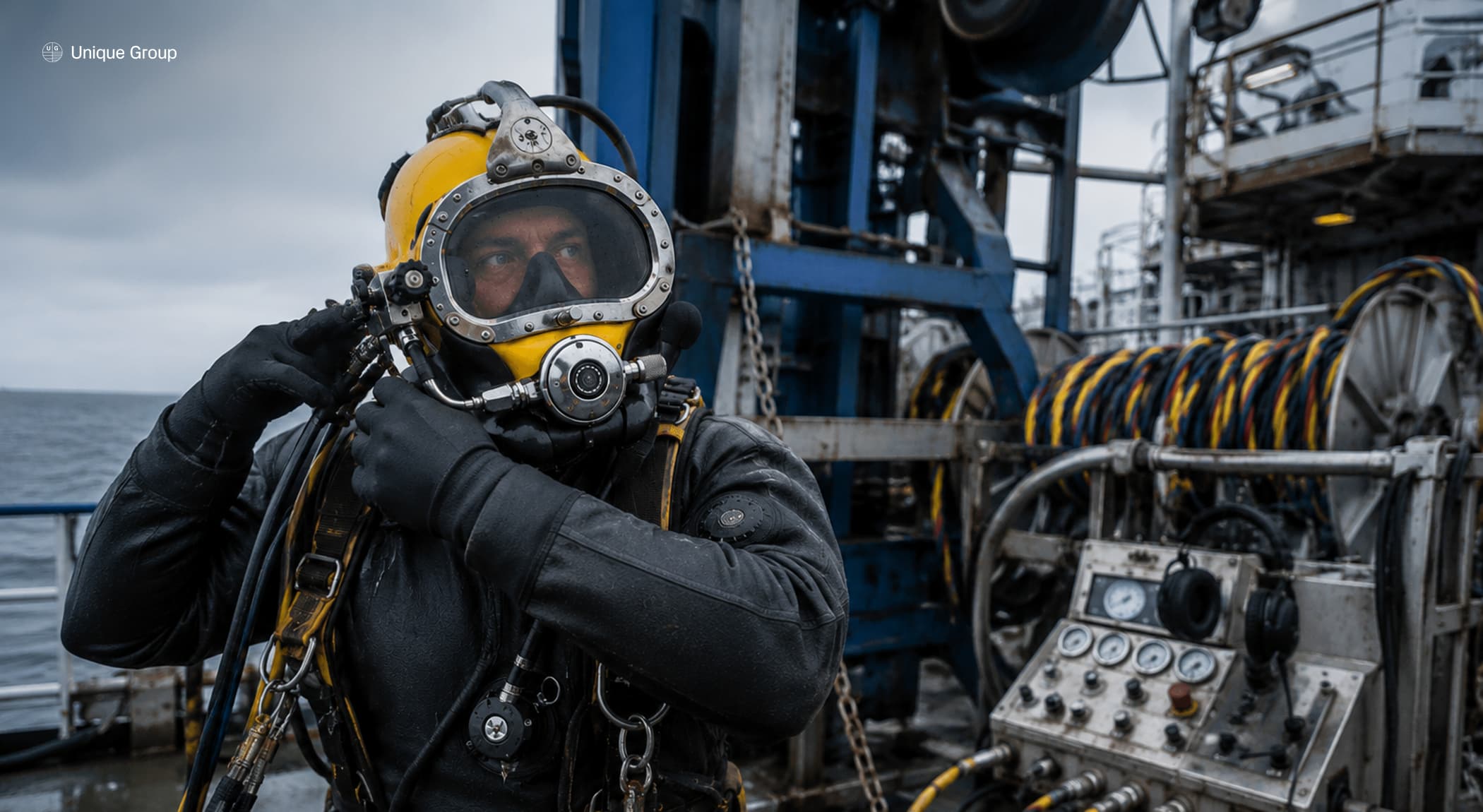
Communication between a diver and the surface is not a convenience. It is a fundamental safety requirement of commercial diving operations.
A diver who cannot communicate with their diving supervisor cannot report a change in conditions, request assistance, signal distress, or receive guidance during a developing emergency. Every commercial diving code of practice, from the UK Diving at Work Regulations 1997 to IMCA D 014, mandates effective two-way communication between diver and supervisor throughout every dive.
Despite its importance, diver communications is a technically challenging field. Sound propagates poorly through water compared to air. The acoustic environment in an active offshore location is filled with machinery noise, propeller wash, and structural vibration, and the diver’s breathing equipment (particularly in deep mixed-gas diving) introduces additional noise.
This guide examines the principal communication technologies, their performance characteristics, and best practices for equipment selection and maintenance in offshore diving programmes.
Key Takeaways
- Hardwire (through-umbilical) communication is the mandatory primary channel in surface supply diving. Through-water acoustic systems and hand signals serve as backup.
- IMCA D 014 requires supervisors to maintain direct communication with any diver in the water at all times, and requires communication records to be retained.
- Saturation diving requires helium speech unscramblers to correct the pitch distortion caused by breathing heliox under pressure.
- Communication equipment must be tested for two-way intelligibility before every dive, with backup methods verified alongside the primary system.
- Equipment selection should match the diving mode and helmet type, not just the budget — dual-channel capability and connector durability are common points of failure.
Hardwire (Through-Umbilical) Communication Systems
The most reliable and widely used communication method in surface supply diving is hardwire communication via the diver’s umbilical.
The umbilical, which carries the diver’s breathing gas, hot water, and video signal, also contains a dedicated communication cable pair. The diver’s helmet is fitted with a microphone and earphone or speaker connected to this cable, and the surface supervisor monitors and speaks via a control panel topside.
Hardwire communication is inherently reliable. It does not depend on acoustic propagation through water, is unaffected by background noise from vessel thrusters or machinery (beyond what the microphone picks up inside the helmet), and provides a dedicated two-way channel that is continuously monitored.
Signal degradation is rare and easily diagnosed. For this reason, hardwire remains the required primary communication method in all surface supply commercial diving operations.
Through-Water (Acoustic) Communication Systems
Through-water communication systems transmit voice signals as acoustic waves through the water column without a physical wire connection.
They are used as a secondary or backup communication channel in surface supply diving, and as the primary method in some specialist operations, such as free-swimming scientific diving, search and rescue, and military diving, where an umbilical is not practicable.
Acoustic through-water systems use an underwater transducer suspended from the vessel or mounted on a deployed frame, paired with a transducer in or adjacent to the diver’s helmet.
Communication quality is affected by water depth, thermal layers, ambient noise, the diver’s orientation relative to the transducer, and multipath reflections from vessel hulls and the seabed. In noisy offshore environments with vessel thrusters and dynamic positioning running, acoustic communication quality can be significantly degraded, which is why hardwire remains the mandatory primary channel.
Hand Signals and Line Signals as Manual Backup
Where both hardwire and through-water communication fail, standard hand signals and line-pull signals remain the diving industry’s manual fallback.
These signals are limited to a small set of pre-agreed messages (such as “OK,” “coming up,” or “in trouble”) and cannot convey detailed instructions. They are not a substitute for electronic communication, but every commercial dive team is trained in them as a last-resort method when equipment fails underwater.
Selecting Diver Communication Equipment
Equipment selection should match the diving mode, not just the budget. For surface supply air and mixed-gas diving, a hardwire panel with helmet-integrated microphone and speaker is the baseline requirement, with a through-water system carried as backup.
Panels used on multi-diver spreads should offer dual-channel capability, so the supervisor can communicate with each diver on a separate, clearly separated channel without cross-talk or interference.
Communication units must be compatible with the specific diving helmet or full-face mask in use, and rated for the saltwater exposure, vibration, and impact conditions of an offshore worksite.
Unique Group supplies and supports diver communication equipment from established manufacturers, including partner brands such as Amron, alongside its own range of surface diving and saturation diving systems.
Saturation Diving Communications
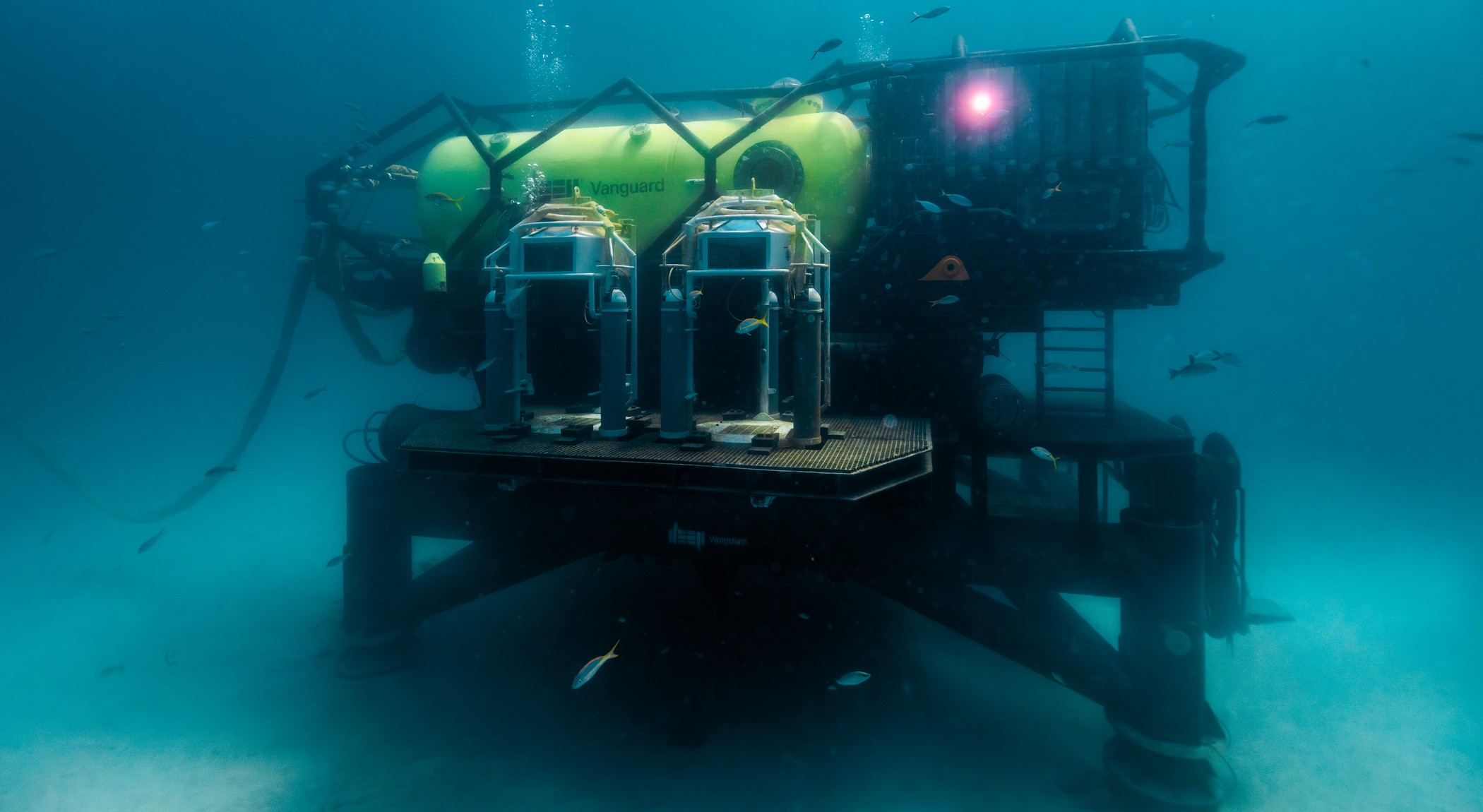
In saturation diving, the communication infrastructure is more complex. Divers live and work under pressure in a habitat (living chamber) that may be on the vessel deck or in a submersible pressure vessel.
Communication channels are required between:
- The saturation control room and the living chamber
- The control room and the diving bell during bell runs
- Inside the bell, between divers
- Surface support team, bell, and habitat, linked as a three-way intercom arrangement
Saturation systems use helium-oxygen mixtures (heliox) at operational depth. The high helium content causes the “Donald Duck” voice distortion effect: acoustic pitch-shifting that makes normal speech unintelligible.
Helium speech unscramblers (descramblers) are mandatory in saturation communication panels. They process the incoming diver voice signal and restore intelligible speech for the supervisor. Both analogue and digital descrambler technologies are in current use, with digital systems generally offering better performance.
Diver-to-Diver Communication
In buddy-pair diving, direct communication between divers is often as important as communication with the surface.
In surface supply diving, diver-to-diver communication is typically achieved through the umbilical-hardwire system, by routing both divers’ audio through the surface control panel, which the supervisor monitors. Some systems provide a direct diver-to-diver channel that bypasses the supervisor position, though in commercial diving the supervisor must be able to monitor all communications.
Through-water diver-to-diver systems are also available, typically using short-range acoustic transducers integrated into or attached to the diving helmet. These are valuable for situations where two divers must coordinate closely without time delay through the surface panel, for example during complex rigging or tool handling tasks where simultaneous voice and tactile coordination is required.
Helmet Integration and Noise Management
The performance of any communication system is ultimately determined by the interface at the diver’s helmet.
Microphone placement, typically inside the helmet face seal area, must minimise breathing gas turbulence noise while capturing the diver’s voice clearly. Pneumatic demand valves used in air and mixed-gas diving generate intermittent noise spikes that can mask speech. Some helmet designs use noise-cancelling microphones to reduce this effect.
Speaker or earphone placement inside the helmet affects both comfort and audio intelligibility. Helmet-mounted speakers are standard in most commercial diving helmets, while custom-moulded earphones provide better isolation from ambient noise in high-noise environments.
All helmet microphones and speakers must be compatible with the umbilical cable impedance and the surface control panel input specifications. Impedance mismatches cause distortion and reduced range.
Maintenance and Testing Requirements
Communication equipment must be tested before every dive as part of the pre-dive checks required by commercial diving regulations. Testing should confirm two-way intelligibility, not just that signal is present, with the diver in the water before departing the surface. Backup communication methods (through-water acoustic, backup umbilical wire pair, or pull-cord signals) should also be verified.
Many surface control panels include dedicated audio recording outputs, allowing the full communication record to be logged. IMCA D 014 requires that these records be retained until any incident investigation is complete, so recording capability is a genuine equipment selection consideration, not just a convenience feature.
Maintenance of communication equipment requires regular inspection of umbilical cable condition, connector integrity (both in-water and deck connectors), microphone and earphone capsule condition, and control panel function.
Salt water ingress at connectors is the most common failure mode. Silicone-greased and correctly torqued wet-mateable connectors are essential for reliable operation. Spare communication panels and pre-tested replacement umbilical assemblies should be available on board for rapid substitution if a component fails.
Conclusion
Diver communication systems are life-safety equipment. Their selection, installation, maintenance, and testing must be treated with the same rigour applied to breathing gas supply and emergency equipment.
Whether for surface supply air diving, deep mixed-gas operations, or saturation diving systems, investing in well-maintained communications hardware and training dive teams in its operation is a non-negotiable element of a safe diving management system.
Speak with our diving specialists to discuss your project requirements.
Frequently Asked Questions
Is through-water communication acceptable as the primary diver communication method?
In most commercial diving regulatory frameworks, through-water acoustic communication is not acceptable as the sole primary communication method for surface supply diving. Hardwire through-umbilical communication is mandatory as the primary channel. Through-water systems serve as backup or secondary communications. Check the applicable national regulations and IMCA guidance for the jurisdiction in which the diving is being conducted.
What causes voice distortion in saturation diving?
Saturation divers breathe heliox (helium-oxygen) at elevated pressures. Helium is much less dense than nitrogen and changes the resonant frequency of the vocal tract, raising the pitch of the diver’s voice to an unintelligible squeak. Helium speech unscramblers process the incoming audio signal to shift the frequencies back to the normal range, restoring intelligible speech. The quality of the descrambler significantly affects communication clarity at depth.
What happens if both hardwire and through-water communication fail underwater?
Dive teams fall back on pre-agreed hand signals and line-pull signals. These convey only a limited set of standard messages and are not a substitute for voice communication, which is why redundant electronic systems and pre-dive testing of backup channels are required rather than optional.