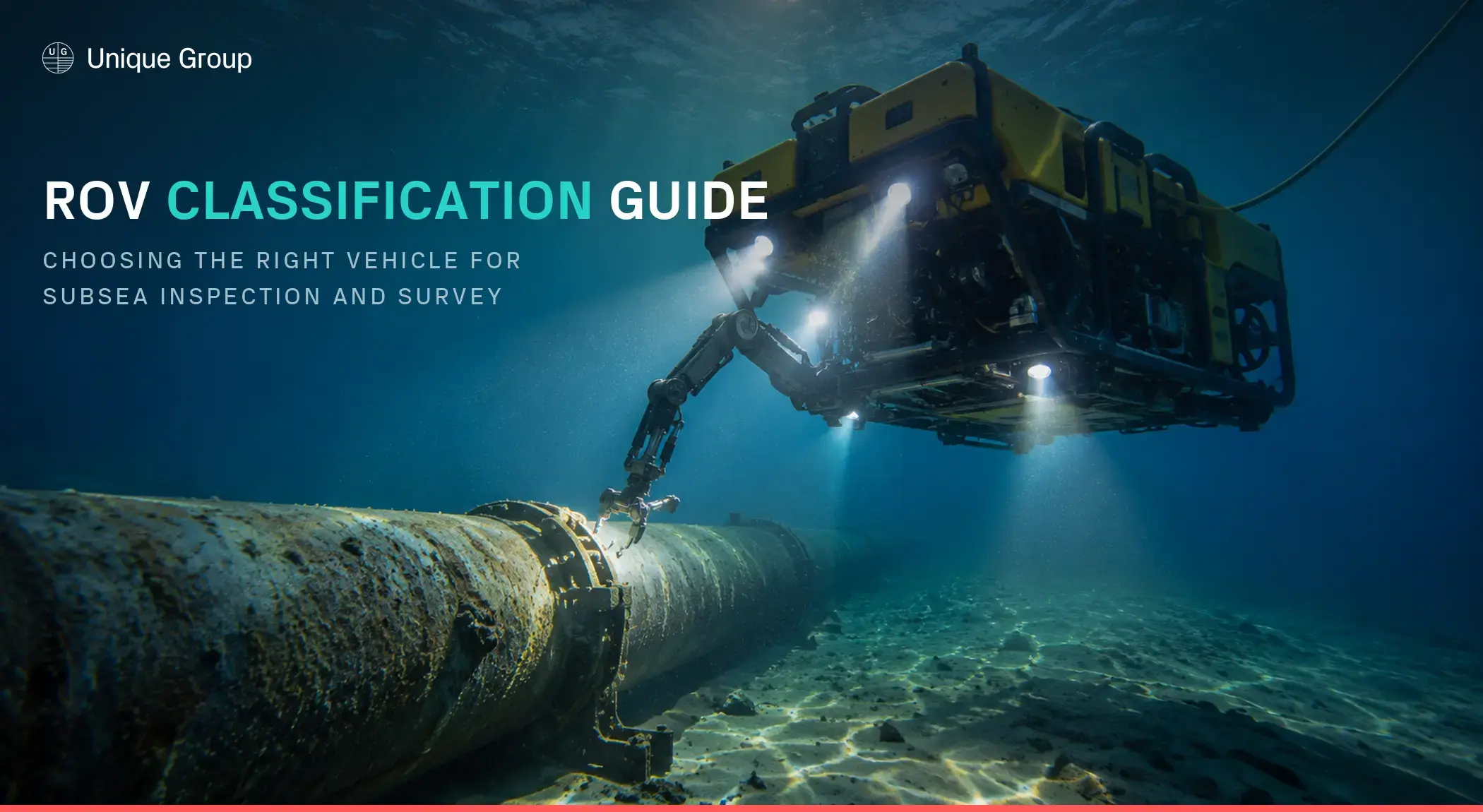
Remotely operated vehicles (ROVs) are the workhorse of offshore subsea inspection, survey, and light intervention. From a Class I observation ROV weighing a few kilograms to a 3,000-metre-rated work-class vehicle weighing several tonnes, the range of ROV systems available today covers almost every subsea inspection and survey application.
Selecting the right ROV class, sensor payload, and deployment configuration is a decision that shapes operational efficiency, data quality, and project cost.
This guide sets out the ROV classes most relevant to inspection and survey work, the sensor systems most commonly used, and the key considerations for project managers and survey engineers when specifying ROV operations.
ROV Classification
The International Marine Contractors Association (IMCA) classifies ROVs into several categories, widely adopted by operators, classification societies, and flag state regulators. The classes below are the ones most relevant to inspection and survey applications:
Class I: Observation ROVs
Class I ROVs are small, pure-observation vehicles designed primarily for visual inspection. They carry video cameras and lighting but have limited or no payload capacity for additional sensors or tooling. Class I systems are widely used for pre-dive surveys, hull inspections in sheltered waters, and rapid visual assessments where instrument data is not required. Their low cost and ease of deployment from small vessels make them attractive for routine inspection tasks.
Class IIA: Observation ROVs with Payload Capability
Class IIA systems provide camera and lighting capability with some additional sensor payload — typically sonar, USBL (ultra-short baseline) positioning, or basic NDT (non-destructive testing) sensors, without manipulator or intervention tooling. This class is commonly used for cable and pipeline inspection, subsea structure surveys, and pre-installation route clearance.
Class IIB: Observation ROVs with Light Intervention
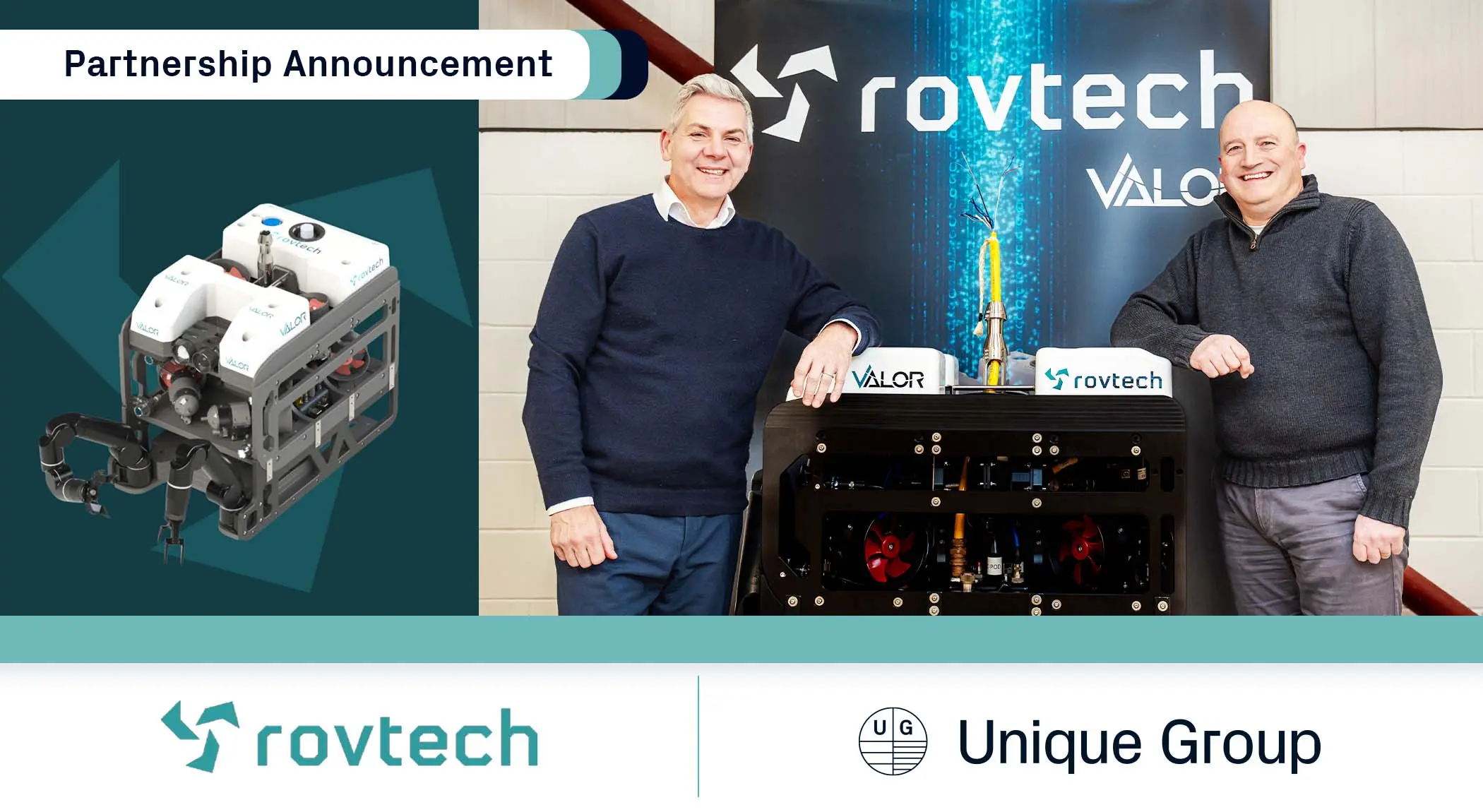
Class IIB vehicles add manipulator or tooling capability to the Class IIA sensor payload, enabling minor intervention tasks alongside survey work. The Saab Seaeye Falcon is a widely deployed example of this class — a 300m-rated observation platform with optional manipulator tooling for light intervention. Purpose-built intervention vehicles such as the ROVTech Valor and portable systems like the Deep Trekker Pivot with its optional grabber arm also fall into this class.
Class III: Work-Class ROVs
Work-class ROVs are large, heavily powered vehicles capable of carrying substantial tooling and sensor payloads, operating at depths to 3,000 m or beyond, and performing intervention tasks such as valve actuation, hot stab operations, and subsea equipment maintenance. They are deployed from purpose-built ROV support vessels with Launch and Recovery Systems (LARS) rated for the vehicle weight and the deepest planned operating depth. Work-class ROVs are typically the platform of choice for deepwater pipeline inspection, umbilical repair, and tree intervention.
Unique Group’s own commercial ROV systems span Class I through IIB. A multi-brand fleet including Deep Trekker, Boxfish, Saab Seaeye and ROVTech, available for rental or purchase.
Here’s a summary table for the ROV Classification section — works well right after the four class descriptions, or as a quick-reference instead of them:
| Class | Capability | Sensor Payload | Tooling | Typical Use | Unique Group Example |
|---|---|---|---|---|---|
| Class I | Pure observation | Camera + lighting only | None (as standard) | Pre-dive surveys, hull inspection, rapid visual assessment | Boxfish Luna, Deep Trekker Photon |
| Class IIA | Observation + payload | Sonar, USBL, basic NDT | None (as standard; tooling optional) | Cable/pipeline inspection, subsea structure surveys, route clearance | Deep Trekker DTG3, Deep Trekker Revolution |
| Class IIB | Observation + light intervention | Sonar, USBL, basic NDT | Manipulator/tooling (standard or configured) | Minor intervention alongside survey work | Saab Seaeye Falcon, ROVTech Valor, Deep Trekker Pivot, Boxfish Alpha |
| Class III | Work-class | Substantial tooling + sensor payloads | Full intervention (valve actuation, hot stab) | Deepwater pipeline inspection, umbilical repair, tree intervention | — |
Key Sensor Systems for Subsea Inspection and Survey
Multibeam Echosounders for ROV Integration
Compact multibeam echosounders designed for ROV integration provide high-resolution bathymetric and backscatter data along the vehicle’s flight path. ROV-mounted MBES systems are used for pipeline free-span detection, scour monitoring, anode surveys, and seabed characterisation around subsea structures. Unique Group stocks and rents MBES systems configured for ROV integration; details are available at https://www.uniquegroup.com/product-category/survey-equipment/rov-equipment/multibeam-echosounders/.
Imaging and Profiling Sonars
Multibeam imaging sonars — such as the Kongsberg M3, Blueprint Oculus, and Coda Octopus Echoscope ranges — provide real-time acoustic video images of subsea structures, allowing inspectors to identify corrosion, biofouling, damage, and cathodic protection (CP) system status in zero-visibility conditions. Profiling sonars measure cross-sectional profiles of pipelines, trenches, and foundations, supporting burial depth assessment and structural integrity management.
Cathodic Protection (CP) Survey Equipment
Monitoring the sacrificial anode systems that protect subsea steel structures from corrosion requires specialist CP survey equipment: contact probes that measure the potential difference between the structure and the seawater, and proximity electrodes for non-contact potential measurements. CP survey data is routinely collected during ROV-based inspection campaigns on pipelines, jackets, and subsea production systems.
Non-Destructive Testing (NDT) Tools
Advanced inspection ROVs can carry a range of NDT tools for assessing the condition of steel structures and welds: magnetic flux leakage (MFL) systems for detecting internal corrosion and metal loss in pipelines, ultrasonic testing (UT) arrays for weld and wall thickness measurement, and eddy current tools for surface crack detection. Deploying NDT tools via ROV rather than by a diver significantly reduces personnel risk, particularly in deepwater or high-current environments.
USBL and DVL Positioning
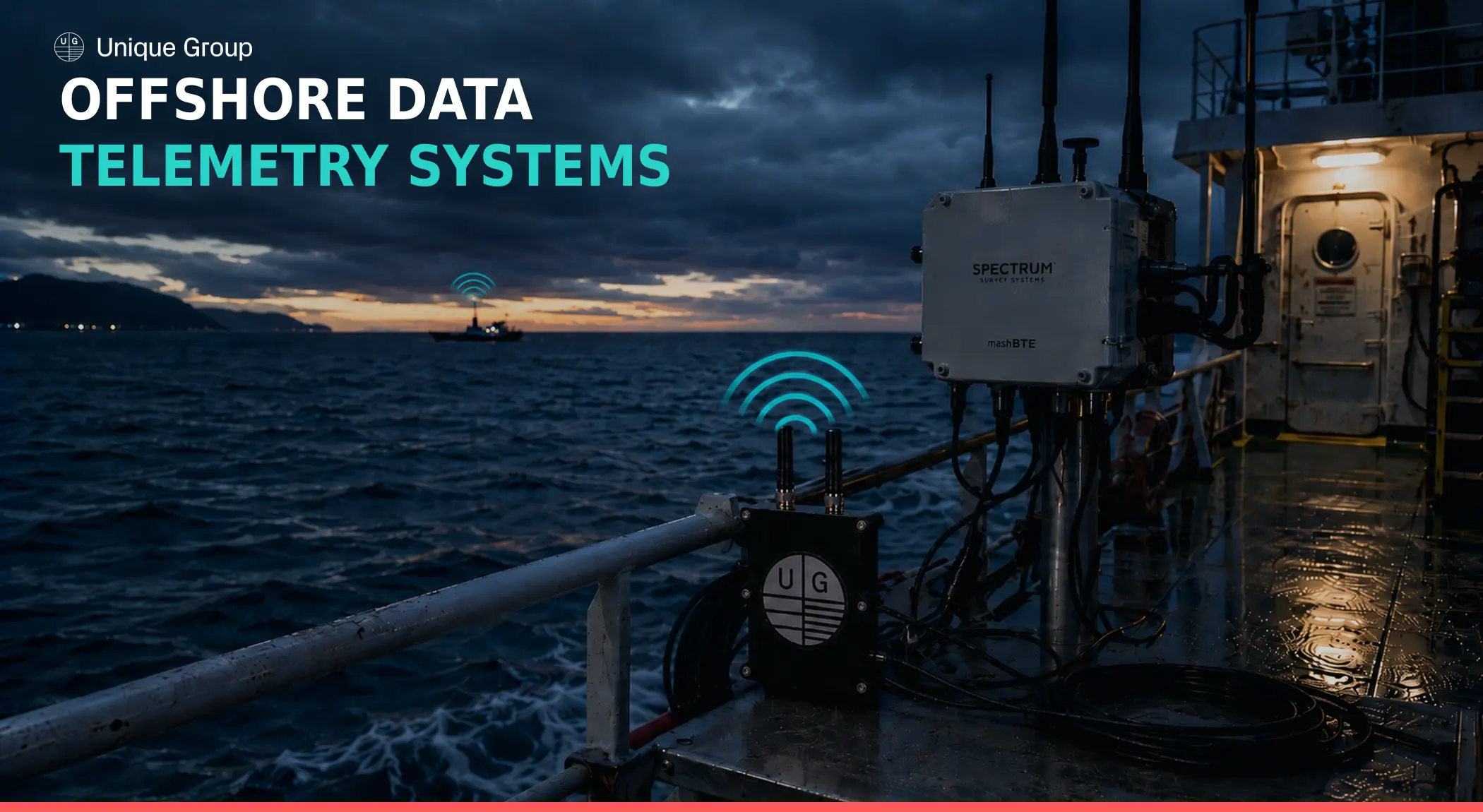
Accurate positioning of the ROV and its sensor data is essential for inspection reporting and asset management. Ultra-short baseline (USBL) acoustic positioning systems track the ROV’s position relative to a transceiver head mounted on the vessel hull, while Doppler velocity logs (DVLs) provide precise dead-reckoning navigation close to the seabed. Combined with the vessel’s DGPS position, USBL and DVL data allow inspection findings to be georeferenced to the relevant pipeline kilometre point (KP) or structure node. This positioning data is typically relayed to the surface alongside video and sensor feeds through the vessel’s data telemetry system.
Planning an ROV Inspection Campaign
Defining the Inspection Scope
Before selecting an ROV class and sensor payload, the inspection engineer must define the scope: the type of structure or pipeline to be inspected, the depth range, the data deliverables required (visual only, bathymetric, NDT, CP), and the environmental conditions anticipated during the campaign. This scope definition drives every subsequent specification decision.
Vessel and LARS Requirements
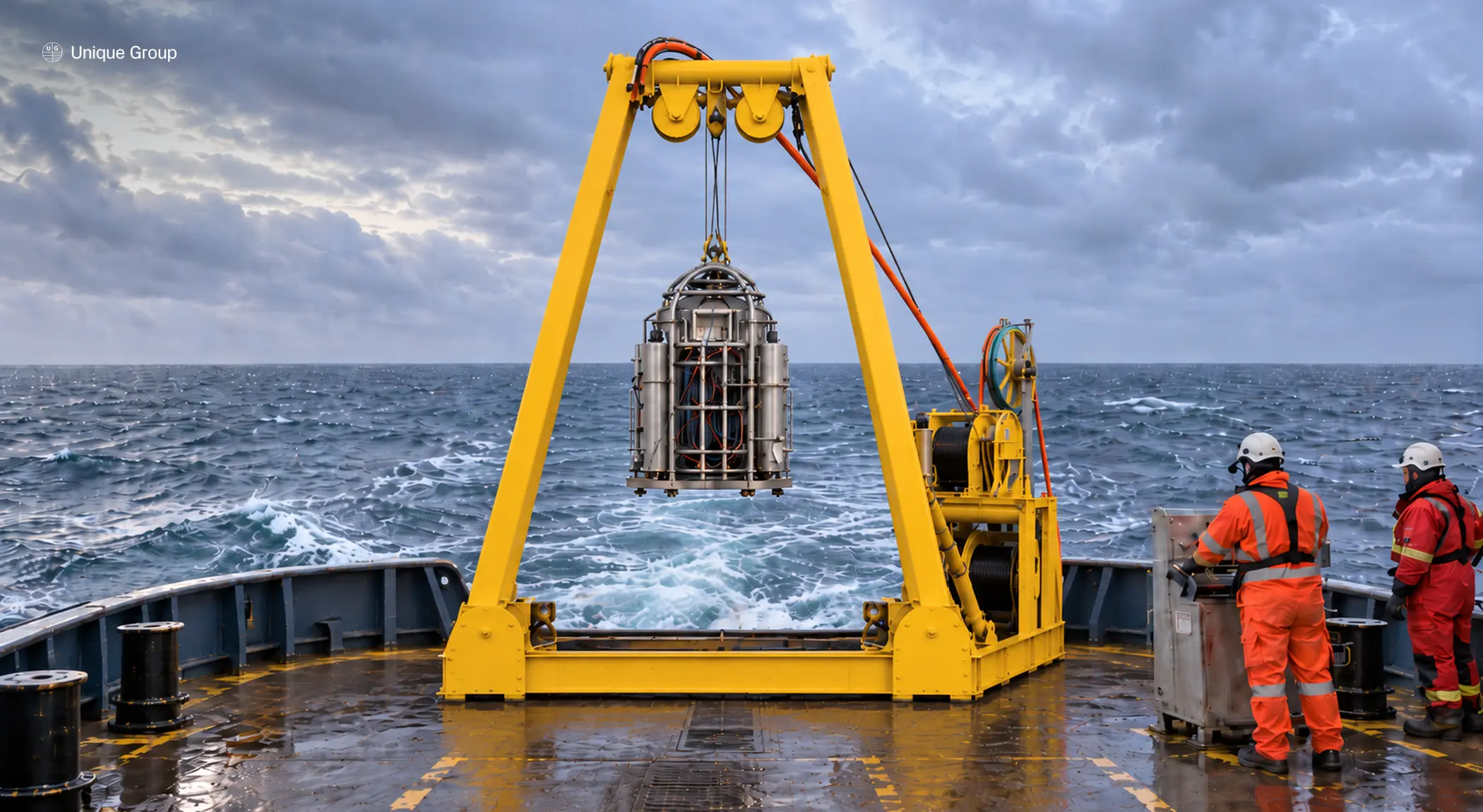
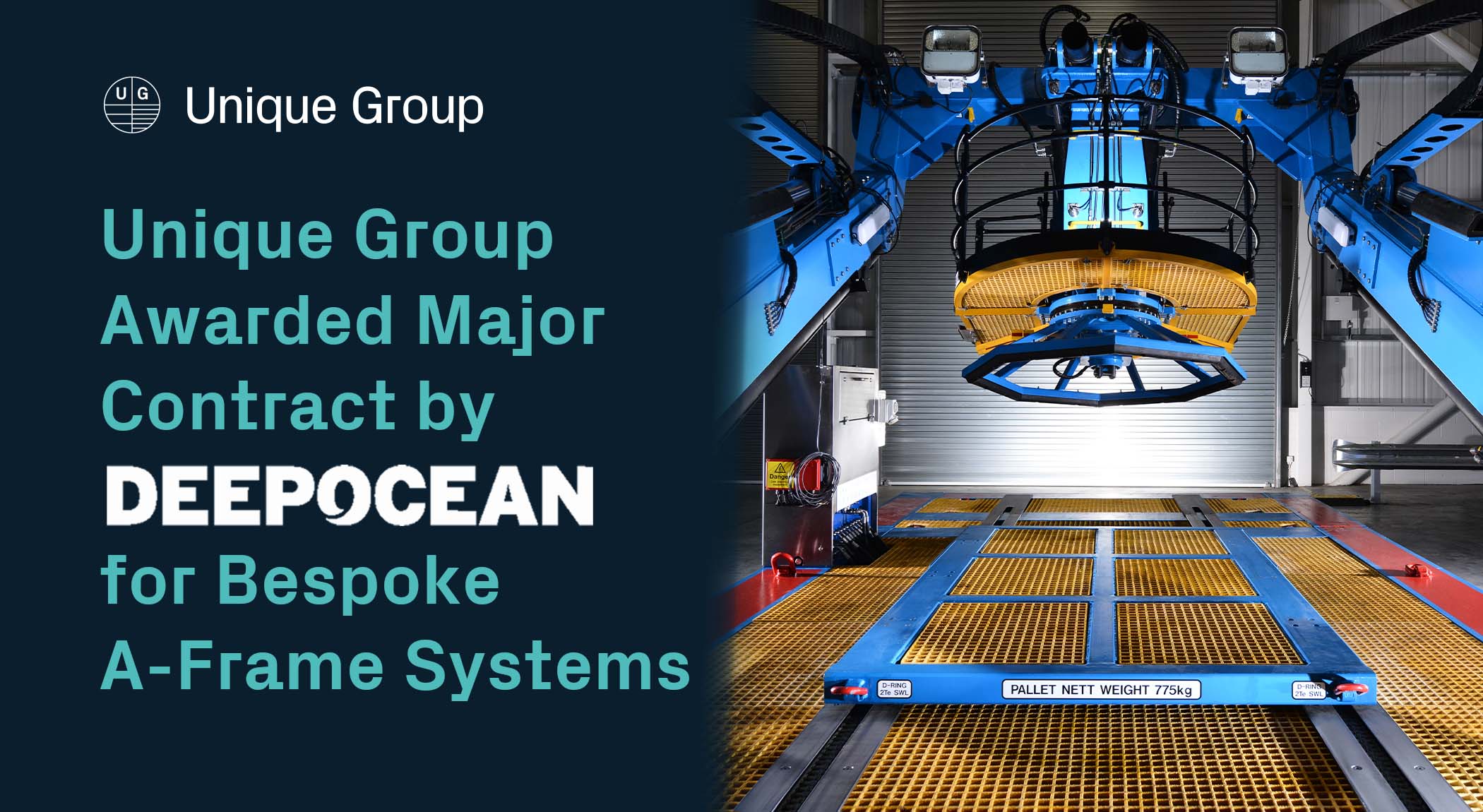
The selected ROV class determines the required vessel capabilities. Class I and II ROVs can be deployed from small workboats or over the side of a support vessel with basic crane handling. Work-class ROVs require a purpose-fitted LARS — typically a large A-frame or dedicated ROV handling system — with dynamic positioning capability on the vessel. Vessel selection should account for the maximum expected sea state and current conditions at the survey location.
Data Management and Reporting
ROV inspection campaigns generate large volumes of data: video footage, sonar data, CP measurements, NDT records, and positional data. A data management plan should be established before mobilisation, defining file formats, naming conventions, backup procedures, and reporting templates. Many operators now require inspection data to be integrated into digital twin or pipeline integrity management systems, which imposes specific requirements on data formatting and georeferencing precision.
Conclusion
Unique Group provides a comprehensive range of ROV-compatible survey equipment for sale and rental. Explore the full ROV equipment range, including multibeam echosounders for ROV integration. Full survey equipment capabilities are summarised on the survey equipment solutions page
Frequently Asked Questions
What is the difference between an observation ROV and a work-class ROV?
An observation ROV is designed primarily for visual inspection, carrying cameras and lighting with a limited sensor payload. A work-class ROV is a large, highly capable vehicle that can carry heavy tooling, perform subsea intervention tasks, and operate at depths exceeding 3,000 m. Work-class ROVs require dedicated LARS and are usually deployed from large offshore support vessels with dynamic positioning.
What sensors are used for pipeline inspection by ROV?
Pipeline inspection typically employs visual cameras, MBES for bathymetric profiling, imaging sonar for zero-visibility assessment, and CP contact probes. For detailed integrity assessment, UT or MFL tools measure wall thickness and detect corrosion. Sensor selection depends on the inspection standard being followed (e.g., DNVGL-RP-F116, PIMS requirements) and the pipeline owner’s integrity management philosophy.
Can ROVs replace divers for all subsea inspection tasks?
ROVs can perform most routine visual and instrument-based inspection tasks without divers. Some tasks still require diver intervention, particularly those needing fine manual dexterity, complex tooling operations, or work in confined spaces. As a practical rule, ROVs are preferred in deepwater (below air diving limits), in high-risk environments, and where physical intervention is not required. Divers are generally preferred for close-up NDT, complex intervention, and tasks requiring real-time adaptive decision-making.