A hydraulic power pack drives the winches, spoolers and launch and recovery systems (LARS) that make up a deck package. Also called a hydraulic power unit, it supplies pressurised oil to the motors and cylinders on that equipment. Getting the size wrong affects everything downstream, from line speed to deck space to running cost.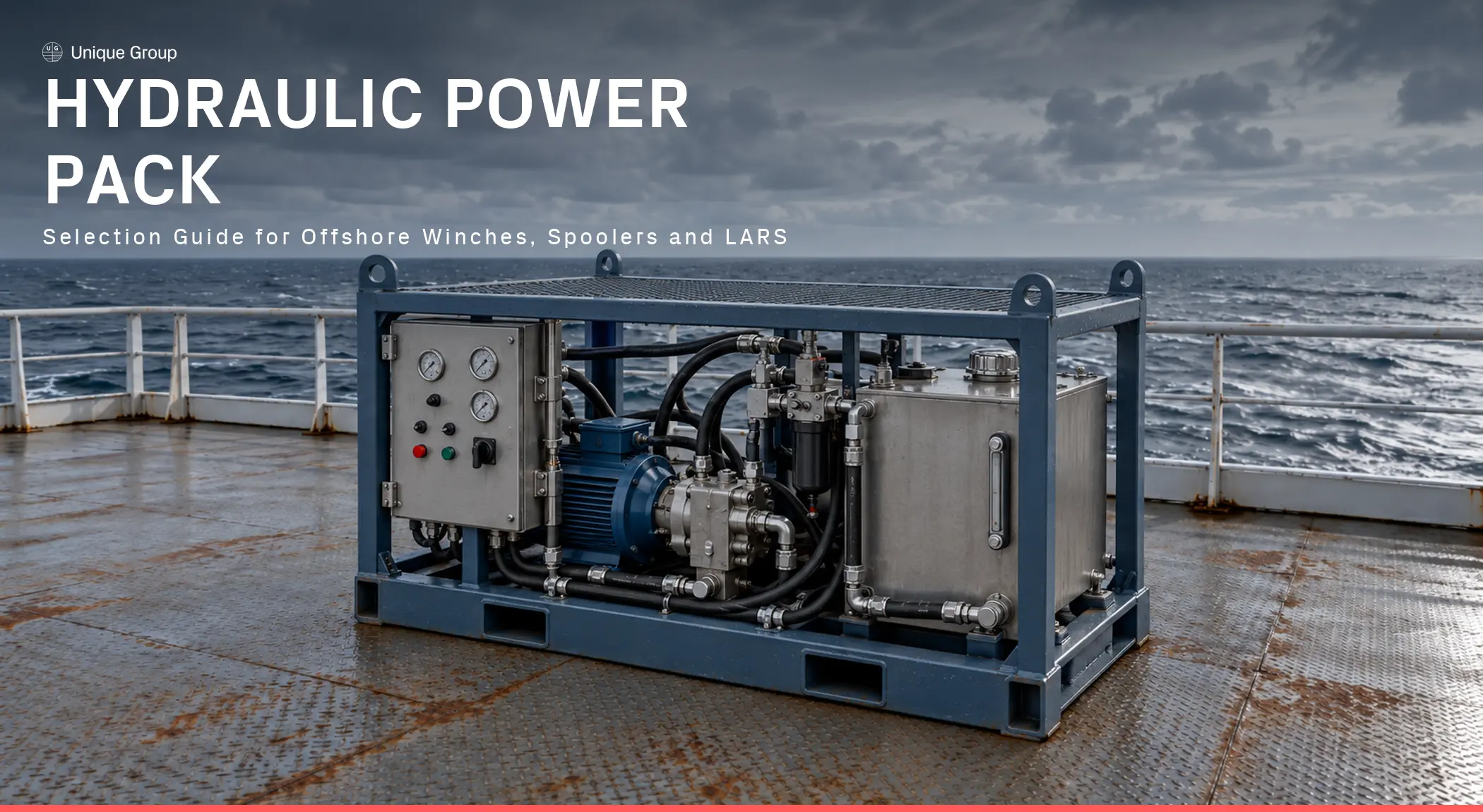
This guide sets out how to size a hydraulic power pack from the equipment it drives, then covers the offshore decisions that a generic sizing calculation leaves out.
Key takeaways
- A hydraulic power pack’s size is determined by the equipment it drives — line pull, line speed, drum diameter and gearing set the required flow and pressure, not the load weight alone.
- Hydraulic power (kW) = pressure differential (bar) × flow (L/min) ÷ 600, then divided by the pump’s overall efficiency to get the required prime mover input power.
- Electric and diesel prime movers shouldn’t be compared using a fixed kW percentage difference — each depends on its own duty, torque and efficiency factors.
- Hazardous area zone (Zone 1/Zone 2) determines certification requirements, not whether the unit should be electric or diesel.
- DNV-ST-E271 (2.7-1) certifies the lifting frame or container, not the HPU’s hydraulic performance.
- Never multiply a unit’s maximum flow and maximum pressure together to estimate its power — the two figures aren’t necessarily available simultaneously.
What is a Hydraulic Power Pack?
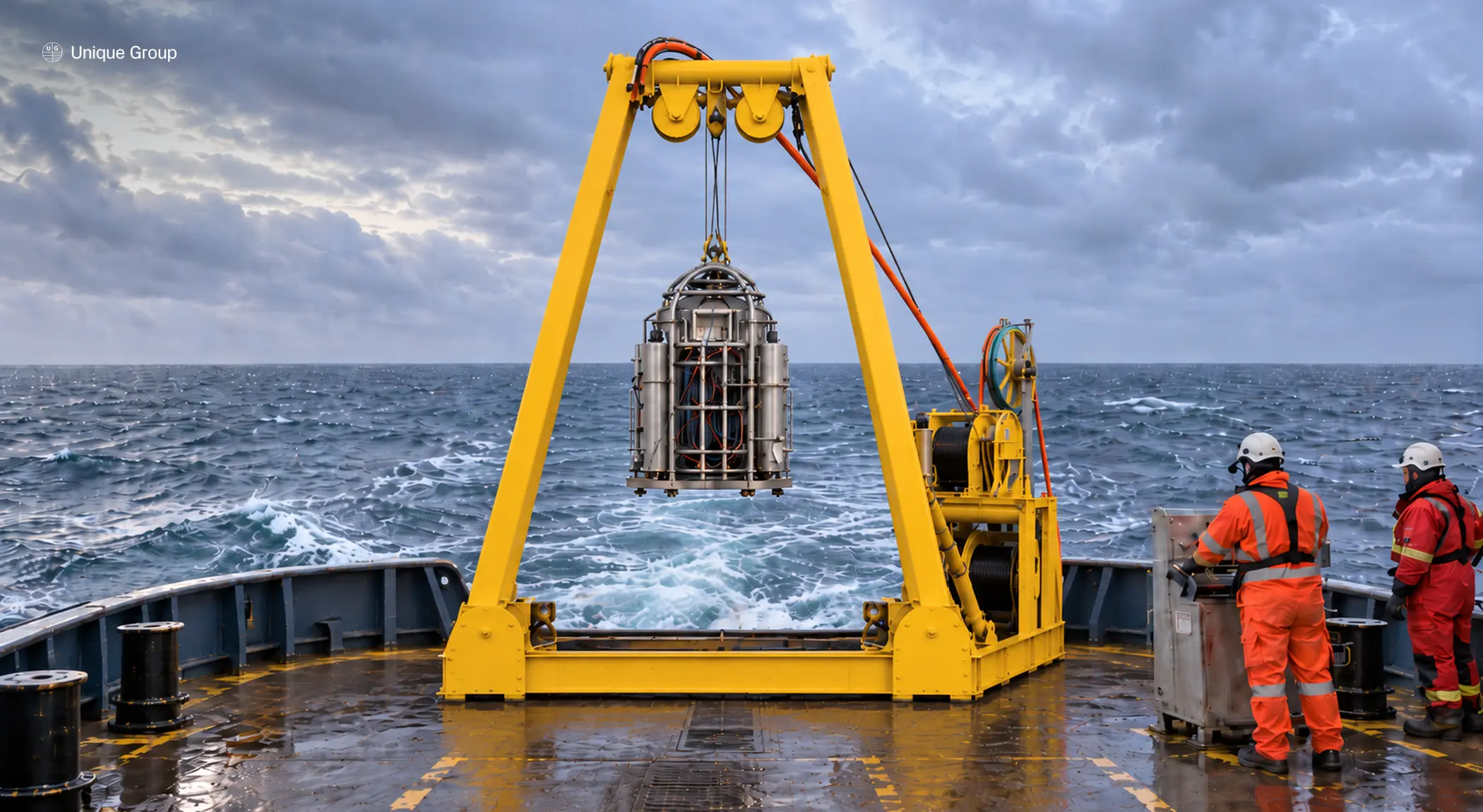
A hydraulic power pack, or hydraulic power unit, is a self-contained system that generates pressurised hydraulic fluid to drive winches, spoolers, A-frames and other hydraulic equipment. It consists of a prime mover (an electric motor or an engine), a pump, a reservoir and a set of controls. Offshore HPUs are commonly mounted in transportable skids, crash frames or offshore containers. Where offshore-container certification is required, the HPU package may be certified to DNV-ST-E271 (2.7-1).
What a Hydraulic Power Pack drives offshore
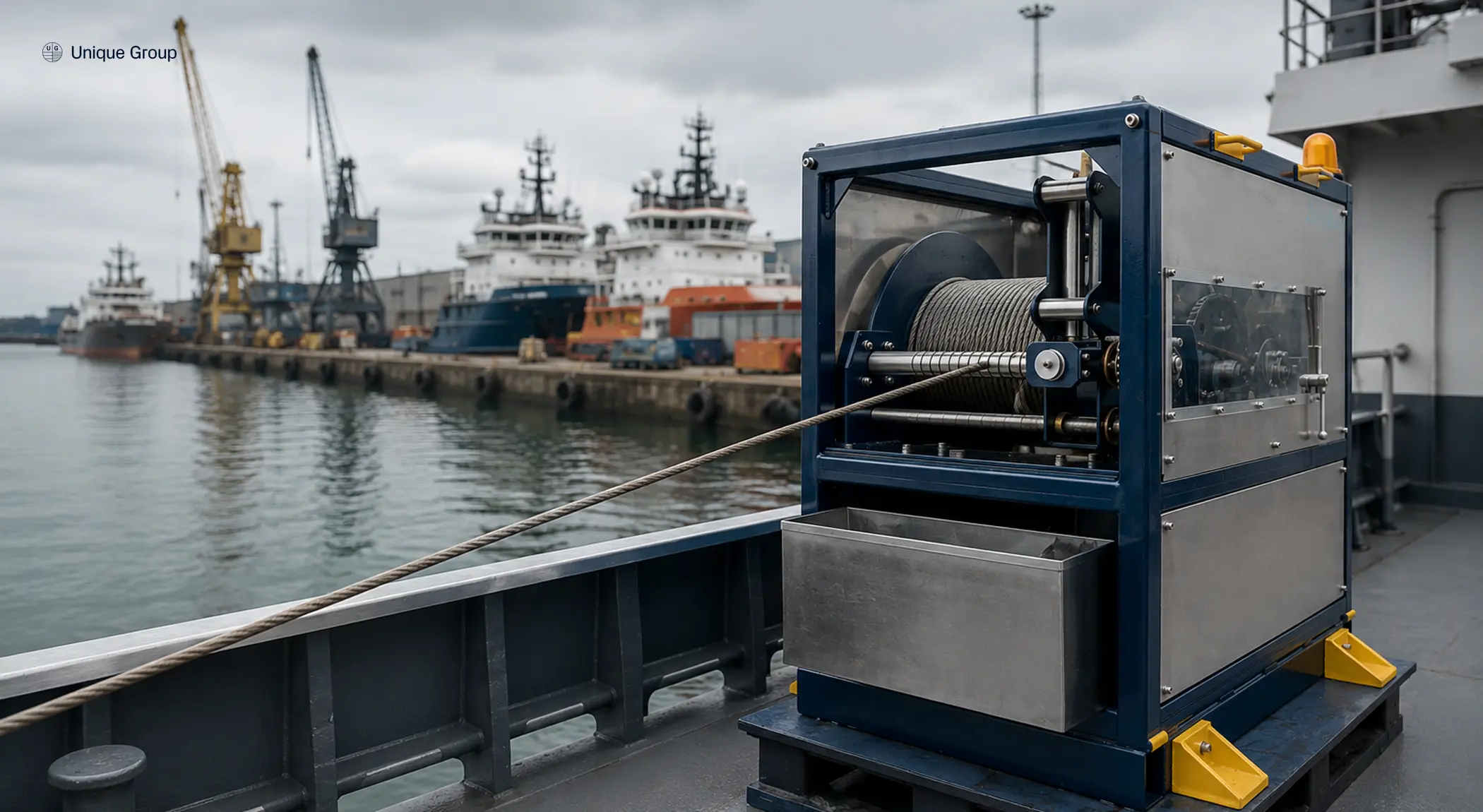
Winches: Mooring, lifting and pulling winches all need a defined line pull and line speed, which are key inputs for determining the flow and pressure the power pack has to deliver. Unique Group’s 18-tonne hydraulic constant tension winch is one example of the kind of unit an HPU in this category has to drive.
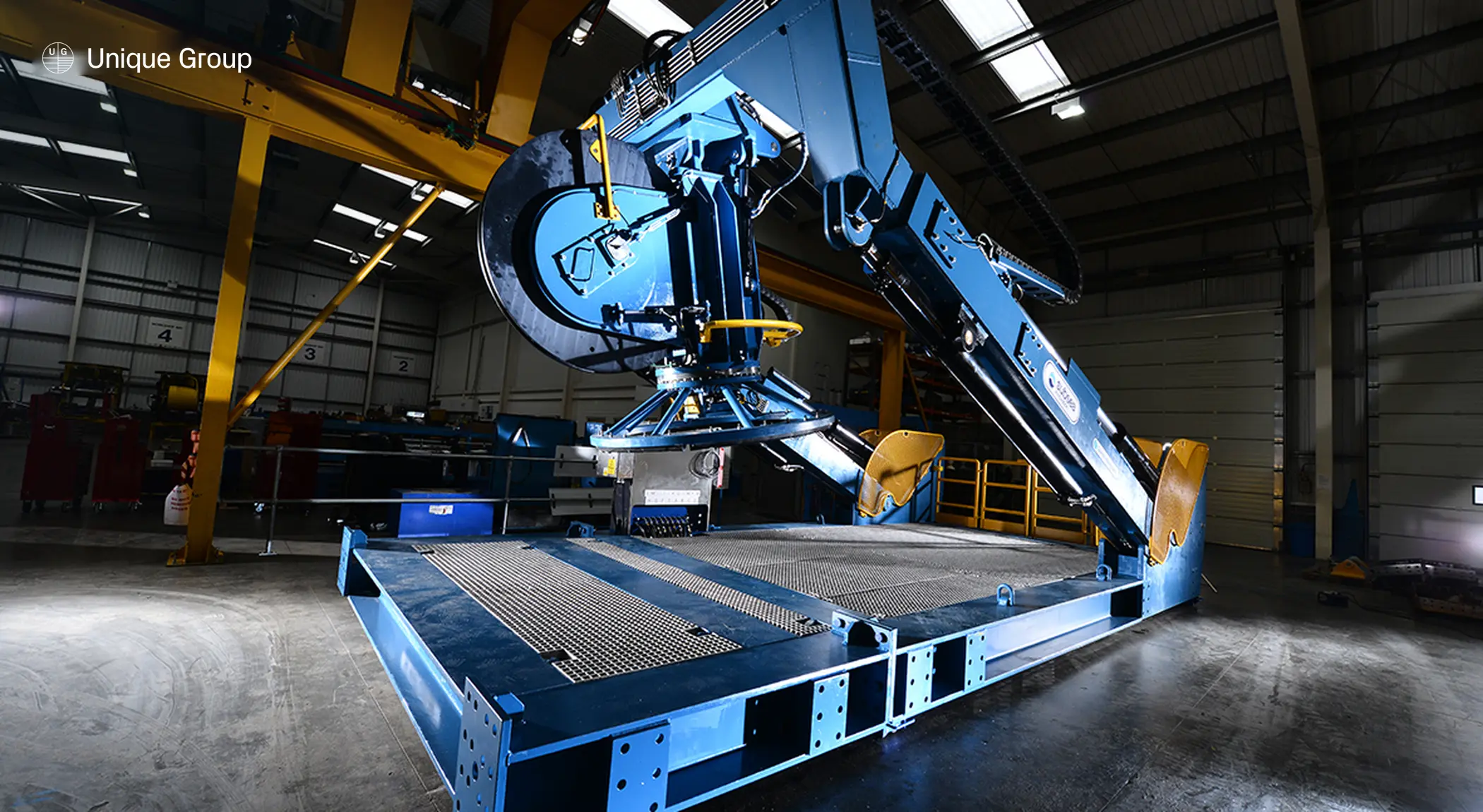
Spoolers: A spooling winch rotates a reel of wire, rope or umbilical under controlled tension. Sizing is matched to the required reel torque, rotational speed and tension-control duty, with reel diameter, mass and inertia forming part of the design inputs. Reel weight alone does not determine hydraulic power. Unique Group’s 40-tonne and 80-tonne spooling winches are examples of this category, each with different reel torque and tension-control requirements.
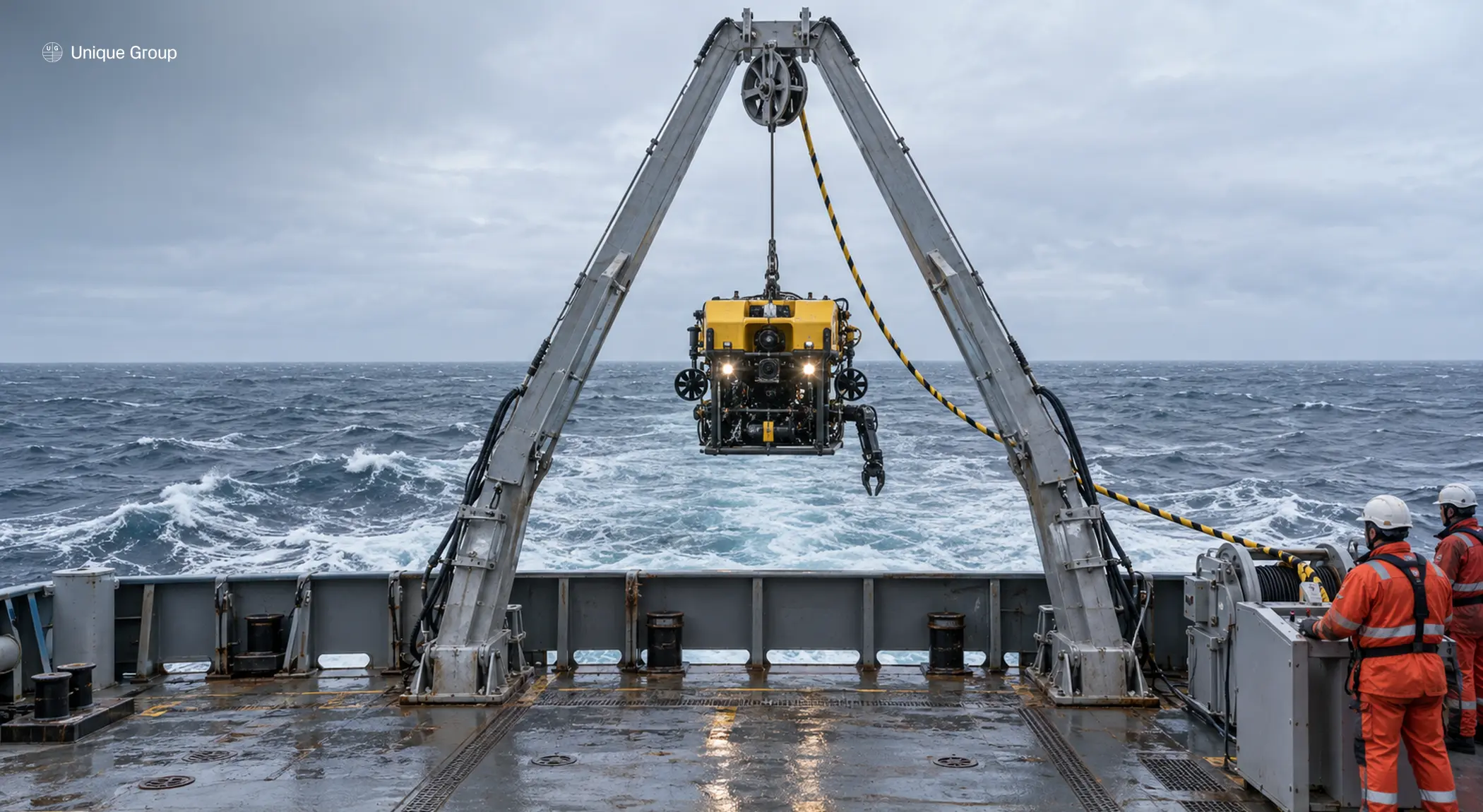
Launch and recovery systems: A LARS may use a shared HPU to operate the A-frame, winch and other hydraulic functions. HPU capacity should be based on the system’s operating sequence and the maximum permitted simultaneous demand. Where functions can operate together, their combined flow and power requirements must be considered; where functions are interlocked, sizing can follow the permitted worst-case operating condition. For guidance on refurbishing or upgrading an existing LARS package, see our LARS refurbishment guide.
Subsea tooling: Cutting, shearing, excavation and intervention tools can also be powered hydraulically. Where an OEM tool specification already defines the required pressure, flow, fluid type and return conditions, those interface requirements become the starting point for selecting the HPU rather than deriving demand from line pull and line speed.
Sizing a power pack from the load
Flow from speed
Flow rate determines actuator or hydraulic motor speed. For a winch or spooler, the required line speed first determines the drum rotational speed, based on the effective drum diameter. Gear ratio, hydraulic motor displacement and volumetric efficiency then determine the flow required from the HPU.
Because effective drum diameter changes as line builds up on the drum, line speed can also vary through the operating range.
Pressure from load
Pressure determines the torque available from the hydraulic motor. For a winch or spooler, the required line pull first has to be translated into drum torque, which depends on the effective drum radius. Gear ratio, drivetrain efficiency and hydraulic motor displacement then determine the pressure differential required from the HPU.
This means the same hydraulic pressure does not produce the same line pull at every drum layer. As the effective drum diameter increases, more motor torque is required to maintain the same line pull.
Power and prime mover
Once flow and pressure differential are known, hydraulic power follows a standard formula:
Hydraulic power (kW) = pressure differential (bar) × flow (L/min) ÷ 600
That figure is then divided by the pump’s overall efficiency, which incorporates both volumetric and mechanical losses, to estimate the shaft power required to drive the pump.
Worked example (illustrative only): a winch requiring 150 bar at 60 L/min needs roughly 15 kW of hydraulic power (150 × 60 ÷ 600). At an illustrative 85% overall pump efficiency, the pump input power required is closer to 17.6 kW.
This figure is the pump input power, not a motor or engine rating to select directly. Duty cycle, starting and transient torque, service factor, auxiliary loads and environmental derating still need to be considered when the prime mover is specified.
Electric or diesel?
The prime mover must be selected to provide the required pump input power and torque at the intended operating speed, with allowance for the application’s duty cycle and transient loads.
For an electric HPU, selection also considers motor efficiency, starting method and current, voltage and frequency, duty rating and available vessel electrical capacity. For a diesel-driven unit, engine speed, continuous or intermittent rating, torque reserve, transient response, auxiliary loads and environmental derating must be considered.
Electric and diesel prime movers should not be compared using a fixed percentage difference in kW. The complete pump and prime-mover operating envelope should be checked for the specific duty.
| Factor | Electric-driven | Diesel-driven |
|---|---|---|
| Best suited to | Vessel or site with suitable electrical capacity | Standalone operation, or where a suitable external electrical supply is unavailable |
| Prime-mover selection | Check pump input power and torque, motor duty, efficiency, starting method and available electrical supply | Check pump input power and torque, engine rating, operating rpm, transient response, derating and auxiliaries |
| Operating cost | Depends on the vessel or site power source and operating profile | Depends on fuel consumption and operating profile |
| Hazardous-area use | Requires suitable Ex configuration where applicable | Requires suitable hazardous-area engine and unit configuration where applicable |
| Deployment | Requires compatible voltage, frequency and electrical connection | Self-contained, but requires fuel, exhaust, ventilation and engine servicing |
Offshore requirements beyond size
Hazardous-area classification
If the HPU will operate in a classified hazardous area, the complete unit must be suitable for the project’s specified zone, gas group, temperature class and applicable equipment protection requirements. Do not select the prime mover type from the zone number alone. Both electrical and engine-driven systems may require specific hazardous-area design and certification, depending on the project.
Certification and lifting frame
Where offshore-container certification is required, the HPU package may be certified to DNV-ST-E271 (2.7-1). This standard covers offshore containers and their lifting sets; other standards may apply to equipment assemblies or portable offshore units, depending on the package design and project requirements. The certification does not, by itself, certify the hydraulic performance of the HPU.
Cooling, temperature and oil cleanliness
Continuous or high-duty hydraulic operation generates heat, so many offshore HPUs incorporate an oil cooler. Required cooling capacity should be calculated from the expected duty cycle, hydraulic losses and ambient conditions rather than selected from motor power alone.
The specified minimum and maximum ambient temperatures also affect fluid viscosity, starting behaviour and cooling. Cold-climate systems may require oil heating or preheating.
Oil filtration and the required cleanliness class, commonly specified using ISO 4406, should match the requirements of the pump, hydraulic motors, valves and other downstream equipment. Hydraulic fluid type and viscosity grade should also be confirmed, along with compatibility with environmentally acceptable hydraulic fluids (EAHFs) where the project requires them.
Controls and monitoring
Monitoring should be defined for the duty and may include pressure, oil temperature, reservoir level, filter condition and flow, together with alarms and shutdowns where required. A defined E-stop philosophy should cover the whole deck package, not just the power pack itself.
Redundancy
Redundancy requirements depend on the equipment and the applicable safety or class standard. For diver LARS, redundancy and emergency recovery are safety-critical design considerations and must meet the applicable diving-system requirements. Unique Group’s LR80 A2, for example, uses independent hydraulic power packs for main and standby power. ROV LARS arrangements vary by system design, class and project requirements, so the required backup philosophy should be confirmed during specification.
Hydraulic Power Pack Specification Checklist
- Required line pull and effective drum diameter or operating layer
- Required line speed
- Hydraulic motor displacement and gearbox ratio, where known
- Required flow and pressure differential
- Duty cycle and expected continuous operating period
- Simultaneous-function or operating-sequence requirements
- Prime mover type and rating
- Electrical supply voltage and frequency, or engine and fuel requirements
- Hydraulic fluid type, viscosity and EAHF compatibility
- Oil cleanliness requirement and filtration
- Reservoir capacity
- Cooling duty
- Expected ambient temperature range
- Hazardous-area classification, where applicable
- Certification or class requirements
- Control, alarm and E-stop philosophy
- Redundancy or emergency-recovery requirement
Common specification mistakes
- Sizing the prime mover from flow or pressure alone, without calculating combined power.
- Deriving pressure and flow from line pull and line speed without accounting for drum diameter, gearing and motor displacement.
- Applying a fixed percentage difference between electric and diesel prime mover ratings instead of checking the full operating envelope.
- Assuming a hazardous area zone dictates electric or diesel drive type.
- Multiplying a unit’s maximum flow and maximum pressure together to estimate power, without confirming both are available simultaneously from the pump’s operating curve.
- Treating cooling and filtration as optional extras rather than duty-driven specifications.
Specify your power pack with a specialist
Sizing a power pack on paper is a starting point. Deck space, existing vessel infrastructure and project-specific certification requirements often change the final specification.
Unique Group supplies hydraulic power packs for subsea and offshore deck equipment, including the 65kW Electric Hydraulic Power Pack, engineered for subsea cutting, shearing, excavation and recovery systems. Browse the hydraulic winches and spoolers range or read our guide on electric vs hydraulic offshore winches.
Speak with our subsea mechanical specialists to discuss your project requirements.
Frequently asked questions
What is the difference between a hydraulic power pack and a hydraulic power unit?
They are the same equipment. “Hydraulic power pack” and “hydraulic power unit” (HPU) are used interchangeably across the offshore industry.
How do I size a hydraulic power pack for a winch?
Start from the winch’s required line pull and line speed, then translate these into drum torque and rotational speed using the effective drum diameter, gearing and hydraulic motor displacement. This gives the pressure and flow the HPU must deliver, and from that the required pump input power.
Should I choose an electric or diesel-driven HPU offshore?
The choice depends on available electrical supply, deployment flexibility and the project’s operating profile, not on a fixed sizing multiplier between the two. Check the full pump and prime-mover operating envelope for the specific duty.
Does hazardous area zone determine whether I need electric or diesel?
No. The zone classification determines the certification and protection the complete unit needs. Both electric and diesel-driven HPUs can be engineered for hazardous-area use.
What does DNV-ST-E271 (2.7-1) certification cover?
It covers the structural, manufacturing, testing and lifting requirements for offshore containers and associated lifting sets. It does not certify the hydraulic performance of the pump, motor or complete hydraulic system.
Can one power pack run a winch and an A-frame together?
Yes, this is common in LARS packages, provided the unit is sized for the system’s operating sequence and the maximum permitted simultaneous demand between the two.