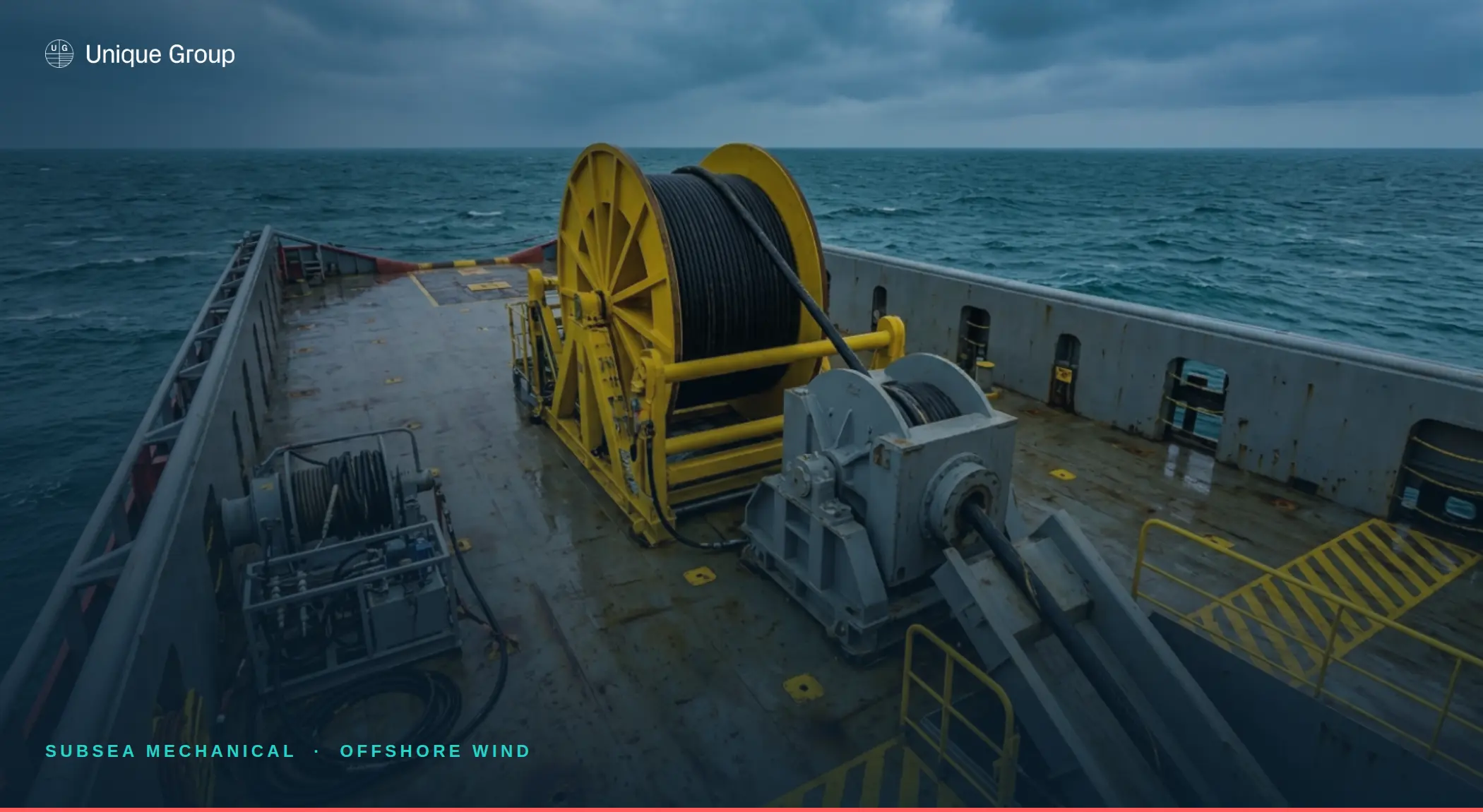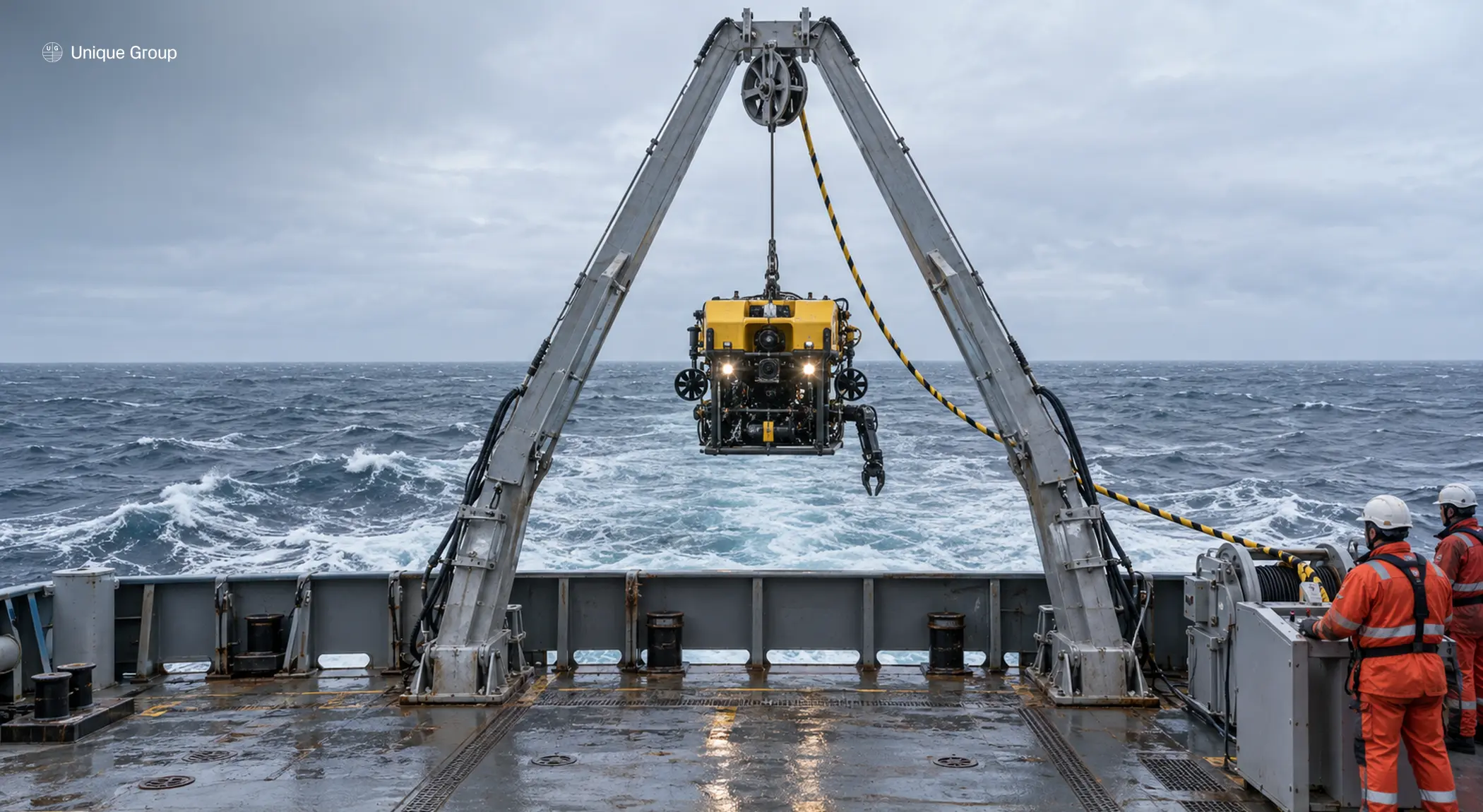
A launch and recovery system (LARS) is the equipment that puts a remotely operated vehicle (ROV), towed body, or diving bell into the water from a vessel and recovers it again at the end of the dive. A LARS is a complete operational system. It normally combines a lifting structure such as an A-frame or articulated arm, one or more winches, a power pack, an umbilical or tether handling arrangement, and a control unit from which the launch is run.
The choice of system is a constraint on the whole operation rather than a detail of deck outfitting, because the type fitted determines which vessels can carry it, which sea states the vehicle can be launched and recovered in, and which classes of vehicle it can handle at all. Getting it wrong narrows the work a spread can win. This guide sets out the five main LARS types, the operating envelope factors that rule configurations in or out, and a decision sequence for arriving at the right system for a given vessel and vehicle.
Key Takeaways
- A launch and recovery system (LARS) is the complete system that deploys and retrieves a remotely operated vehicle (ROV) or towed system safely between a vessel and the water, combining the lifting structure with winches, power packs, and control units.
- The main LARS types are A-frame, davit, moonpool, swing-out (overside), and skid-frame systems, each suited to a different vessel configuration.
- The right LARS depends on the vessel’s deck space, its safe working load (SWL) requirement, the sea states it must operate in, and the class of vehicle being deployed.
- Operating envelope factors, including safe working load, sea state, operating depth, vehicle envelope, and deck footprint, determine which LARS configurations are viable for a given operation.
- A structured selection process, working from vessel type through vehicle class to sea state, narrows the options to the LARS types genuinely suited to the job.
Types of Launch and Recovery System
Five configurations account for most subsea deployment work, and they are distinguished by how the vehicle crosses from deck to water rather than by capacity alone. The five below differ primarily in deployment geometry, vessel integration, load capacity, and transferability between vessels. Each type takes its name from the lifting structure, and in every case the complete system also includes the winch or winches, the power pack, the umbilical handling arrangement, and the control unit.
Unique Group’s launch and recovery systems fall within this taxonomy, and the range is set out later in this guide.
A-Frame LARS
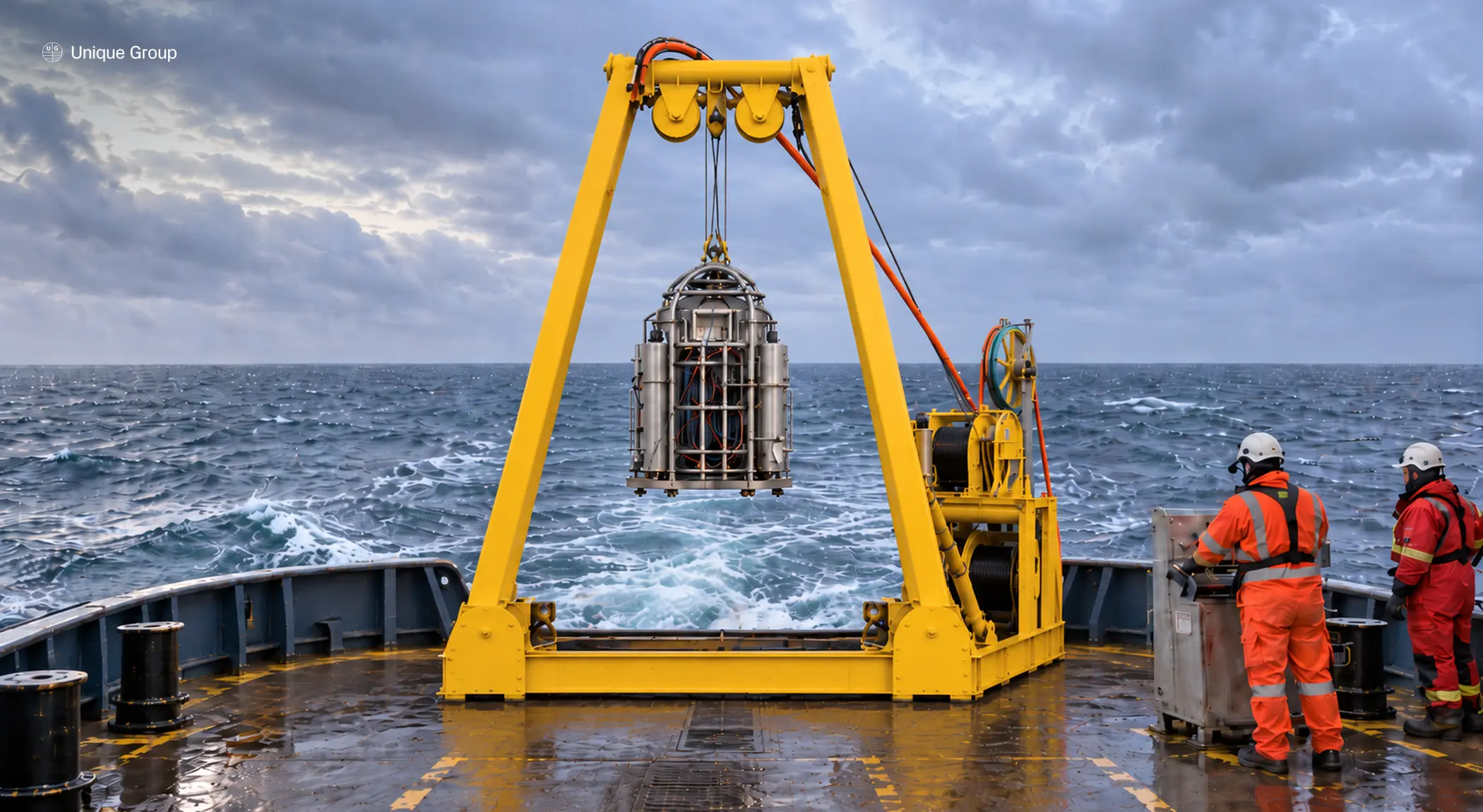
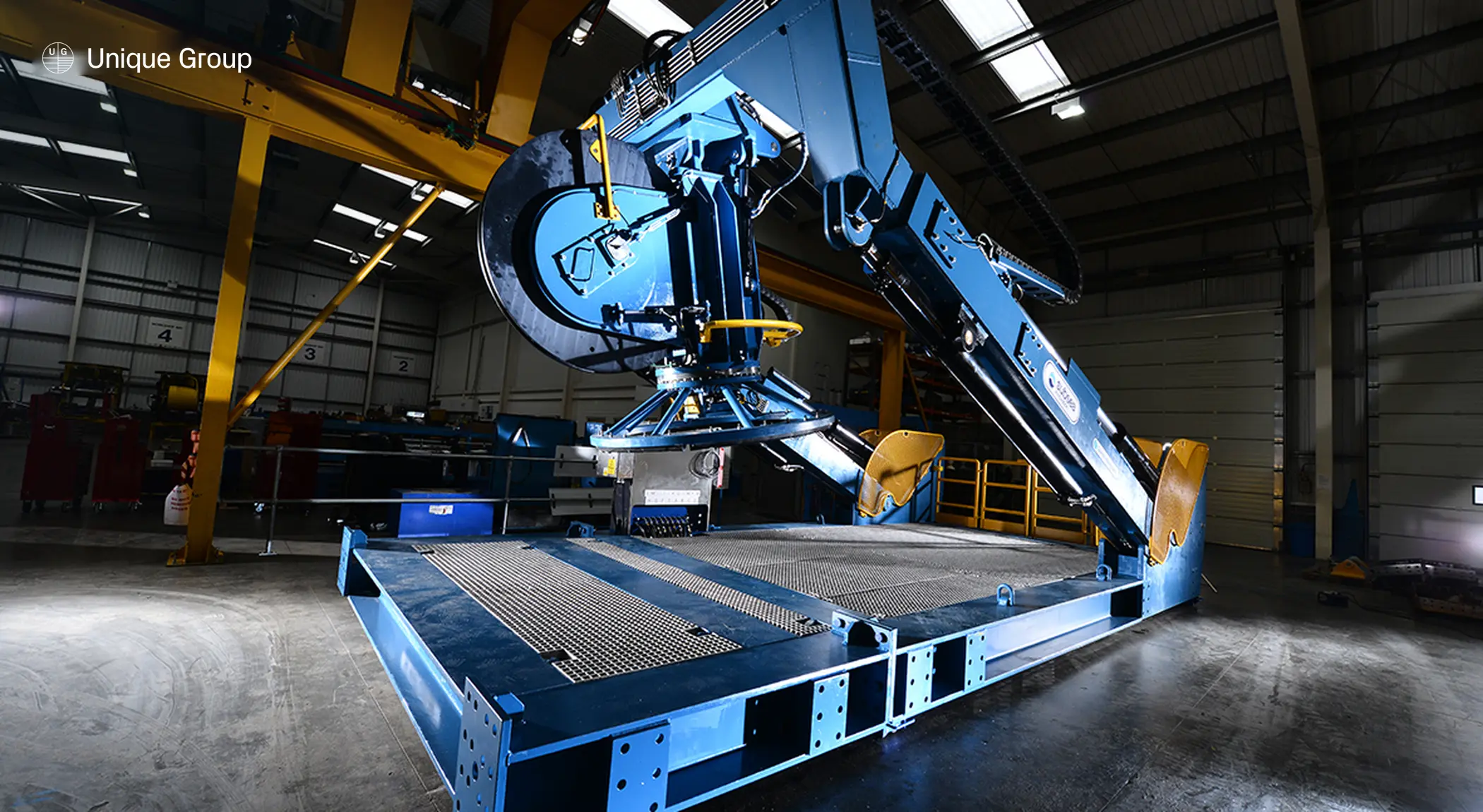
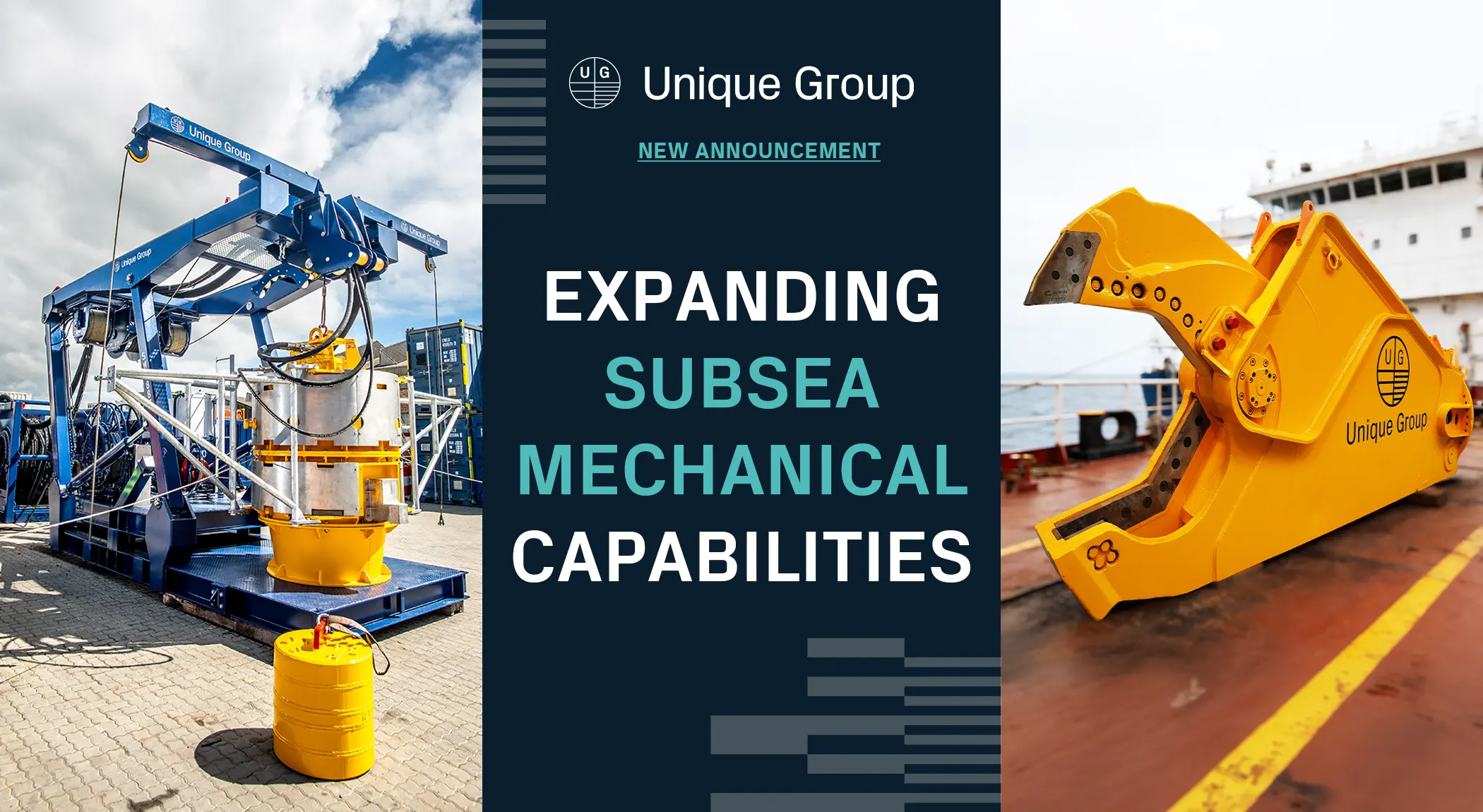
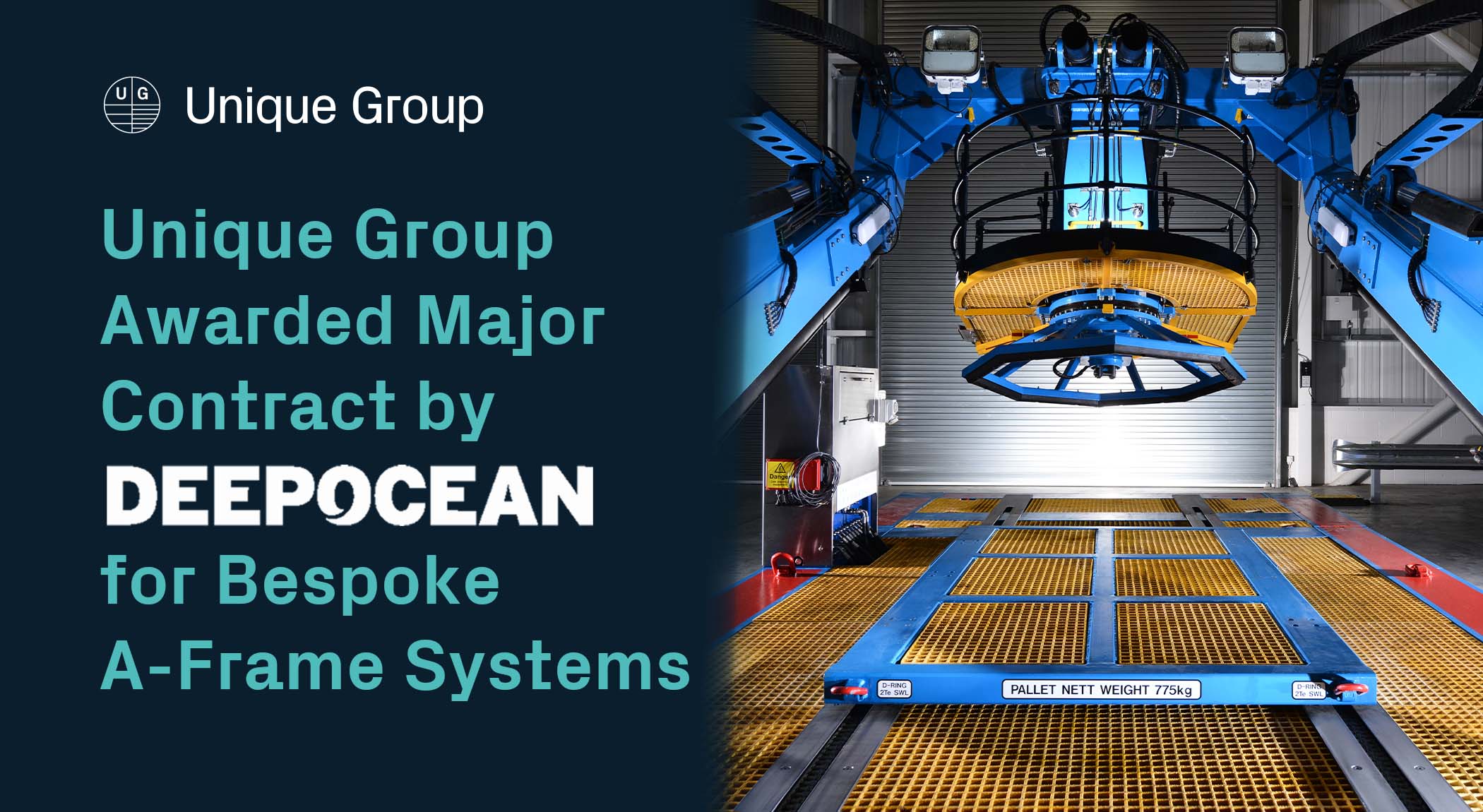
An A-frame LARS is built around a fixed or articulated A-frame, the lifting structure itself, usually mounted at the stern or side, which pivots outboard to carry the vehicle clear of the hull before lowering it through the splash zone. The A-frame works together with the winch, power pack, and control unit that complete the system.
The geometry places the lift point well outside the vessel line, which keeps the vehicle away from the hull during the most exposed part of the launch. A-frames suit larger support and construction vessels with the stern access and deck strength to carry them, and they are commonly used for heavier vehicles: work-class ROVs with a tether management system (TMS), trenchers, and other subsea vehicles. The trade-off is footprint. An A-frame occupies more back deck than any other type, and that deck area is unavailable for anything else for the duration of the campaign.
Davit LARS
A davit LARS is a crane-like arm, commonly knuckle-boom or telescopic, that lifts the vehicle and swings it out over the vessel’s side. Because the arm folds, a davit occupies far less deck than a frame of equivalent reach, and it can be positioned at the side rail rather than requiring clear stern access. That makes it the practical choice on smaller vessels, and on larger vessels whose stern deck is committed to other equipment. The trade-off is capacity. A davit is commonly used for lighter loads than a large A-frame of comparable cost, and the single-arm geometry gives the load more freedom to swing, which tightens the sea states in which recovery stays controlled.
Moonpool LARS
A moonpool LARS launches and recovers through an opening in the hull rather than over the side, so the vehicle passes through water that is sheltered by the vessel itself. This reduces exposure to the splash-zone conditions that affect overside launches, because the vehicle is not exposed to breaking waves or to the pendulum effect of a swinging load alongside a moving hull. Moonpool systems can offer a wider operating window in rough conditions because deployment is sheltered within the hull. The constraint is structural. A moonpool exists only on vessels built with one or expensively converted to have one, so the option is available on a narrow subset of the fleet.
Swing-Out (Overside) LARS
A swing-out or overside LARS is mounted at the vessel’s side rail and swings the vehicle outboard for deployment, with a simpler mechanism and fewer moving parts than a davit or an articulated frame. Installation is correspondingly straightforward, and the simpler arrangement can reduce installation complexity and cost. Swing-out systems suit smaller inspection-class vehicles, towed equipment, and survey work where the vehicle is light and the launch is short. The trade-off is envelope on both axes: load capacity is generally suited to lighter vehicles and equipment, and because the vehicle hangs alongside a moving hull with limited control over swing, the sea state at which recovery becomes unsafe arrives sooner than with a frame or moonpool system.
Skid-Frame LARS
A skid-frame LARS is a self-contained launch and recovery unit built on a skid base, complete with its frame, winch, and power pack, that can be lifted onto a deck and secured without permanent modification to the vessel. That makes it the answer for vessels of opportunity and charter tonnage, where a spread has to be assembled quickly on whatever hull is available and removed again at the end of the campaign. Mobilisation and demobilisation can be faster than for a permanently fitted system. The constraints are the skid’s own footprint, which must fit the available deck, and the host vessel’s deck strength and sea fastening arrangements, which have to accept the unit’s gross weight and the dynamic loads it imposes in a seaway.
Operating Envelope: What Constrains the Choice
Operating envelope is the combination of safe working load, sea state, operating depth, vehicle envelope, and deck footprint within which a given LARS can work safely. It is the practical constraint on selection, because a system that satisfies four of those five factors and fails the fifth is not a candidate. Each factor rules configurations out in a different way.
Safe working load (SWL) is the maximum weight the system may lift and hold, and the figure has to account for everything in the lift rather than the vehicle alone: the vehicle, its TMS if fitted, the umbilical or tether paid out, any tooling or skid mounted to it, and the dynamic amplification that vessel motion adds to a static weight. Unique Group’s LARS range is rated at 15Te SWL across all five units, which places it in work-class ROV, trencher, and subsea vehicle territory.
Sea state determines how much of the year the system can actually work. Rather than a single wave height, the meaningful figure is the motion the system is designed to accept while keeping the load under control. Unique Group’s units are specified with a swing frame envelope of ±30 degrees pitch and ±30 degrees roll, with adjustable throttling and damping, and sheave fleeting of ±10 degrees. Frame design also affects this directly: the HFM-135 uses a dipping frame arrangement that brings the ROV closer to the splash zone, which reduces the swing that has to be controlled before docking is achieved.
Motion compensation is the equipment that cancels the effect of vessel movement on the suspended load, so the vehicle holds its position relative to the seabed or the frame instead of rising and falling with the deck. It matters because the limiting factor in most launches is the dynamic load added when the vessel heaves rather than the static weight of the vehicle, which raises peak tension in the rope and makes the final approach to the docking position harder to control. Passive systems absorb that motion through a spring and damper arrangement, active heave compensation (AHC) measures vessel movement and drives the winch against it to hold the load at a near-constant depth, and constant tension control holds a set line tension rather than a set position. Fitting compensation widens the sea state window a given system can work in, and it is specified alongside the winch rather than added afterwards.
Operating depth is set by the winch and the A-frame together. The governing figures are the rope or umbilical capacity of the winch drum and the capacity of the A-frame that carries the resulting load, so winch capacity and A-frame capacity are specified as a single decision rather than assessed separately. Deeper work means more rope on the drum, greater stored weight and tension in the lift, and more demanding spooling control, and each of those feeds directly back into the rating required of the structure. Depth capability is therefore engineered to the requirements of the project. Unique Group supplies systems matched to the working depth of the campaign, and designs bespoke systems where a project calls for a rating beyond the standard range.
Vehicle envelope must clear the frame and the whole deck path from parking position to the water. Outreach is the governing dimension, and it varies across otherwise similar units: 4.3 metres on the XT-90 and XW-90, 4.4 metres on the FSM-90, 5.2 metres on the XWM-90 with its cranked boom, and 6.3 metres on the HFM-135.
Deck footprint covers the system, its hydraulic power unit, and safe personnel access around it. Unique Group’s units run from 3.2 metres wide by 6.3 metres long on the XT-90 to 4.0 metres by 6.3 metres on the larger units, with gross weights from 23,600kg to 35,000kg, so deck area and deck strength both have to be checked against the specific unit. The mounting method belongs here too, since a unit welded to fabricated stools on the vessel weighs less than the equivalent on a skid base but cannot be transferred between hulls.
How to Select the Right LARS: A Decision Sequence
Selection is a sequence rather than a comparison of feature lists, because each answer removes options before the next question is asked. Working in the order below avoids the common failure of specifying a capable system that the intended vessel cannot carry.
Start with the vessel. Available deck area, deck strength, and access geometry eliminate more options than any other factor. A vessel with clear stern access and structural deck capacity keeps A-frames in play. A vessel with a committed back deck or side-only access points to a davit or swing-out system. A vessel with a moonpool opens the sheltered-launch route. A charter vessel that changes between campaign points points to a skid-frame unit, since permanent modification is not available.
Then narrow by vehicle class. The lift is the vehicle plus its TMS, umbilical, and tooling, with dynamic amplification applied, and that total sets the minimum SWL. Work-class ROVs and trenchers demand frames in the 15Te class. Inspection-class vehicles and towed bodies open up lighter davit and swing-out options that a work-class vehicle would rule out immediately. Vehicle dimensions matter equally, because outreach and frame clearance have to accommodate the vehicle’s envelope through the whole launch path.
Then narrow by sea state. This is where the remaining candidates separate. An operation with a long weather window and a tolerance for standby can accept a system with a tighter motion envelope. A campaign on a day rate in an exposed area cannot, and that pushes towards moonpool launch, a heavier frame, or motion compensation.
Finally, check the whole envelope together. Confirm that the surviving candidates satisfy SWL, motion envelope, outreach, footprint, and deck loading simultaneously, and that the winch capacity and the frame capacity suit the working depth as a matched pair. A system that meets every factor except deck loading is not a shortlist entry.
Comparing Launch and Recovery System Types
The table below sets the five types against the four factors that most often decide the choice. Two points on how to read it. The relative ordering between types is reliable and reflects the geometry of each configuration rather than any one manufacturer’s range. The absolute figures are not generic properties of a type, because a davit and an A-frame can both be built to almost any capacity, so the only numeric entries stated here are those verified against Unique Group’s published specifications.
| Type | Safe working load | Sea state tolerance | Deck space | Vehicle class |
|---|---|---|---|---|
| A-frame | Highest of the five. Unique Group’s A-frame range is rated at 15Te SWL. | High. Outboard geometry keeps the vehicle clear of the hull, and the swing frame envelope on Unique Group’s units is specified at ±30 degrees pitch and ±30 degrees roll. | Largest footprint. Unique Group’s units occupy from 3.2 by 6.3 metres to 4.0 by 6.3 metres, at 25,000kg to 35,000kg gross. | Work-class ROVs with TMS, trenchers, subsea vehicles, autonomous and observation vehicles, and gliders. |
| Davit | Lower than an A-frame at comparable cost and footprint. | Moderate. Single-arm geometry gives the load more freedom to swing, which tightens the recovery window. | Compact. Folds clear of the deck, and can mount at the side rail rather than requiring stern access. | Inspection-class and light work-class vehicles, towed bodies. |
| Moonpool | Configuration-dependent, and set by the vessel’s moonpool structure as much as by the frame. | Highest of the five. Launch is sheltered by the hull, which removes splash zone exposure and pendulum effect. | No overside footprint, but requires the moonpool itself plus internal handling space. | Work-class ROVs on deepwater and long-duration campaigns. |
| Swing-out (overside) | Lowest of the five. | Lowest of the five. The vehicle hangs alongside a moving hull with limited swing control. | Smallest footprint. Rail-mounted, simple installation. | Inspection-class vehicles, towed and survey equipment. |
| Skid-frame | Matches the frame built onto the skid, and is limited in practice by the host vessel’s deck strength. | Matches the frame type on the skid, subject to sea fastening and the host vessel’s motion characteristics. | Variable. Self-contained unit including winch and power pack, so the footprint is the skid envelope. | Set by the frame specified, from inspection-class up to work-class. |
Unique Group’s Range of Launch and Recovery Systems
Unique Group designs, builds, and tests launch and recovery systems in-house, within the Bespoke Engineering Solutions line of business. The current LARS range sits in the A-frame family described above, and is offered alongside diver launch frames, hydraulic winches, umbilical handling equipment, and control consoles.
Each unit is supplied as a complete launch and recovery system, with the A-frame, winch, power pack, and control unit engineered and tested together. All five units share a 15Te safe working load, a 1,680mm sheave wheel, and a swing frame envelope of ±30 degrees pitch and ±30 degrees roll. They are differentiated by outreach, footprint, and how they mount to the vessel.
| Unit | Outreach | Gross weight | Distinguishing feature |
|---|---|---|---|
| LARS XT-90 | 4.3m | 25,000kg | The most compact footprint in the range at 3.2m by 6.3m. |
| LARS XW-90 | 4.3m | 28,000kg | Wider skid base than the XT-90, at 4.0m by 6.3m. |
| LARS XWM-90 | 5.2m | 28,500kg | Cranked boom extends outreach beyond the XW-90. |
| LARS FSM-90 | 4.4m | 23,600kg | Mounted on fabricated stools welded to the vessel rather than a skid base, which makes it the lightest unit in the range. |
| LARS HFM-135 | 6.3m | 35,000kg | Dipping frame design, bringing the vehicle closer to the splash zone to reduce swing before docking is achieved. |
The XWM-90 and FSM-90 illustrate the mounting decision described earlier in this guide. Both share a similar frame design, but the XWM-90 sits on a skid base while the FSM-90 is welded to stools on the vessel, which trades transferability between hulls for a lower gross weight. Systems are designed, built, and tested in-house to meet relevant codes and standards including DNVGL, Lloyd’s Register, BV, ISR, and RINA standards.
More than 150 launch and recovery systems have been delivered, and both bespoke and standard configurations are available with on-site commissioning. Refurbishment of existing systems is covered in LARS refurbishment for WorkClass ROVs, and the surrounding deck equipment in winches, spoolers, and back-deck systems.
Speak with our launch and recovery system specialists to discuss your project requirements.
FAQ
What is a launch and recovery system (LARS)?
A launch and recovery system is the equipment that deploys a remotely operated vehicle (ROV) or towed system from a vessel into the water and recovers it at the end of the dive. It is a complete system, typically consisting of a lifting structure such as an A-frame or articulated arm, one or more winches, a power pack, an umbilical handling arrangement, and a control unit. Manual deployment is unsafe and impractical for anything beyond the smallest and lightest vehicles, because of both the weight involved and the loss of control in a seaway.
What are the main types of LARS?
There are five main types. An A-frame pivots the vehicle outboard from the stern and handles the heaviest loads. A davit swings it out on a folding arm from a compact footprint. A moonpool system launches through an opening in the hull, sheltered from wave action. A swing-out or overside system is rail-mounted and suits light vehicles. A skid-frame unit is self-contained and can be moved between vessels without permanent modification.
What depth can a launch and recovery system work to?
There is no single figure, because operating depth is set by the winch and the A-frame in combination. The determining factors are how much rope or umbilical the winch drum can hold and the load capacity of the A-frame carrying it, which is why the two are specified together rather than independently. Systems are therefore rated to the depth the campaign requires, and Unique Group designs bespoke launch and recovery systems where a project calls for a rating beyond the standard range.
How do I choose the right LARS for my vessel?
Work through the constraints in order. Start with the vessel, since deck area, deck strength, and access geometry eliminate the most options. Narrow next by vehicle class, calculating safe working load from the vehicle plus its tether management system, umbilical, and tooling. Narrow again by the sea states the operation must cover. Then confirm the surviving candidates satisfy load, motion envelope, outreach, footprint, and deck loading together rather than individually.
What is the difference between an A-frame and a davit LARS?
The difference is capacity against footprint. An A-frame carries a higher safe working load and holds the vehicle in a more controlled path through the splash zone, at the cost of occupying more back deck than any other configuration. A davit folds into a compact envelope and can mount at the side rail rather than requiring clear stern access, but typically carries less load, and its single-arm geometry gives the vehicle more freedom to swing during recovery.
What sea states can a LARS operate in?
There is no single figure, because tolerance depends on the LARS type, the vessel’s size and motion characteristics, and whether motion compensation is fitted. Moonpool systems generally work in the roughest conditions, since launch is sheltered by the hull, while overside systems reach their limit soonest. The meaningful specification is the motion envelope the system is designed to accept: Unique Group’s units are rated at ±30 degrees pitch and ±30 degrees roll. Operating limits for a specific spread are set in the system’s operations manual.
Can Unique Group help select or supply a LARS?
Yes. Unique Group designs, builds, and tests launch and recovery systems in-house, with a current range of A-frame type units rated at 15Te safe working load and outreach from 4.3 metres to 6.3 metres, alongside diver launch frames, hydraulic winches, and umbilical handling equipment. Unique Group can advise on matching a system to a vessel’s deck space, safe working load requirement, and operating envelope. Compatibility with a specific vessel requires a specification review rather than being assumed.