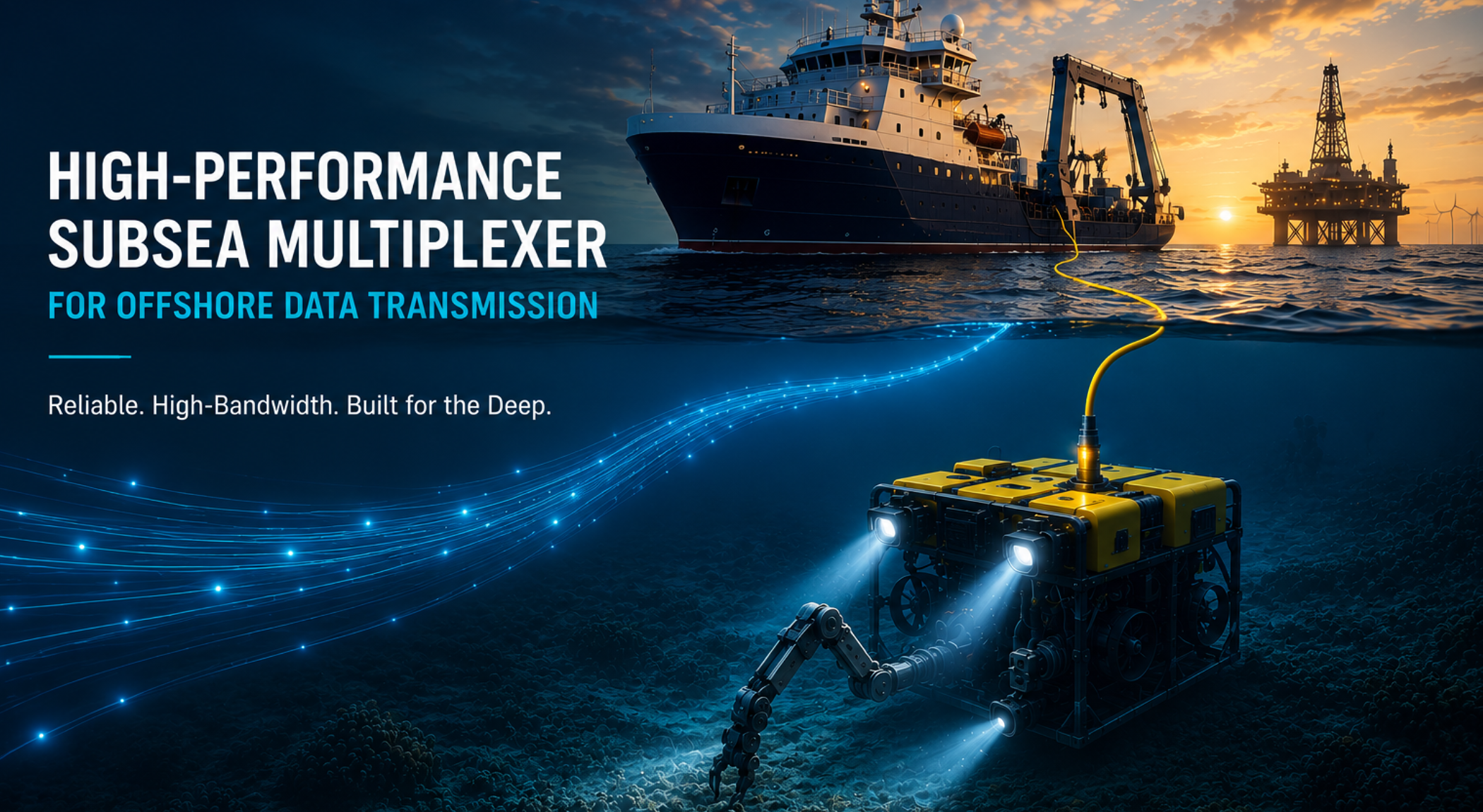
Modern offshore and subsea operations depend on the rapid transmission of large volumes of data between subsea equipment and surface control systems. From high-definition ROV video streams and sonar data to real-time positioning and control signals, offshore projects now require reliable, high-bandwidth communication systems capable of operating in harsh underwater environments. At the centre of this communication infrastructure is the subsea fibre optic multiplexer (MUX), a critical technology that enables multiple data streams to be transmitted efficiently through a single fibre optic link, supporting high-performance offshore data transmission.
Why High-Performance Data Transmission Matters Offshore
Subsea operations rely on accurate, real-time data for:
- ROV navigation and control
- Survey and inspection workflows
- Monitoring offshore infrastructure
- Installation and construction activities
Fibre optic communication is preferred in these environments because it:
- Transmits data using light signals
- Supports high bandwidth and long-distance communication
- Is resistant to electromagnetic interference
In large-scale subsea systems, fibre optic cables can carry massive volumes of data over long distances, forming the backbone of modern offshore communication networks.
Why Fibre Optic Systems Are Preferred Over Traditional Copper Systems
Traditional copper-based communication systems face limitations in offshore environments due to bandwidth restrictions, signal degradation, and susceptibility to electromagnetic interference.
Fibre optic systems provide significantly higher bandwidth capacity, longer transmission distances, and improved signal integrity, making them the preferred solution for modern offshore and subsea operations.
Role of High-Performance Multiplexers
A subsea multiplexer enhances fibre optic communication by:
- Combining multiple signals into a single transmission channel
- Enabling simultaneous data, video, and control signal transfer
- Reducing the need for multiple cables
Multiplexers are specifically designed to transmit multiple data streams simultaneously through a single communication link, significantly improving operational efficiency.
What Defines a High-Performance Subsea Multiplexer
Not all multiplexers are equal. High-performance systems used in offshore environments are designed with specific capabilities:
To better understand the key selection criteria, read our guide on How to Choose the Right Subsea Fibre Optic Multiplexer.
1. Multi-Signal Transmission Capability
A high-performance multiplexer must support:
- Video feeds (including HD)
- Sensor data (sonar, positioning, environmental)
- Control signals
Using advanced multiplexing techniques, multiple signals can be transmitted over a single fibre by assigning different channels or wavelengths, significantly increasing data capacity.
Depending on system requirements, subsea multiplexers may support Ethernet, serial communication, video transmission, telemetry, and sensor integration across offshore platforms and subsea vehicles.
2. High Bandwidth & Data Throughput
Offshore operations generate large volumes of data that must be transmitted in real time.
High-performance systems ensure:
- Minimal latency
- High data rates
- Continuous communication without bottlenecks
This is critical for:
- Live ROV operations
- Real-time seabed imaging
- Monitoring and diagnostics
3. Long-Distance Transmission Reliability
Subsea operations often span long distances, requiring stable communication over extended ranges.
Fibre optic systems are ideal because they:
- Maintain signal integrity over long distances
- Experience minimal signal loss
- Use optical amplification when required to sustain performance
4. Integration Across Complex Systems
Modern offshore systems are highly integrated, combining:
- Survey equipment
- Inspection tools
- Navigation systems
A high-performance multiplexer acts as the central communication hub, ensuring that all systems can operate together seamlessly.
5. Robustness in Harsh Subsea Environments
Subsea equipment must operate under:
- High pressure
- Corrosive saltwater conditions
- Extreme temperatures
High-performance multiplexers are designed for:
- Reliability under pressure
- Long-term deployment
- Minimal maintenance requirements
Subsea fibre systems are specifically engineered to withstand harsh underwater environments, including pressure and mechanical stress.
For a broader overview of operational use cases, read our article on Applications of Fibre Optic Multiplexers in Offshore and Subsea Operations.
High-Performance Use Cases in Offshore Operations
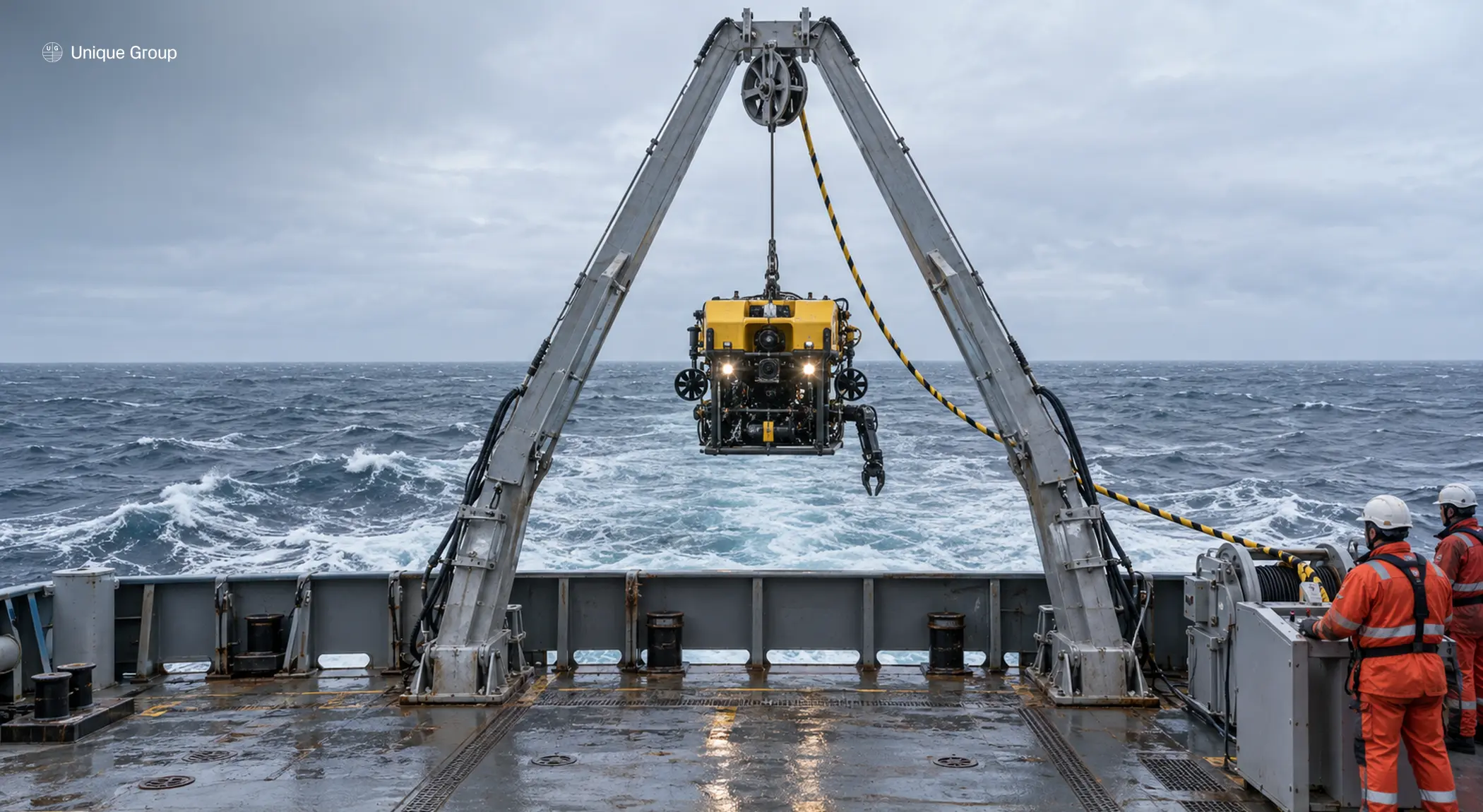
1. ROV Operations
Multiplexers enable:
- Real-time video transmission
- Sensor data communication
- Remote control of subsea systems
Without high-performance multiplexing, ROV operations would face:
- Data delays
- Communication limitations
- Reduced operational efficiency
2. Offshore Survey & Geophysical Operations
Survey systems generate large datasets from:
- Sonar systems
- Positioning equipment
- Environmental sensors
- Multibeam and Single Echosounders
Multiplexers allow:
- Simultaneous data collection
- Efficient transmission to the surface
- Real-time analysis and decision-making
3. Subsea Inspection & Monitoring
Inspection operations require:
- Continuous video feeds
- Sensor integration
- Real-time diagnostics
High-performance multiplexers ensure:
- Reliable communication
- Minimal signal disruption
- Accurate data transmission
4. Offshore Construction & Installation
During installation projects, multiplexers support:
- Monitoring of subsea operations
- Communication between tools and vessels
- Real-time feedback for precision work
Why High-Performance Subsea Multiplexers Are Critical Offshore
As offshore operations become more complex and data-driven, the role of multiplexers becomes increasingly important.
They enable:
- Simplified system architecture
- Reduced cabling requirements
- Efficient use of bandwidth
- Seamless integration of multiple systems
Without high-performance multiplexers:
- System complexity increases
- Data transmission becomes inefficient
- Operational risks rise
Positioning High-Performance MUX in Offshore Systems
In a typical offshore setup:
- Fibre optic cables provide the communication backbone
- Multiplexers act as the data integration layer
- Subsea equipment generates and consumes data
Together, they form a complete communication system that supports:
- Real-time operations
- High data throughput
- Reliable offshore performance
High-performance subsea multiplexers such as the Uni-Mux Deeplink6 are designed to support modern offshore operations requiring reliable high-bandwidth communication for ROVs, survey systems, and integrated subsea platforms.
Growing Demand for High-Bandwidth Offshore Communication
As offshore operations continue to adopt autonomous systems, advanced sensors, AI-assisted inspection technologies, and real-time seabed mapping, the demand for high-bandwidth subsea communication infrastructure will continue to increase.
High-performance subsea multiplexers will play an increasingly important role in supporting scalable and data-intensive offshore operations.
Conclusion
High-performance subsea multiplexers are a critical component in modern offshore data transmission systems. By enabling multiple signals to be transmitted through a single fibre optic link, they support efficient, reliable, and scalable communication across subsea operations.
With increasing reliance on real-time data, high-definition video, and integrated systems, these multiplexers play a central role in ensuring that offshore operations remain efficient, safe, and technically advanced.
Frequently Asked Questions (FAQs)
What is a subsea multiplexer?
A subsea multiplexer is a communication system that combines multiple data, video, and control signals into a single fibre optic transmission link for offshore and subsea operations.
Why are fibre optic multiplexers used offshore?
Fibre optic multiplexers are used offshore because they support high-bandwidth communication, long-distance data transmission, and reliable performance in harsh subsea environments.
What are the benefits of high-performance subsea multiplexers?
High-performance subsea multiplexers help reduce cabling complexity, improve data transmission efficiency, support real-time communication, and enable seamless integration across offshore systems.