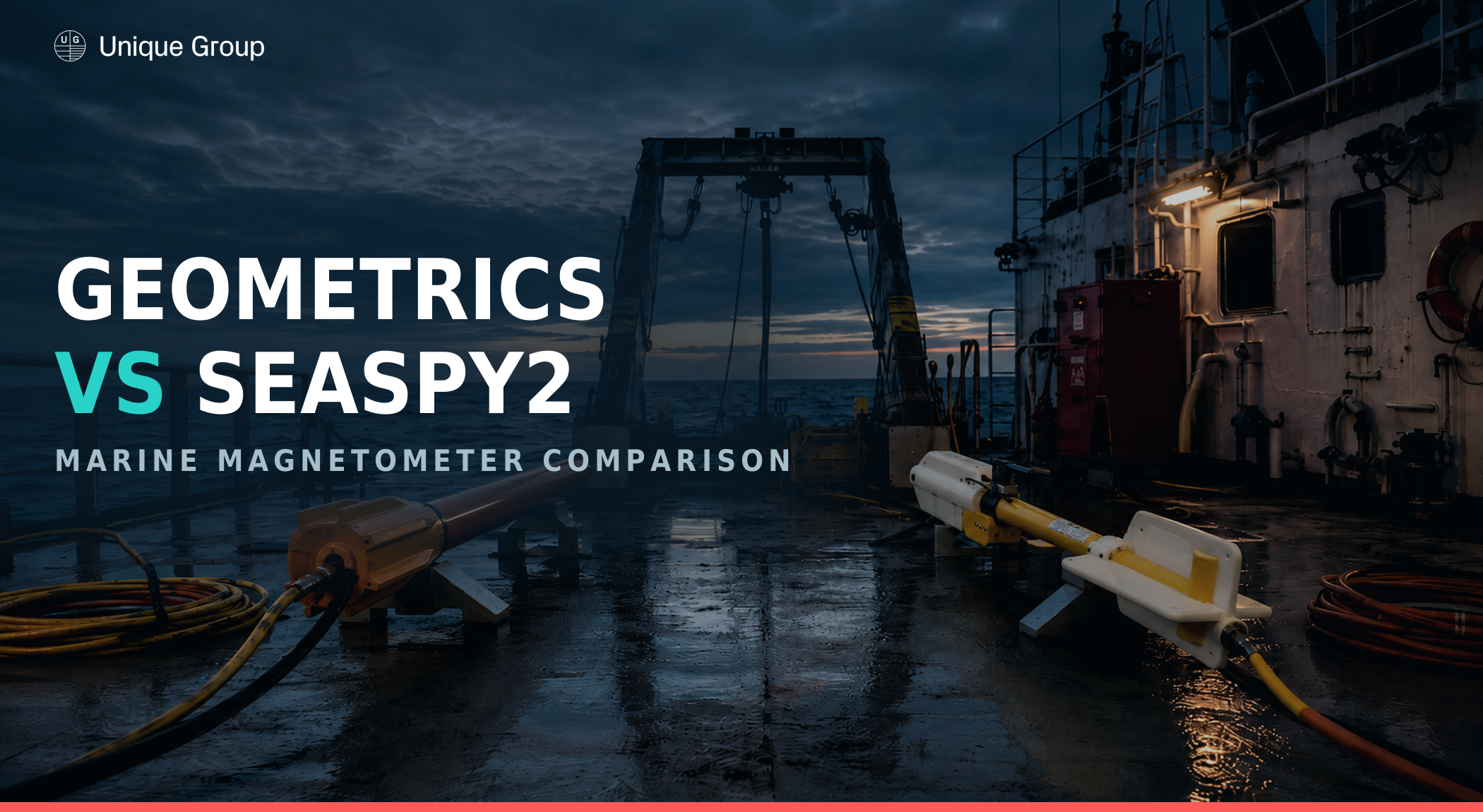
Offshore magnetometer surveys are used to detect and map ferrous objects on and below the seabed — pipelines, anchors, unexploded ordnance (UXO), and shipwreck debris. Two of the most widely used systems in this space are the Geometrics G-882 and the SeaSPY2. Both are proven tools, but they’re built on different sensor technology and suit different survey profiles.
This article breaks down how they compare, so you can choose the right system for your next survey. For the wireless links and mesh radios that carry this sensor data back to the vessel, see our guide to choosing the right offshore data telemetry system.
How Marine Magnetometers Work
A marine magnetometer measures small variations in the Earth’s magnetic field. These variations, or anomalies, indicate the presence of ferrous material on or beneath the seabed. The magnetometer is towed behind the survey vessel, close to the seafloor, and logs field-strength data along each survey line.
Sensor type is what mainly separates one system from another — it determines sensitivity, how the unit handles motion and vibration, and how it performs across different depths.
Geometrics G-882: Cesium Vapor Sensor
The Geometrics G-882 uses a cesium vapor sensor. It’s a compact, low-cost unit that samples at up to 20 Hz and is rated to detect ferrous objects across a wide range of sizes.
Key characteristics:
- Cesium vapor sensor, self-oscillating split-beam design, with a heading error of under 1 nT across a full 360° spin
- Samples at up to 20 Hz for dense data coverage across larger survey areas
- Depth rated to 4,000 psi (approx. 2,730 m)
- Sensor fish weighs 18 kg (40 lb); deployable by one person without a winch
- Streamlined, fibre-wound fibreglass housing designed to reduce fouling risk when towed near obstructions
- Meets the standard for UXO clearance in the North Sea
- Commonly deployed with the Geometrics Telemetry System for long-cable operation, or mounted on the Geometrics TVG G-882 Frame for gradiometer surveys
Typical applications: anchor, chain, cable, and pipeline detection; ballast stone and shipwreck debris mapping; UXO and munitions surveys; aircraft and engine detection; geological studies. Objects as small as a 5-inch screwdriver are detectable when the sensor is towed close to the seafloor within practical range.
SeaSPY2: Overhauser Sensor
The SeaSPY2 uses an Overhauser sensor rather than cesium vapor. This design is omnidirectional — it returns consistent readings regardless of how the sensor is oriented relative to the Earth’s magnetic field, which removes heading bias between survey lines.
Key characteristics:
- Overhauser sensor — omnidirectional, maintenance-free, no realignment or recalibration required
- Absolute accuracy of 0.1 nT, sensor sensitivity of 0.01 nT, and zero measurable heading bias or dead zone
- Sampling range of 0.1–4 Hz — lower than the G-882’s 20 Hz, reflecting its focus on absolute accuracy over data density
- Available in three depth-rated configurations: 1,000 m (1,500 psi), 3,000 m (5,000 psi), and 6,000 m (9,000 psi)
- No warm-up required — operational immediately on power-up, with identical data quality from -40°C to +60°C
- Towfish weighs 12 kg (27 lb) in air, 4 kg (9 lb) in water; 119 cm long
- The only magnetometer integrated inside an AUV and a glider, and the only longitudinal gradiometer currently on the market
Typical applications: deep-water and AUV/glider-based surveys, gradiometer arrays, and projects where heading-independent accuracy and consistent readings across extreme temperatures matter most.
Where the Marine Magnetics Synapse Fits
The Marine Magnetics Synapse is a separate product from SeaSPY2 — a lightweight, Rubidium-sensor magnetometer built for gradiometer arrays of up to 30 nodes. At 3.5 kg in air with low power draw, it’s designed to integrate with side-scan sonar towfish such as the Edgetech 4205 and 4125i, making it a fit for combined side-scan and magnetometer surveys rather than a standalone towfish deployment.
Geometrics vs SeaSPY2: Quick Comparison
| Geometrics G-882 | SeaSPY2 | |
|---|---|---|
| Sensor type | Cesium vapor | Overhauser |
| Heading error | < 1 nT over 360° spin | None |
| Sample rate | Up to 20 Hz | 0.1–4 Hz |
| Depth rating | 4,000 psi (2,730 m) — fixed | 1,000 m / 3,000 m / 6,000 m — configurable |
| Sensor weight | 18 kg (40 lb) | 12 kg (27 lb) towfish |
| Best suited for | UXO clearance, pipeline/debris detection, higher data density | Deep-water, AUV/glider, gradiometer surveys, absolute accuracy |
| Frame/telemetry options | Geometrics Telemetry System, TVG Frame | Side-scan, ROV, AUV, glider integration |
Choosing the Right System
For UXO clearance and general pipeline or debris detection in shallower water, the G-882’s higher sample rate (20 Hz vs. SeaSPY2’s 0.1–4 Hz) gives denser data coverage per pass, and its established telemetry ecosystem makes it a strong default. For deep-water work, AUV or glider integration, or surveys where line-to-line heading consistency and absolute accuracy matter more than sampling density, the SeaSPY2’s Overhauser sensor removes a variable the G-882 can’t.
Both systems can be paired with the UG Magnetometer Soft Tow Cable, rated for use with Geometrics G881/G882 systems.
Refer to datasheet for detailed technical specifications.
Speak with our survey specialists to discuss your project requirements.